


Previous Post
Hi,
Every month, I get an avalanche of emails about cross-promotion. There’s not a week that goes by when someone from LetterGrowth or a similar outreach platform hits me up with the same message:
“We should cross-promote!”
I get why they are reaching out. I have over 50,000 newsletter subscribers so it makes sense that a lot of people want to promo with me, even if there’s no earthly reason they should.
I’m not trying to be mean, but I’ll look at their newsletter, see they have 800 subscribers, and a completely different niche, and just... sigh.
I respect the ambition and the hustle, but the disconnect is unreal. You want to punch out of your weight class, awesome. Game recognize game and hustle respect hustle, but you’re going about it all wrong.
Most pitches I get fail for the same three reasons. If you’re sending cold outreach to someone with a bigger platform than yours, there’s a good chance you’re doing at least one of these wrong.
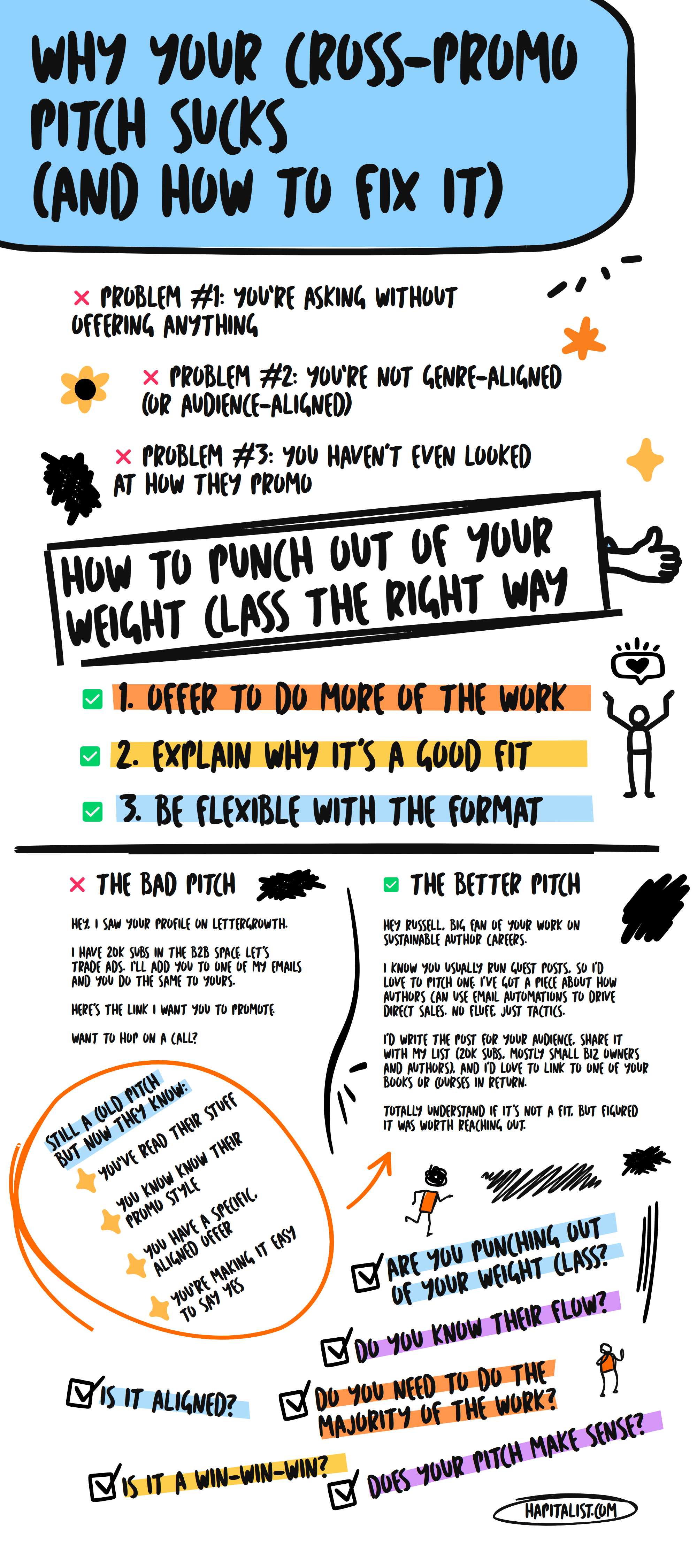
❌ Problem #1: You're Asking Without Offering Anything
If I have 50x your audience, you're not offering me a trade. You're asking for a favor, especially if you offer a straight 1:1 swap.
And that’s fine. I do lots of favors for people, but if you’re going to ask for a favor, you’d better make it easy to say yes.
Bad pitch example:
“I’ve got 1,200 subs. Let’s swap promos.”
That’s not a swap. That’s a leverage imbalance. It’s like offering a paperclip in exchange for a used car. And that’s a hard no.
So if you’re asking for a cross-promo, you need to offer more. Way more.
This might mean:
- Writing the copy yourself
- Sending multiple emails to your list
- Promoting on socials
- Offering design assets
- Giving something exclusive to my audience
When I reach out to someone bigger than me, I don’t say, “Let’s swap.” I say, “Let me do all the work. Here’s what I’ll give your readers. Here’s how I’ll support it.”
❌ Problem #2: You're Not Genre-Aligned (or Audience-Aligned)
Even if you had a comparable list size, if your content is completely unrelated to what I send my audience, it’s still not going to happen.
Here’s a real-ish example I get all the time:
“I run a real estate and lead-gen newsletter. Want to swap audiences?”
I write about building sustainable author careers. What do you think my readers are going to do with a MailerLite automation setup for cold B2B leads?
Your content might be valuable, but it’s not valuable for my people. I’m not going to promote something that doesn’t serve them, even if you have a million subscribers.
Want to work outside your genre? You have to tell me why it makes sense. Connect the dots. I’m not going to do that work for you.
- Why does this help my audience?
- How does this tie into what I already talk about?
- What’s the angle that makes this work?
Because if you don’t tell me, I’m not going to make that leap for you.
❌ Problem #3: You Haven’t Even Looked at How I Promo
I don’t usually run ads in my newsletter, especially not for other people’s stuff. I don’t often do solo recommendations unless we are really aligned. I rarely plug someone else’s work.
But I do run guest posts all the time. I promote other people by giving them a platform to write something valuable for my readers. If you want to pitch me, and your entire ask is built around a format I never use, then it’s clear you didn’t read anything I send out.
If you don’t know my format, my rhythm, or my boundaries, why would I trust you with my audience?
So How Do You Punch Out of Your Weight Class The Right Way?
You can absolutely work with people who are ahead of you in their journey. I’ve done it. I still do it, but I do it strategically. When I reach out, I come with something strong.
If you want to pitch someone with a bigger platform than yours, here’s how to actually stand a chance.
✅ 1. Offer to Do More of the Work
Earlier this year, I built an anthology. I reached out to the partner with since my idea was for a business book and I don’t have the strongest business contacts. In fact, that’s one reason I wanted to do it.
I told them I would put together the book if they reached out to their contacts, and then we would both get the emails at the end of the promotion.
That felt like a fair trade, using my unique skills to do something that has high leverage for them. All the writers who participated had to do was send us a previously published, formatted piece that fit our prompt, and share the book when it went live.
We did the layout. We did the outreach. We handled most of the marketing. They just had to show up.
And after the promo? They could use the book however they wanted. I made it valuable for them. I made it low-lift. And I made it easy to say yes.
That’s the kind of work you do when you’re punching out of your weight class or even when you’re trying to open a new market. Still, we went out to close to 50 people to find a dozen who were into it.
✅ 2. Explain Why It’s a Good Fit
I’ve promoted doulas. I’ve worked with mommy blogs. I’ve pushed people to my audience who usually have nothing to do with writing. I work with all sorts of people, but when they pitched me, they told me why it mattered to my audience.
They said something like:
“Your audience is mostly creatives. I think they’d benefit from learning about X, because it helps them do Y. I’d position it like this...”
They gave me the angle. They gave me the framing. They made the case. And I appreciated that enough to say yes.
✅ 3. Be Flexible With the Format
When you reach out to somebody better leveraged, then you have do more to balance the scales.
That might mean the bigger named creator will send one email. Meanwhile, you might run a webinar, share a bundle, write a guest post, and follow up with a paid ad.
If you’re the one with less leverage, you have to bring more action. Don’t expect 1:1 output. Expect to do more, because the other person has already done the work to earn their audience’s trust.
Think of it like a collaboration, not a transaction.
Bonus: Fixing the Pitch
Here’s what a bad cold email looks like (based on one I got this week):
❌ THE BAD PITCH
Hey, I saw your profile on LetterGrowth.
I have 20k subs in the B2B space. Let’s trade ads—I'll add you to one of my emails and you do the same to yours.
Here’s the link I want you to promote.
Want to hop on a call?
No context. No understanding of my audience. No acknowledgment of how I operate. Just “give me your list.”
Also, nobody ever wants to get on a call. Ever.
✅ THE BETTER PITCH
Hey Russell—big fan of your work on sustainable author careers.
I know you usually run guest posts, so I’d love to pitch one. I’ve got a piece about how authors can use email automations to drive direct sales. No fluff, just tactics.
I’d write the post for your audience, share it with my list (20k subs, mostly small biz owners and authors), and I’d love to link to one of your books or courses in return.
Totally understand if it’s not a fit, but figured it was worth reaching out.
Still a cold pitch. But now it shows:
- They’ve read my stuff
- They know my promo style
- They have a specific, aligned offer
- They’re making it easy to say yes
That’s a pitch I’ll at least consider.
Or… Stay in Your Weight Class
And if you don’t want to do all that? That’s fine, too.
You don’t have to punch out of your weight class. There’s a ton of value in working with people who are on your level. Build a crew. Run group promos. Create something together.
Several small lists, when aligned, can become a powerhouse. If you can become the connector, you can eventually become the draw.
But if you’re going to aim high, show up strong.
Because otherwise… your pitch is just another unread tab in someone’s inbox.
✅ Cross-Promo Pitch Checklist: Are You Actually Ready?
Before you hit send, ask yourself:
⚖️ Are You Punching Out of Your Weight Class?
- ⬜ Is their audience significantly larger or more established than yours?
- ⬜ If yes, are you offering something substantial in return?
🔍 Do You Know Their Flow?
- ⬜ Have you read their recent newsletters?
- ⬜ Do you know what kind of promos they actually run?
- ⬜ Are you offering something in the format they already use (guest post, anthology, etc.)?
🎯 Is It Aligned?
- ⬜ Do your genres, audiences, or vibes clearly overlap?
- ⬜ If not, are you clearly explaining why it’s still a good fit?
💼 Are You Doing the Work?
- ⬜ Are you offering to write, design, coordinate, or promote more than they are?
- ⬜ Are you reducing the friction for them to say yes?
- ⬜ Are you giving them an asset they can use again?
🧠 Does Your Pitch Make Sense?
- ⬜ Is it short, clear, and easy to understand?
- ⬜ Are you making it feel like an opportunity—not an ask?
🙌 If They Say No…
- ⬜ Are you open to working with people closer to your level?
- ⬜ Can you build a network from where you are, instead of begging your way into a place you haven’t earned yet?
If you can’t check most of these boxes, rewrite your pitch.
If you don’t want to do the work, that’s fine. But then stop wondering why your cold outreach isn’t landing.
Because you’re not pitching. You’re just asking for favors, and people notice.
What do you think?
- Have you ever punched out of your weight class and had it actually work? What made the difference? (What did you offer? How did you frame it?)
- If you’ve done successful cross-promos, what’s your go-to strategy for making the pitch land?
Let us know in the comments.
If you found this interesting, then there are over 600 exclusive posts available behind the paywall, including tons of interviews, courses, books, and more to help you on your author growth journey. You can start exploring with a seven-day trial, or even just give us one tip to show your support.