


Previous Post
Hi,
My wife rolls her eyes every time I tell people I’m semi-retired. She’s better about it now that I’ve been doing it for years, but that phrasing really matters to me. It gives shape to the career I want, one where I’ll always write, show up for readers, hop on podcasts or stages, but I don’t need to do any of it to keep the lights on.
I will always do those things because I like praise and crave the attention. Plus, I genuinely love writing. It regulates my brain and filters my anxiety. So, I’m always going to do the work. I just don’t want to be trapped by it.
Since I’ll always rely on my back catalog for some amount of passive income, and I’ll always need an audience to sustain that catalog, it means I’ll never be 100% retired.
At best I’ll ever be 80% retired, which means instead of needing to work 40 hours a week, I only need to work 8.
Once I named that, I realized I was already only working 30 hours a week. That’s 25% retired, which was a good start. Since then I built systems and shifted the shape of my weeks.
Now. I hover around 60% retired. I still need to work about 16 hours a week, though not every week is the same. Those hours include meetings, writing, and anything I’m doing “for the money” instead of purely “because I want to.” Even then, I’ve worked to make the have-tos feel like want-tos.
A recent weekly “had to do” list:
- Co-host a webinar about writing.
- Be interviewed on a podcast by dear friends.
- Host a breakthrough session for Hapitalist members.
- Join a meeting with a partner I chose to work with.
Last year, I “had” to be at Author Nation, which meant seeing friends all day, watching The Wizard of Oz at the Sphere, seeing O at Bellagio, eating at the Netflix Bites restaurant, and hosting partner dinners hanging out with old friends.
Another week, I had a livestream with a friend, a Zoom about a potential partnership, a planning meeting with a partner, a coaching call with a client I adore, an interview for our podcast with people I love dearly, host a Hapitalist breakthrough session for my amazing members, and co-hosting Craft Con, where I interviewed 12 of my favorite successful authors about how they think and how they break blocks.
Yes, those are “have tos”, but what a life, right?
I also try to stay 5-6 months ahead on my writing schedule. I still write 1–2 articles a week, but the pressure is gone.
All that took a long time to build, but it started with recognizing I have agency. I may not be fully where I want to be, but I’m some percentage of the way there, and that percentage moves in the right direction when I design for it.
How to define semi-retirement as a writer
Most creative careers don’t have a clean on/off switch. We don’t stop making, but we can stop needing to make in order to survive.
Instead, we define semi-retirement with two numbers:
- Your full-time baseline. For many people that’s 40 hours. If yours is different, pick the number that represents “I’m working full-time.”
- Your required hours. The minimum number of hours per week you must work for money to maintain your life and business.
Your retirement percentage is the reduction from baseline. If you need eight hours instead of forty, you’re 80% retired. If you need twenty, you’re 50% retired.
This math reframes progress. You don’t have to wait for an arbitrary financial finish line. You can move from 10% to 25% to 40% retired by shaving down the hours you must sell each week.
If you need help defining that retirement even looks like, then I recommend this article on defining your win condition.
Set your win condition
Hiya friendo,
 Russell Nohelty
Once you have that win condition, and your retirement percentage, here’s how this looks for fiction vs. nonfiction authors.
- Fiction authors: Build read-through. Align back matter to lead into the next book. Offer box sets. Use audio strategically. Plan release cadences that feed the catalog without burning you out. School visits, festivals, book clubs, Patreon, and limited signed runs can be both joyful and lucrative.
- Nonfiction authors: Anchor your ecosystem around a core transformation. Books point to a talk, workshop, course, or consulting offer. Each format should be evergreen enough to sell without a constant live presence. Create two or three signature talks so every gig reuses the same spine.
Here are some levers you can use to increase that percentage and move closer to your win condition over time.
- Build an income-generating backlist. For fiction, that’s series with strong read-through, omnibuses, audiobooks, translations, library distribution, large print, and smart pricing. For nonfiction, that’s evergreen titles, updated editions, audio, workbook companions, and rights sales. Your backlist is your retirement account.
- Go wide on rights and formats. Exploit print, digital, audio, foreign, film/TV, special editions, direct sales, bundles, library rights, and speaking. Rights are levers. Each lever is a small annuity.
- Treat your reader list like compounding interest. A healthy email list and consistent communication keep your backlist alive. One thoughtful note a week can outperform a dozen frantic launches.
- Productize your expertise. If you teach, coach, or consult, package it: cohorts, workshops, video courses, templates, memberships. Productize once, deliver many times.
- Design a “one have-to per day” calendar. I try not to schedule more than one mandatory thing a day. It protects creative energy and stops obligation creep. If I stack two, I feel it. Three is a bad day.
- Pull the joy forward. Choose podcasts, events, and partnerships you’d happily do for free. If you must sell hours, sell them in rooms that feed you back.
- Front-load the writing. Being five months ahead evaporates pressure. Batch first drafts, schedule editing windows, and automate publication. Futures you will send present you a thank-you card.
- Install low-friction systems. Templates for outreach, launch checklists, canned responses, a weekly finance block, and “done for future me” folders reduce decision fatigue and reclaim hours you can reclassify from “must” to “want.”
Here’s what a sample 16-hour “must” week might looks like.
- Two 90-minute creation blocks to keep the pipeline moving.
- One 90-minute admin and finance block.
- One 60-minute partner meeting.
- One 60-minute reader-facing session (live, webinar, or Q&A).
- One 60-minute coaching or client call.
- One 60-minute marketing block (newsletter, promo, backlist tune-ups).
- Buffer: 3–4 hours for the unpredictable.
Everything else like reading, thinking, walking, journaling, and noodling on ideasdoesn’t count as “must”, which means that’s part of already living your retirement.
A note on “passive” investments
We’ve talked a lot about how to make your catalog and business work for you, instead of you working for it, but perhaps the best, and some would argue only true form of, passive income comes from investing in the markets, or in ways that allow your money to grow without you doing anything except watching. There’s a robust cross-section of literature that talks about pulling money from your business and investing it in index funds.
If you can do that, then you’ll never “need” your books to make money at all, and your business can truly be about play.
That’s not a reality most writers live in, but I committed to maxing out my IRA every year, and every time we get extra money, we put as much as we can into savings, and have for decades now. Success with creative things is always very volatile, which is why successful creators are always investing in car washes, and wineries, and phone companies that are considerably more stable.
We can’t do it all right now, but even opening a little space in your life is a big deal. If this article has shown you nothing, I hope it has shown that even moving 1% toward a thing every week or month can create massive, seismic shifts over a long enough time horizon.
In 2015, when I started Wannabe Press, I was 0%, or even negative retired from working over 40 hours, but over 10 often painful years, I was able to shift that to 60% retired, with even the “worst” weeks being filed with friends and loved ones collaborating with me.
My wife and I both work from home, and eat lunch together almost every day, and spend a lot of time together on the weekends. We are able to do just about anything we want, and take at least one big trip a year, plus going home for the holidays and small trips to conferences multiple times to speak on panels and teach workshops.
Maybe it can’t be your life now, but if you can find your win condition and pull it forward, then it could be your life eventually, little by little. We think this kind of thing happens all at once or not at all, but this is slow work, like water carving a canyon in stone, and it starts with a mindset shift.
30–60–90 day plan to increase your retirement percentage
If you have trouble visualizing how this could work for you, even if your 0%, or gods forbid, negative percentage retired because you’re working more than full time, then here are some strategies you can take this quarter to help get you where you need to be.
Next 30 days
- Define your baseline and required hours. Name your current retirement percentage.
- Audit your backlist: metadata, pricing, read-through, back matter, formats.
- Implement one automation: a welcome sequence for new readers or a reusable launch checklist.
- Block your calendar with one have-to per day maximum.
Next 60 days
- Create one productized offer (workshop, box set, audio edition, template pack).
- Pitch five aligned podcasts or events you would enjoy regardless of the money.
- Batch four weeks of content and schedule it. Get a month ahead.
Next 90 days
- Release one backlist optimization (new edition, audio, omnibuses, translations).
- Build or refresh a simple evergreen funnel from book to next step.
- Do a quarterly review: new required-hours number, updated percentage, one lever to pull next.
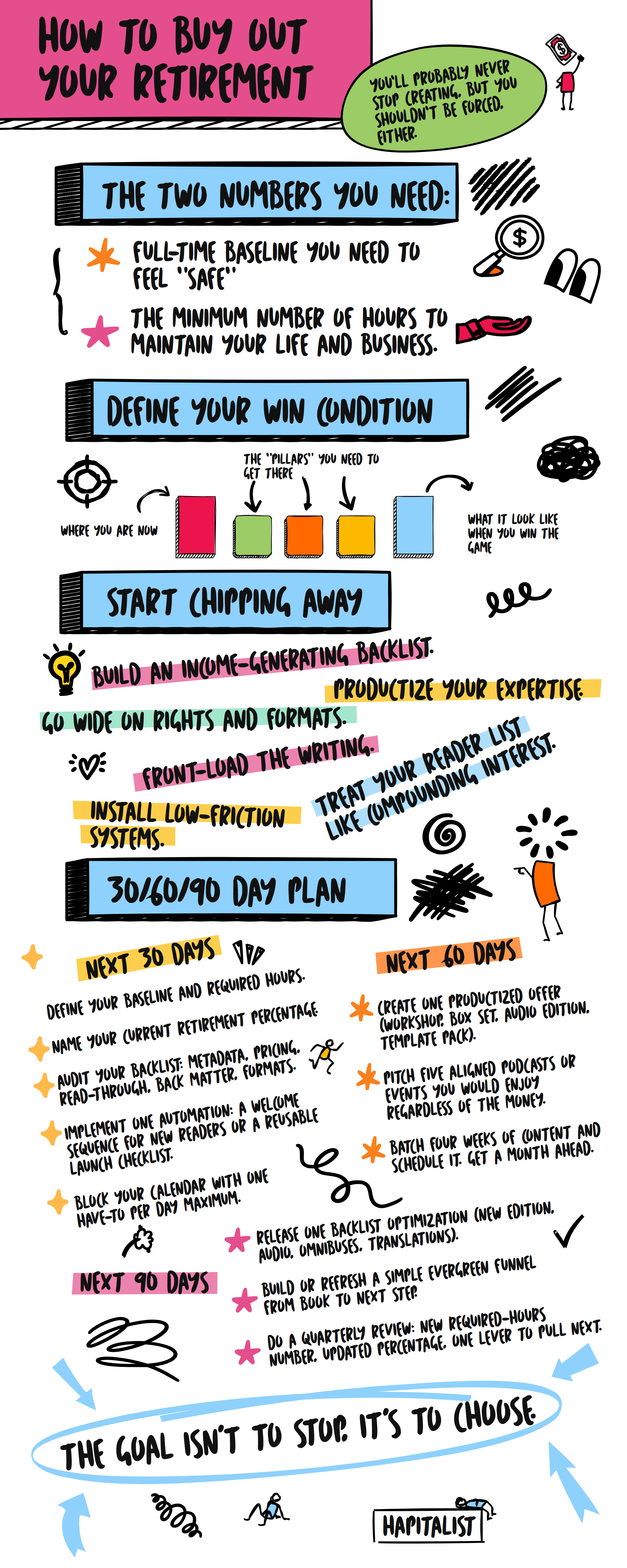
The goal isn’t to stop, it’s to choose. I still need to do things, but most days, even the things I have to do are with people I like, about topics I care about, in formats I enjoy.
That wasn’t luck. I designed it that way.
If the idea of “semi-retired author” makes someone in your life roll their eyes, let them. Language is leverage. It reminds you that your job isn’t to meet the industry’s appetite; it’s to right-size your obligations so you can keep loving the work.
I’m not at 80% yet. But I’m further than I was, and I’m moving a little closer every week. This whole game is about build a calendar centered around joy. Yes, these are have-to things, but what a life that would be.
What do you think?
- What’s your full-time baseline? How many hours per week do you need to work to keep the lights on?
- What’s your current “retirement percentage”? Even if it’s 0%, what would +10% look like for you?
Let us know in the comments.