
Previous Post
Phoebe Ravencraft is one of my favorite publishing humans. I’ve been so blessed to have seen her at both of our conferences, and as a member of Hapitalist. She is a fierce advocate for indie authors, and an expert at helping authors turn their listless blurbs into something that sells.
She spent six years as Editor-in-Chief at BPF and writing Fiction Blurbs the Best Page Forward Way, she’s taking on new clients, and so I asked her to come talk about what makes a great blurb.
If you’re a paid member, you also have access to my blurb methodology in How to Write Irresistible Books that Readers Devour and a worksheet in our Write a Great Novel course. Our🦄Unicorn members have a workbook with exercises in it, too, but Phoebe lives and breathes this stuff, and frankly hiring her is a steal.

Capitalism makes a lot of demands. The largest, of course, is that we constantly consume. We’re raised to believe in this key principle from the time we’re able to watch and understand commercials. The relentless march toward greater and greater consumption undergirds our entire experience.
It’s no wonder we all need therapy.
But capitalism isn’t going away, and thriving in it means understanding how to make it work for us. Particularly as independent creatives, finding the ways to monetize the solemn dictate to consume is critical to our success and happiness.
Selling is how we do that.
Most of the creatives I know hate selling. They’re artists. Selling is icky. But what you have to understand as an indie author is that you’re more than a writer; you’re a publisher. That’s a business.
Businesses have to sell to stay in business.
For authors, this means having a high-quality book description. It’s one of the foundational tools to selling books. It’s also the piece of their businesses authors hate most. How to turn a 100,000-word masterpiece into a 250-word sales document that makes people want to buy is a mystery many of us not only struggle to solve but despise even attempting.
The good news is that selling involves one simple concept, and if you figure out that part, it becomes easy.
The Power of Emotion
We don’t need 90% of the stuff we buy. We need food. We need shelter. We need clothing. Everything else is completely unnecessary for survival (including the excess food and clothes we buy and homes bigger than our needs).
It isn’t just the relentless drive for consumption that causes us to purchase all that extra stuff. We feel a need for things we … don’t need. We want the awesome car, instead of the cheaper, practical one. We want toys and TV’s and computers and the latest fashions and accessories. We want regular entertainment (including books) and the general feeling of comfort.
And we desire these things because advertisers have made us feel a need for them, but that feeling is an illusion. Indeed, desire is a powerful stimulus, and it’s the one sellers trade in the most.
All selling is about emotion. This is the single, most-important thing to understand before entering any commercial enterprise. To sell your product, you must create an emotional reaction in your prospective customer.
It’s easier to do than you might imagine.
The Princess Leia Principle
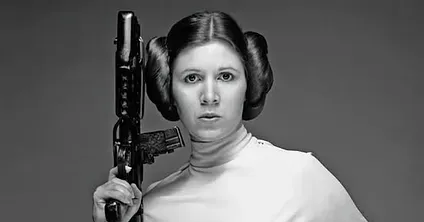
When I saw Star Wars for the first time, I instantly fell in love with Princess Leia. She was absolutely electrifying. Fierce, blunt, and intelligent, she stood up to everyone, even the giant dude in black armor threatening her life. As soon as she’s released from her cell on the Death Star, she takes charge of the rescue operation, getting the heroes out of trouble when they are trapped.
I looked at Leia Organa and saw the woman I wanted to be. I related to her. I aspired to be just like her.
Now, I was only nine years old at the time, so I didn’t really understand any of that. It was operating on a subconscious level. My desire to grow up to be strong and influential and brave connected with Leia’s character. I had a blueprint for my deepest ambition.
And it was this emotional connection that helped make me a total Star Wars geek throughout my childhood and youth.
The Princess Leia Principle is the emotional connection between the reader and the main character. It’s the key to selling fiction.
Make the reader love your protagonist.
(Yes, I know that Leia is not the main character of Star Wars. What I’m trying to illustrate is the power of the emotional connection. My dad took me to see the movie the first time, because he thought my brother and I would enjoy it. But it was my emotional connection with Leia Organa that made me insist on seeing it again. And again and again.)
Despite the fundamental truth of selling through emotion, as artists we believe readers are interested in something else. We tell them all about the setup of the book. We wax poetic about the setting, the magic system, the state of the sports franchise that figures in the story – anything except what actually matters to the reader: Will they identify with the main character?
Listen, I was agog sitting in that darkened theater in 1977, watching light saber duels, spaceships spitting laser beams, and the strangest alien creatures imaginable. It was all really kewl. But that was just set dressing. What drew me to Star Wars was imagining being as fierce and as respected as Princess Leia.
That’s the draw.
Putting Principle into Practice
Emotion may be the key to selling, but how do you invoke it? The answer is by writing your description about your main character and the conflict they’re struggling with, not about your story.
The essence of all fiction is conflict. The protagonist has a problem. They have to save the world. They need to convince the handsome stranger to fall in love with them. They must catch a killer. Whatever the conflict is, the narrative of the story is them wrestling with this problem and either solving it (for a happy ending) or failing (for a tragedy).
The character is at the center of this conflict, and it’s their journey to its resolution we care about as readers. So that is the thing we use to sell the book.
I always open a book description introducing my main character and their basic emotional state. I try to do it in as few words as possible, with my target range being 5-10. Then I build on that emotion, outlining the character a little deeper until I pull the rug out from under them with the novel’s inciting incident (the moment at the end of Act I where the character is forced out of their comfortable environment and into the action of the narrative).
Here’s an example from my sapphic romantasy novel, The Dark Legend:
Wren Xavier only truly loved one other person. Now, the woman for whom she yearned for a quarter century is dead, murdered while on assignment in the enchanted land of elves. The magical secret agent’s crush named her killer in a cryptic message. And Wren swears she’ll bring him to justice when she’s sent undercover to his homeland.
That first sentence is only eight words long, and it’s absolutely dripping with emotion. The woman who has only ever had one true love is a familiar trope, and it’s laced with underlying pain, because we can anticipate something is going to happen that messes with that opening emotional state. Much the same way I didn’t understand why I loved Princess Leia at the age of nine, the reader doesn’t know what’s going to happen, but their experience reading in the genre triggers them to anticipate something bad.
And we get it in the very next sentence with, “Now, the woman for whom she yearned for a quarter century is dead …” The first part of this sentence is doing a lot of work. We find out not only that Wren’s true love is dead, but that love was unrequited, making the loss even more painful. At this point, we’re feeling Wren’s grief and sympathizing with her, and we still don’t know what the story is about. That’s important, because we’re selling the book based on the main character and not on the plot.
The back half of the sentence finally gives us some story information – “… murdered while on assignment in the enchanted land of elves.” We learn that Wren’s beloved was murdered. Not only does that tell us the stakes are high, it deepens the emotional loss.
This was no ordinary death; Wren’s beloved was deliberately killed. We get a couple of genre clues here, too. The other woman was “on assignment,” so she must have been some sort of government agent. And the killing took place in the “enchanted land of elves,” establishing that this is a fantasy novel.
We later reveal that she was a magical secret agent, identifying this novel as a fantasy-espionage mashup piece and that Wren has been assigned to find out what happened, indicating she is in the same business as her lost love.
But all of this is done via emotional language. Wren swears she’ll bring the killer to justice. That is an emotional approach to a murder investigation. The stakes are personal, which makes this a very big deal to our protagonist. And that allows the reader to connect more deeply with them.
Here’s another example, this one in first-person:
You ever wonder what you did to deserve all this? Like, seriously, y’all, I just want to play D&D and live my life, ya know? But I’m barely making ends meet working at a game store, our biggest creeper customer is constantly hitting on me, and my best friend in the world would really prefer to be my girlfriend.
And as if all that weren’t enough, I just found out the fantasy stuff I love is real, because a giant-ass demon tried to murder me in front of my apartment.
A first-person blurb has to establish character voice immediately. We get that right out of the gate with the snarky, “You ever wonder what you did to deserve all this?” Our main character opens with a relatable line and suggests right off the bat she is in some sort of trouble. She then spends the next two sentences bringing us into her world and letting us relate to her like a friend. The target reader for this book should already be identifying with her as a hot-mess young woman just trying to get by – a familiar situation to so many readers.
Then it takes a hard swerve by introducing the inciting incident. With us relating to her complicated life, she introduces us to the fact that magic is real, demons exist, and one just tried to kill her. Now, we’re hooked. The stakes just went way up from a hot-mess lifestyle to trying to avoid death from supernatural creatures.
At this juncture in the description, we don’t know much about the story. We don’t know why a real demon tried to kill her. We don’t know what’s going to happen.
All we know is that a relatable nerd girl was just minding her business when the supernatural got real.
The later paragraphs of these blurbs give a little more story information. We discover that Wren has to match wits “with a megalomaniacal elf and a psychotic, human assassin.” We learn that she is in over her head in a “culture she doesn’t understand” and that she starts falling in love with the elven nation’s beautiful security chief.
Likewise, our narrator in the second book reveals she is rescued by a “clandestine organization that’s supposed to keep the supernatural hush-hush,” and that a dragon has ordered a hit on her, because she is supposed to be some sort of Chosen One.
But all of this plot information is presented in a way that raises the personal stakes for the main character. Because The Dark Legend is a romantasy, the love affair impacts the mission: “And when they start falling for each other,” I write, “their passion may get both of them killed.” The stakes are personal – they are falling in love and that may get them killed.
In Sleeping Dragons, our narrator closes with, “I may be rolling in geek knowledge, but if I don’t level up fast, I can kiss my friends – and my butt – goodbye.” There is a lot of gaming imagery in there to build on the established character trait of her being a fan of Dungeons & Dragons (and to appeal to the TTRPG sub-audience), but it’s all presented in a way that make the stakes incredibly personal. She could lose all her friends … and her life!
This is the Princess Leia Principle at work. Over the space of three paragraphs, we invoke an emotional reaction in the reader that makes them relate to the main character. Then we threaten the main character’s goals, so that the reader has to know what happens.
And the only way to do that is to buy the book.
Selling turns on emotion.
When the reader feels a connection to the protagonist of your story, they become invested before they’ve read the opening line or a single review.
Yes, they’re going to love your world-building, your witty dialogue, and your perfect execution of their favorite tropes. But those things won’t sell your book. Give them emotion. Give them character.
Then they’ll feel that overwhelming, capitalist desire to buy.
Phoebe Ravencraft is the former Editor-in-Chief of Best Page Forward blurb-writing agency and a marketing copy expert with 30 years of experience. She loves helping others make their dreams come true and crafting high-converting sales copy. Contact her at phoebe@phoeberavencraft.com if you’d like to discuss your next project with her.