Honestly, you’ll probably want to just skip to about minute 27 or so of this one when it goes straight into a coaching call and you see in real time how Russell’s brain works, and how it all clicks into place in 30 minutes.
Before we get started, a quick question. There are 31,000 of you subscribed to this blog, but the podcast only gets 50-60 downloads every episode. I’m wondering why, when other podcasts from Substack creators get 1,000+.
The recaps get thousands of reads, but very few listens/views. You might not know this, but I’ve been recording podcasts for over a decade, over 350 episodes in all.
My shows have always been quite well-received, so I’m at a bit of a loss to figure out what’s happening. So…
Now, on to the show recap.
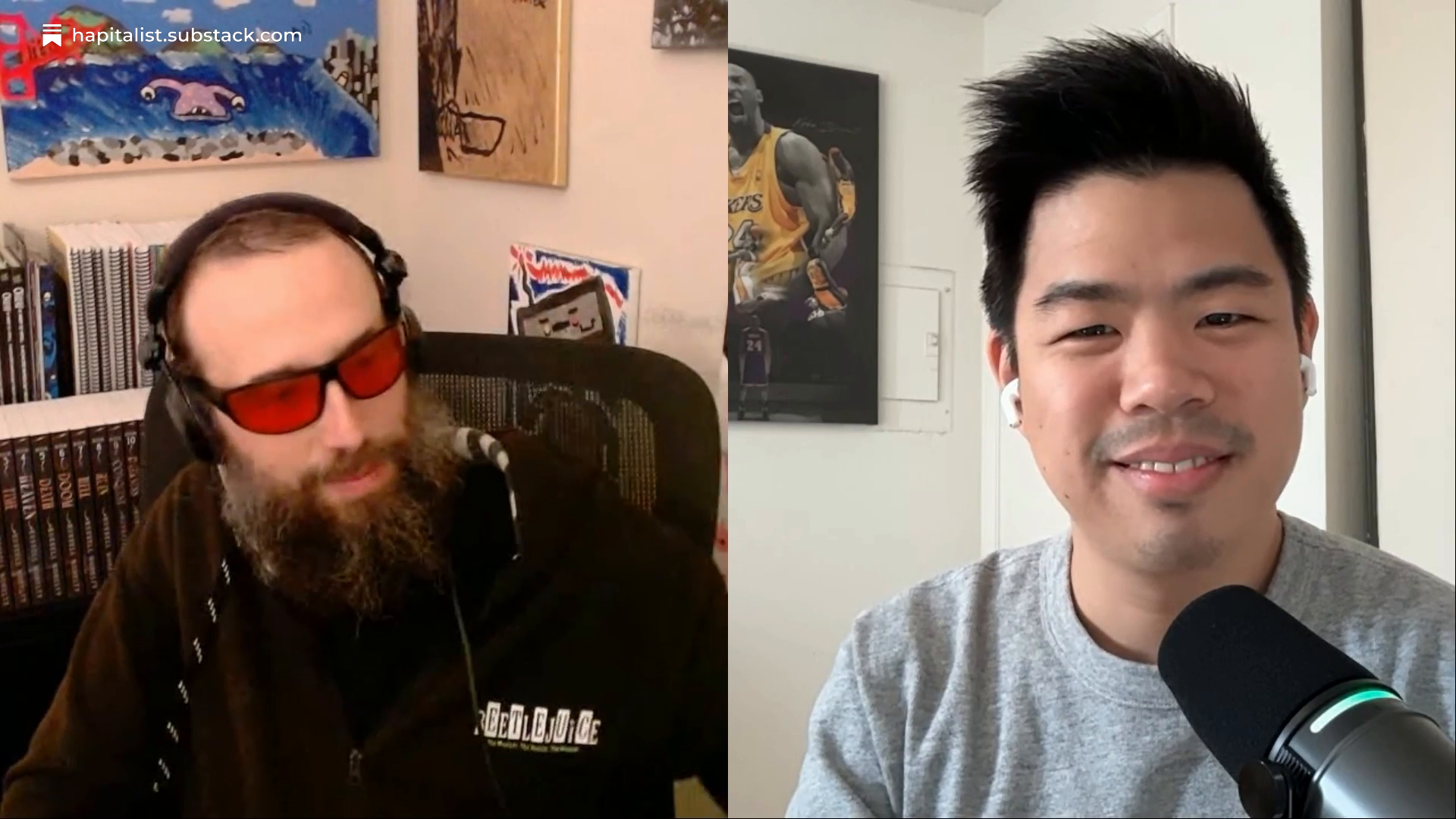
In this one, Russell sits down with Jermaine, a serial founder whose current passion project, Heirlight, an AI-powered estate planning app, grew out of a deeply personal place: trying to understand his mother before she passed. What starts as a conversation about death, legacy, and memory transforms in the second half into a candid coaching session where Russell holds up a mirror to Jermaine’s product, messaging, and the gap between what he says he’s building and what his website actually says.
Jermaine built the first version of Heirlight as a Mandarin-language chatbot so his mom — who was anxious about retirement and unclear on her own finances — could tell her life story in her own language. Four months of conversations later, he realized he had the raw material to build her an estate plan. She passed away three months after he started building the app.
The conversation opens into something broader: both Russell and Jermaine have lost parents, and both had the experience of either trying — and failing — to capture those stories before it was too late, or just barely succeeding. The throughline is that understanding someone’s past unlocks empathy for who they became. Russell connects this to his own father, his stepmother, his grandmother with dementia at 92. Jermaine connects it to a recording he made of his grandmother in 2017 that reshaped his understanding of his entire family.
The emotional core of Heirlight, as Jermaine describes it in the first half, isn’t estate planning at all — it’s connection and remembrance.
At around the midpoint, Jermaine invites Russell to just look at his website and give it to him straight. What follows is one of the more honest product critiques you’ll hear on a podcast.
🔍 What Russell Saw on the Site
Russell pulled up Heirlight.com live and flagged the disconnect immediately:
The hero headline: “Make your will in 27 minutes”
Supporting copy: state-specific, bank-level encryption, unlimited updates, free lawyer referral
His reaction: “27 minutes is a long time. Bank-level encryption — I don’t care about this at all. Free lawyer referral confuses me because I thought you were making my will.”
More pointedly: “We’ve talked for roughly an hour across two calls, and you never once talked about making a will or the fact that it’s quick.”
💡 The Core Tension
Jermaine’s product is mission-driven. His messaging is pain-point-driven. Those are two different apps, and right now the website is selling the wrong one.
Russell’s framework: every product is really about the transformation it delivers. “Make a will in 27 minutes” is a task completion. That’s not a powerful transformation. The real transformation Jermaine kept describing — feeling grounded, feeling like a responsible adult, preserving stories your grandchildren will hear after you’re gone — that’s nowhere on the page.
“The thing you said for the first 25 minutes of this talk is not this site.”
🧭 Key Coaching Insights
Your referral users aren’t your ideal customer. Most of Heirlight’s growth comes from word-of-mouth, and those users come because it’s “easy.” But Russell pushed back: it’s not easy because it’s fast — it’s easy because it’s natural language. People are telling stories. That’s the thing. And yet the app currently buries the conversational part behind the rigid will-building flow.
You’re playing a game you can’t win. Competing on speed and task-completion puts Heirlight in the same lane as every other will-maker. Russell was blunt: “You are going to lose that game because they are already winning it.” But shifting the axis — making Heirlight the app that helps you tell the story behind the will — puts it in a category of one.
There’s almost no risk to going all in on the thing when you have good cashflow. Because Jermaine has a profitable freight forwarding business funding his life, he has rare runway to take asymmetric creative risk. Russell’s challenge: “You are constraining yourself from taking the actual risks you want to take because your brain says businesses do business things.”
The order of operations matters. Currently: rigid legal questions first → natural language/storytelling after. Russell’s suggestion: flip it. Let people tell stories first, then surface the will questions gradually — one per day over four weeks if needed. Let the will be the thing that emerges from the conversation rather than the thing that gates it.
Make it shareable and collaborative. Wills are hard partly because people don’t have all the answers alone. What if you could “phone a friend” — loop in a sibling to help answer two questions? What if a story got cleaned up by AI and you could share it with family? What if your niece could comment and say “that’s not what happened”? That’s a product people talk about.
The face problem. Jermaine revealed he’s been reluctant to put his own story front and center because two teammates quit their jobs to build this with him — and it feels narcissistic to make it about himself. Russell reframed it: “They didn’t follow you because this was the best idea ever. They followed you because of you.” The story doesn’t have to be Jermaine’s exclusively — but someone’s story has to be there. If not his, find a customer whose story can stand in.
🎯 Russell’s Parting Challenge
“What I would love to see next time is what you talked about in the first half of this call to be on this page.”
The episode ends with Russell going full pitch mode — framing wills not as legal documents but as storytelling apparatuses. Every item in a will has a story behind it. 70% of Americans don’t have a will not because they’re lazy, but because wills feel cold, impersonal, and bureaucratic. Heirlight’s bet — if it leans into what Jermaine actually built — is that wills can be the most personal thing you ever make.
“Wills are about how we take bits of our identity and give them to other people and hope they can carry little pieces of us around with them forever.”
3 Takeaways for Founders
Your messaging should sound like you on your best day — not like a product spec sheet. If you’d never describe your company the way your homepage does, something’s off.
The transformation > the feature. “Make a will in 27 minutes” is a feature. “Feel grounded enough to stop avoiding the hardest conversation” is a transformation. Sell the second thing.
Asymmetric risk requires asymmetric positioning. If you’re not going to win by playing it safe, you might as well play it weird and true.
Heirlight is currently live in California. You can try a draft for free at https://heirlight.com/en/podcast/hapitalist