
How to succeed at live events
Discover why in-person events are the most powerful, marketing tool for entrepreneurs and how hand-selling at conventions can build lasting fans.
What if I bribe you, tho?
A couple weeks ago I asked y’all, ”Why don’t you subscribe to the Hapitalist podcast on your favorite podcast player?”
To which an astonishing 69% of you said “I prefer reading” which, as a writer who is told all the time “People don’t read anymore” warmed the cockles of my heart.
I’m in a pickle, though, because I still want you to subscribe to the podcast. Then, I had a great idea. Do you know what always works? Bribery.
So, here’s the deal.
Go to this link.
Subscribe to the podcast on Apple or Spotify.
Enter to win a $25 Amazon gift card.
If you’re not into Apple or Spotify, you can listen on the app of your choice without entering.
So, what do you think? Is bribery enough?
Hi,
If you’re like most indies, the idea of selling your work in person might feel somewhere between daunting and ridiculous. Why spend hundreds of dollars on a table, stock, gas, travel, and maybe even a hotel room just to stand behind a plastic table in a loud convention hall hoping someone buys you stuff?
It’s easy to think, "There’s no way this adds up,” but live events are one of the most underutilized, misunderstood, and transformational tools in your business.
I’ve built my career behind the booth hand-selling to people one conversation at a time. For years, I tabled at 20–30 shows annually. I've sold at massive conventions like San Diego Comic-Con and small-town swap meets where I shared space next to someone peddling handmade soaps. I’ve done library panels, indie signings, anime cons, horror expos, and book festivals. Every one of them was part of a bigger system that built my fanbase brick by brick.
In a world drowning in digital ads, the entrepreneurs who show up in person stand out. Live events are not just about sales. They're about connection, and real, face-to-face, hand-you-something-and-talk-about-it connection is the secret weapon most online-first businesses completely overlook.
The Totem Effect
People don’t buy at conventions because they’re in desperate need of what you’re selling. There’s Amazon for that. They buy because it becomes a physical artifact of an experience. Convention sales are about delighting people so much they want to keep that memory forever.
That’s the magic. You’re not just selling a story. You’re selling a moment, and moments are priceless.
At shows, people spend money more freely than they do online. Why? Because they’re in buying mode. They’ve paid to attend, set aside time, and are looking for something cool to discover. When you offer something beautiful or delicious with a compelling pitch and an enthusiastic attitude, it becomes that something.
Doing shows is also a great way to stand out. You’re not one out of millions anymore. You’re one of maybe a dozen at a specific event. You went from being a pixel in someone’s feed to a real person, standing behind a table, smiling and talking about your work.
We live in a world of noise, scrolling, ads, and email blasts. Everyone wants attention, but no one wants to build trust. However, trust is what drives sales, not just today, but six months from now.
At a show, when someone stops at your table and chat, even if they don’t buy, they’ve had a touchpoint with your brand. If they sign up for your mailing list or take a bookmark, that’s another. If they see you again at another show and remember you, that’s another. Eventually, that person becomes a fan.
Your job isn’t just to sell. It’s to be remembered.
Maybe they don’t buy today. Maybe they go home and Google you, or buy next year on Kickstarter, or sign up for your Substack, or tell a friend.
When someone sees your passion, hears your story, and senses your excitement, it short-circuits the usual skepticism that comes with buying from an unknown quantity. They might not have planned to buy from you today, but something about the experience makes them say yes.
That yes didn’t come from a 3-step email funnel or a perfectly optimized product page. It came from you.
Building momentum
It’s important to understand that live events aren’t just about what you make at the table. They’re about momentum.
You meet vendors and forge partnerships.
You network with panelists and get invited to future events.
You speak on stage, which opens doors to even more credibility.
You gather hundreds of emails for your list.
You test new pitches, price points, and product bundles.
Even at a "bad" show, I walk away with something valuable. Whether it’s a new friend, a contact, a lesson, or even a photo of my booth I can post to build social proof. Every single one of those things feeds my business.
Will it be exhausting? Yes. Will it sometimes feel thankless? Yes. Will it be worth it? Absolutely.
Choosing the right shows (and setting expectations)
Not all events are created equal. Some conventions are well-oiled machines with tens of thousands of attendees and years of brand equity. Others are held in hotel ballrooms with a few hundred people and a shaky Facebook page. So, how do you know which ones are worth your time?
The truth is, you won’t always know. There’s a lot of trial and error in the live events game. But that doesn’t mean you have to walk in blind.
Before you book a table, it’s important to align your goals and expectations. What are you there to go?
Make money? You’ll want high-foot-traffic shows with a strong buying culture.
Build your mailing list? Target smaller, community-driven events where conversations flow more easily.
Network with other creators or vendors? Look for multi-day shows with lots of vendors or robust programming.
Gain exposure and speak? Consider conferences or festivals that allow panel submissions.
Most shows won’t serve all these goals, and that’s okay, but knowing your primary objective keeps you from misjudging the value of a weekend. You might not make $1,000 in sales, but if you meet two future collaborators and add 150 people to your list, that might be a win.
Let’s break this down by category:
Conventions (Comic, Anime, Horror, etc.): Big crowds, mixed interests. Great for genre authors. Expect competition.
Festivals: Often more focused, with panels, readings, and signings. Ideal for writers, speakers, and makers.
Conferences: Fantastic for networking, but harder for direct sales. These are more about industry connections and craft.
Farmer’s Markets & Local Fairs: Cheap tables, friendly crowds. A good training ground for new sellers.
Store Signings & Library Events: Lower foot traffic, but higher engagement. Good for building local community presence.
Signing events: There are lots of genre specific book signing events now that cater to readers, like RARE and BABE.
Don’t let size seduce you. A 50,000-person convention can result in $300 in sales while a 1,000-person boutique con might net $3,000. It’s all about audience fit and your ability to convert.
Small events also let you test pitches, merchandise setups, and new books with lower stakes. They're great laboratories, so don’t discount them.
How do you find them?
Facebook groups and Reddit threads about local shows or niche genres.
ConventionScene.com and similar databases.
Local businesses (especially coffee shops and book stores), who often know about local events.
Asking fellow authors where they’ve had success.
For a sales-based event, your goal should be to 10X your table cost or 2X your total show expenses (including travel). That’s not always realistic at first, but setting that bar will help you analyze ROI accurately.
If a table is $200, you’re aiming for $2,000 in gross sales. If you spent $1,000 getting to and working the show, you want to bring in $2,000 to justify it. It’s hard to know which shows are worth it before you go, but make sure to track this every time.
Preparing for the convention floor
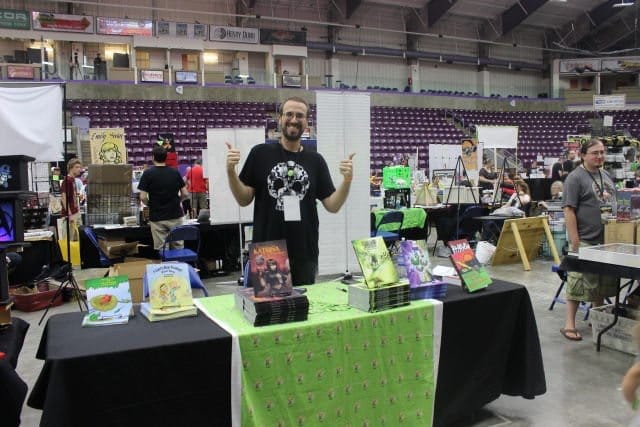
Now that you’ve booked your table, it’s time to think like a stage designer. At live events, your table is your storefront, your resume, and your personality, all wrapped in six feet of folding real estate.
Long before you say a word, your booth is doing the talking. Does it look inviting? Does it scream “this is worth checking out”? Or does it look like someone dumped a box of books and bounced?
Here’s what you need:
A clean, table drape (bring your own. It’s worth it).
A branded runner or banner that showcases your name or series.
Verticality by using shelves, risers, or wire stands to show off covers at eye level.
Freebies that act as icebreakers.
A mailing list signup mechanism like a clipboard, tablet, QR code, whatever works.
Filigree is not my favorite thing, but there’s no doubt if you bring some sort of twinkle lights or confetti it will catch a reader’s eye.
If you’re more introverted, great design can sell without you saying much. If you’re extroverted, great design makes your pitch easier. Here’s a list of things to bring.
Copies of your work (obvi; double copies of book one in any series, if you’re an author)
Business cards, post cards, or bookmarks
Credit card reader (Square, PayPal, etc.)
Cash box and change
Tape, pens, scissors, clips—your tool kit
Water, snacks, comfortable shoes
…and don’t sleep on merch. Books might be your main product, but merch can sweeten deals and improve margins:
Pins, buttons, stickers, and prints add personality and profit.
Bundle items for deals like: "Buy 2 books, get a pin free."
Use merch as mailing list incentives or buyer bonuses.
Think in bundles. You want the average sale to be at least $40, and merch really helps boost up the average cart value. If you price your bundles at $50, you just two sales an hour hits $100/hr. Personally, I like making $60 bundles.
If you’re enjoying this, I also speak words into microphones on the Hapitalist podcast. Some of them are insightful. I’m currently bribing people to subscribe.
Go to this link.
Subscribe to the podcast on Apple or Spotify.
Enter to win a $25 Amazon gift card.
If you’re not into Apple or Spotify, you can listen on the app of your choice without entering.
Pitching and closing with confidence
Pitching isn’t about being pushy. It’s about inviting someone into your world and helping them decide whether or not they want to stay. A good pitch doesn’t feel like a pitch. It feels like a chat with someone who genuinely cares about whether their work is right for them. So let’s talk about how to make that happen.
Stand up. Smile. Be approachable.
Ask questions: “Are you into X?” “What’s your favorite Y?”
Use a “free taste” to draw people in.
Offer a confident, quick pitch: “This series is Buffy meets Star Wars with a splash of Lovecraft.”
Use the “optional close”: “Do you prefer dark fantasy or sci-fi?” instead of “Do you want to buy this?”
Remember: your job isn’t to convince, it’s to connect. Let your excitement be contagious.
The Bookmark Trick
One of my favorite ways to start a conversation is with a simple question:
“Would you like a free bookmark?”
It’s a low-pressure, friendly, natural lead-in, and while they’re reaching for it, you follow up with:
“Have you heard of my books before?”
Boom, you’re in a conversation. From there, you can start the pitch. This is a really low lift way for introverts and quiet entrepreneurs to succeed. If you’re a maker of something else, a free sample also works, or even a free sketch or something if you’re an artist.
The Question Funnel
This is where sales psychology comes into play. You want to guide the customer using closed-ended questions that help you understand their preferences:
“Do you like fantasy or sci-fi?”
“Do you like hot honey or Mānuka?”
“Are you looking for something to hang in your dining room or study?”
Each question helps you tailor your pitch. Every time they answer, they’re giving a little a micro-commitment that makes it easier for them to say a big “yes” when you ask if they want to buy.
The Optional Close
Instead of asking, “Do you want to buy this ?” try:
“Would you like just [product], or would you like the bundle with the pin and print?”
Or:
“Do you want to grab just this one, or complete the set?”
You’re assuming the sale, but offering options. It works because you’re never forcing. You’re just guiding.
My 6-step pitch formula
This process is designed to move a customer from zero interest to a confirmed sale in under a minute. Here are the steps with commentary and actionable framing:
Step 1: The Question
Open with a simple yes/no or binary choice question that filters for interest:
“Do you like mystery boxes?”
“Looking for something to make your kid fall asleep?”
“Are you more into fantasy or sci-fi?”
This gets people engaged and self-identifying as part of your target market. Each “yes” builds momentum.
Step 2: The Option
Present two specific options tied to your inventory:
“Do you prefer X or Y?”
This narrows their focus and makes the conversation more personal while guiding you to the right pitch track.
Step 3: The Pitch
Now that they’ve engaged and made a choice, deliver a tight, emotionally resonant hook:
“It’s Buffy the Vampire Slayer meets Lovecraft—a cosmic horror adventure with a kick butt heroine.”
Focus on:
Motion over plot.
Comps over deep dives.
Benefits over features.
Keep it under 30 seconds.
Step 4: The Flavor
Once they’re holding the book or glancing at the cover, add unique value:
“The artist on this went on to draw Star Wars.”
“Every bottle comes with three recipes.”
You’re adding spice by dropping in little compelling details that enhance their experience and justify the purchase.
Step 5: The Acceptance
Before closing, ask for one more micro-yes:
“Pretty cool, right?”
“That sounds like your kind of thing?”
It primes them emotionally. It’s low-pressure but nudges them toward commitment.
Step 6: The Ask
Now go in for the sale:
“Would you like just this one, or the set with the bonus pin?”
“Do you want to grab a signed copy or unsigned?”
Use the optional close: offer a binary choice, not yes/no. Assume the sale. Let them decide how, not if.
Tips for Great Pitches
Keep it short. 20–30 seconds max before you let somebody else to talk. Think movie trailer, not TED Talk.
Use comps. “It’s Stranger Things meets Narnia.” That shortcut makes a huge difference.
Match their energy. If they’re quiet, don’t go full carnival barker. If they’re excited, match that vibe.
Don’t overwhelm. Too much on the table? Focus their attention. Pick one and talk about that.
Have a fallback. If they’re not into your main product, be ready to pivot: “If you like X, I also have this…”
Remember: every pitch is a conversation. And every conversation is a chance to connect.
The Long Game of Convention Selling
There are thousands of businesses online. Most of them are invisible, but when you show up at the same event two years in a row? You become a familiar face. Familiarity builds trust. Trust builds sales.
I can’t tell you how many people have said, “I saw you at [event] last year!” and then bought something this time. Sometimes they just weren’t ready before. Now they are.
Showing up is half the job. Showing up again is what makes you a fixture.
Every show you do builds your email list. Every person you meet could become a prospect, a buyer, or even a fan. Maybe they don’t buy today. But if they’re on your list, you can reach them tomorrow.
It’s a flywheel. The more you turn it, the faster it spins. You also build relationships with vendors, organizers, and other creators. That leads to:
Panel invites
Speaking gigs
Cross-promotions
Co-author opportunities
Don’t worry if you don’t make five figures at your first con. Worry about getting better. Worry about being memorable. Worry about collecting emails. Worry about giving people a moment they’ll remember.
If you do that, the money will come.
If you liked this one, maybe you would like it in audio. I also speak words into microphones on the Hapitalist podcast. Some of them are insightful. I’m currently bribing people to subscribe.
Go to this link.
Subscribe to the podcast on Apple or Spotify.
Enter to win a $25 Amazon gift card.
If you’re not into Apple or Spotify, you can listen on the app of your choice without entering.
What do you think?
Have you ever sold at a live event? What was your biggest takeaway—good or bad?
What’s stopping you from tabling? Is it fear, logistics, or something else?
If you could hand-sell to your dream reader in person, what would your one-line pitch be?
Let us know in the comments.
If you found this interesting, then there are over 600 exclusive posts available behind the paywall, including tons of interviews, courses, books, and more to help you on your author growth journey. You can start exploring with a seven-day trial, or even just give us one tip to show your support.


Great stuff! I can't wait to put some of these tips into practice at my next event. I'm leaning more into small, one-day book festivals over multi-day cons. They're more cost effective for me, but I love going to cons. Here in the southeast, I use the Southern Fandom Resource Guide to find cons.