0:00
/
0:00
Transcript

Being so you that no one can replicate it with One Brilliant Arc

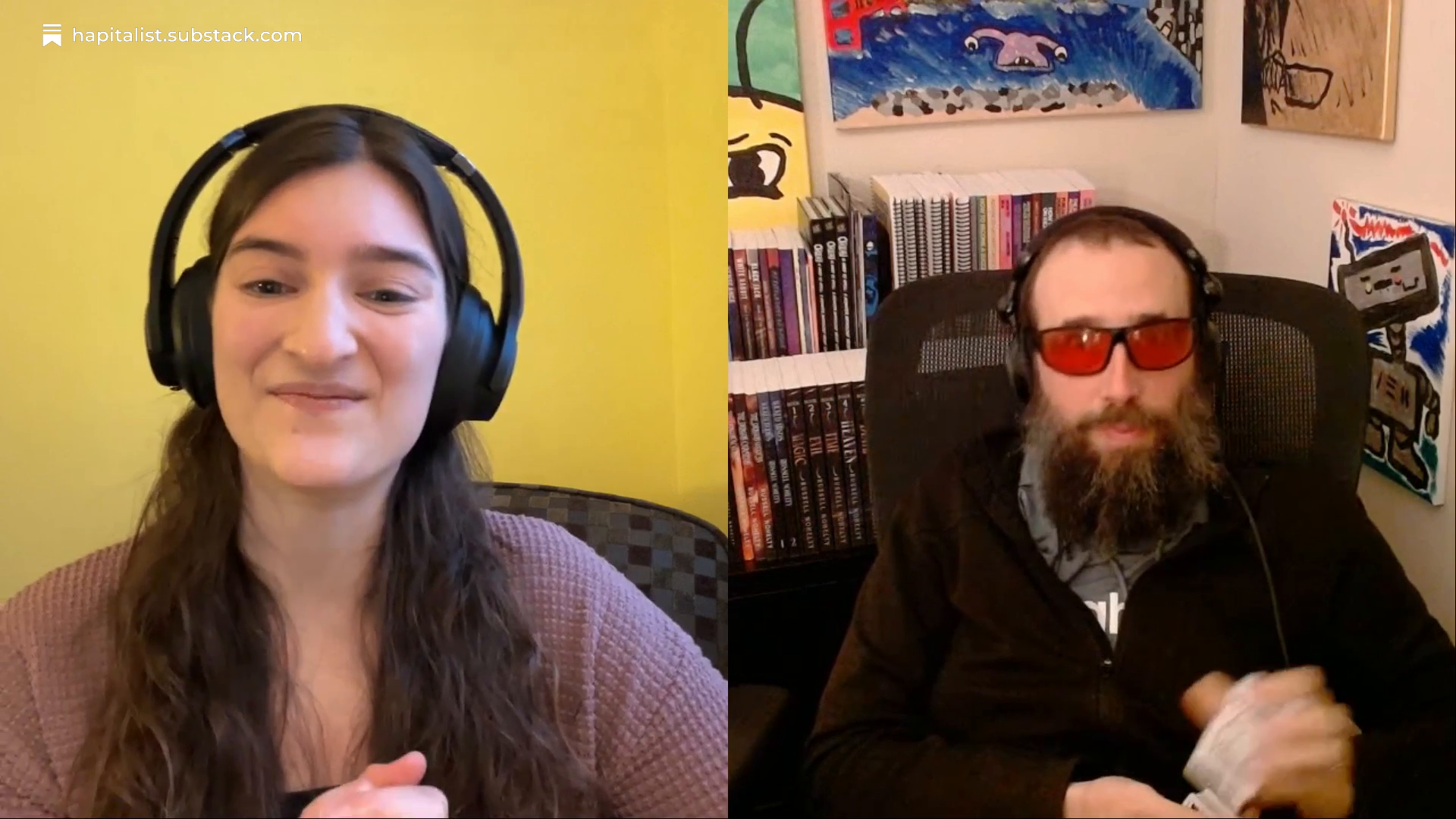
I was a guest on One Brilliant Arc's livestream recently and we went deep on creative freedom, authentic marketing, and the frameworks I use to help writers stop solving the wrong problems.

Hi,

I was a guest on a livestream by my friends at One Brilliant Arc (OBA) this week, and I said a lot of words. Here are some of my best takeaways. I was pretty animated in this one, and I’m still on fire even now typing this bit to you.

Everyone Has the Same Four Problems

Doesn’t matter if you’re publishing novels, drawing comics, running a tech company, or selling tarot decks — the problems are the same. The HAPI Compass breaks them down:

  • H — Project blocks. Things intrinsic to the work itself that you and your team can fix without anyone else’s help. Bad cover. Weak blurb. A third-chapter structure problem. Before you do anything else, fix the thing.

  • A — Audience blocks. You’ve got the right product but you’re talking to the wrong people, on the wrong platforms, or your list was built for a completely different version of what you do.

  • P — Prioritization blocks. Doing too many things, doing the wrong things, doing things in the wrong order. This one’s everyone’s problem, always.

  • I — Income blocks. Your conversion is broken. Not your audience size — your actual sales mechanism.

The reason most people stay stuck is that they misidentify which block they have. And the solutions are often opposite. If you have an audience block, you need to lower the barrier to entry and get more visible. If you have an income block, you need to raise prices and get more exclusive. Apply the wrong solution and you make things worse.

You’re Playing on Someone Else’s Axis

Every platform gives you a set of rules. Substack has one. Amazon has one. TikTok has one. Those rules exist because they maximize the platform’s revenue, not yours.

The problem isn’t that platforms define their own axis. They should. The problem is that most of us just believe it — and play entirely within a game designed for someone else to win.

Your job is to define your own axis. What does winning actually look like for you? What activities give you the best return on energy? Once you know that, you can use a platform without being owned by it.

You Have to Learn the Rules Before You Can Break Them

There’s a version of “going your own way” that’s actually just not knowing what you’re doing. Real creative freedom, like absurdism and surrealism is harder than playing it straight, not easier. It requires that you understand exactly what you’re departing from and why, and that you can bridge the gap for your reader or audience.

Frank Gehry said 85% of what he does is the same as every other architect — gravity, logistics, construction. The 15% is where he has freedom. That’s true in writing, marketing, and building an author business.

You pick your medium, you work within its constraints, and you find your 15%.

Authenticity Has a Practical Definition

Authenticity isn’t a vibe. Here’s how I think about it: Can I sell this for the next ten years without hating my life?

Your books are something you have to talk about for a decade. Your brand is something you have to live with every day. Most early-career authors have no concept of how long ten years actually is.

For me, something is authentic when:

  1. I like it

  2. I get a positive feedback loop from doing it

  3. It flows out of me without a lot of effort to contain

If you have to think about whether something is authentic, it probably isn’t. Your authenticity is you being “back on your bullshit” — the thing your friends recognize immediately as you doing your thing again. The work is figuring out how to make that broadly palatable and position it as a sail, not an anchor.

Chaos Needs a Container

Some people are naturally chaos-oriented. They want to make music and fashion and photography and woodwork all at once. The default advice is “pick a lane.” That advice is often wrong for that person.

The better question is: what container is big enough to hold all of it?

If your chaos spills beyond your monetization structure, that’s a problem. But if you can build a container — a brand, a publication, a body of work — that’s broad enough to be unmistakably you, then the chaos becomes your competitive moat. Nobody else can replicate the specific combination of things you are.

The goal is to plant your flag so clearly that when you pivot or shift or get weird, your audience comes along because there’s nowhere else to get what you offer.

Anyone Can Do It, Even if Not Everyone Can.

Can you make a living as a writer? Yes. Will it look the way you currently imagine it? Probably not.

The math is simple: $100K is 100 people at $1,000, or 300 people at $300, or 4 companies at $25K. The hard part isn’t finding those people once — it’s building a mechanism that keeps finding new ones, because even your biggest fans don’t follow you as closely as you think. (When’s the last time you bought a book from the author who meant the most to you in childhood?)

The goal isn’t to be locked into “books forever.” The goal is to build enough time affluence that you can do what you want, when you want — and then reinvest that into the work that matters most to you right now.

Know What Era You’re In

Growth era or monetization era? These are different modes with different strategies, and you can’t run them both at full throttle simultaneously.

In a growth era: maximize visibility, lower barriers, build the audience. In a monetization era: increase exclusivity, refine conversion, deepen the relationship with the people already there.

The most important thing is honesty with yourself about which one you’re actually in — and what you actually want. Not what sounds good, not what the platform is incentivizing. What do you want right now, and what’s the most energy-efficient path to that specific thing?


One Brilliant Arc is a story coaching and editing service. If you’re working on a story that matters and need help getting it out of your head and into the world, check them out.

If you want to go deeper on any of this framework, everything I covered lives inside Frictionless Growth — which you get free just for subscribing to Hapitalist. We do live sessions twice a month if you want to bring your specific situation.

Discussion about this video

User's avatar

Ready for more?