

Previous Post
For most of indie publishing's history, the bet underneath everything was simple: write a good book and readers will find it. Write a better one and more will. The book was the hard part, the scarce part, and the part that separated the people who made money from the people who didn't.
Everything else was downstream of the manuscript. That bet is now broken, and there's data to show exactly when it broke and what replaced it.
Start with supply.
In 2025, US publishers and self-publishers registered more than four million new ISBN'd titles — up 32.5% in a single year. Of those, 3.5 million were self-published, a 38.7% jump (Bowker via Publishers Weekly). The reason isn't a sudden surge of human inspiration. According to NBER working paper w34777, the spread of large language models from 2022 to 2025 tripled new book releases, and more than half of 2025's releases now contain AI-generated content.
The same paper finds, bluntly, that AI-containing books are lower quality on average and that their rising share is dragging the average quality of all books down (NBER w34777, Reimers & Waldfogel).
The thing you spent a year of nights and weekends agonizing over — finishing a competent book — is no longer rare. The barrier that used to do your filtering for you is gone.
Now, anyone with $20 and a weekend can now generate something book-shaped and upload it next to yours.
So if "write a good book" was the whole strategy, that strategy is dead, not because good books stopped mattering — they matter more — but because good is now the price of admission, not the thing that wins.
When 3.5 million new titles hit the market in a year, being good gets you into the lottery. It doesn't win it.
And before the obvious objection — but my book is actually good; I wrote every word of it myself; it's better than the AI-assembled stuff sitting next to it — notice that being right doesn't save you.
It may well be better. It still won't move your numbers much, because almost nothing that sells a book happens inside the book.
Discovery happens in the metadata: the algorithm that decides whether your book is ever shown reads your keywords, not your prose. The buying decision happens on the product page — blurb, cover, comps — before anyone has read a sentence. A genuinely better book wins you better reviews and word of mouth, but only among the readers who already found it, and finding it is the part that lives entirely outside the text. In this market, a great book that's badly positioned loses to a decent book that's well positioned, every time.
The obvious question is: so what does win now? And here the income data is unusually clear.
The 8% and the 44%
Look at how indie income actually distributes, and you find one of the most lopsided pictures in any creative field.
In the Written Word Media 2025 survey, 44% of indie authors earn $100 or less per month from their writing. At the other end, just 8% earn more than $10,000 a month (Written Word Media 2025, n=1,346).
That survey is self-selected and drawn from authors already on marketing lists, already engaged enough to answer a survey about their author business.
These are the serious indies, and even among them almost half make less than a hundred bucks a month. The true population floor is worse: a median book income of about $2,000 a year across all US authors (Authors Guild 2023, n=5,699).
Whenever you see a rosy "average" indie income, it's usually a mean dragged up by a few big earners — use medians, and the median author is plainly not getting rich on the book.
Now, what separates the 8% from the 44%? Once again, the data answers, and the answer is not talent.
- Backlist size. Authors with 25+ books report a median around $3,000/month, with 40%+ over $5,000. Authors with 1–3 books? Roughly 80% earn under $100/month (WWM 2025). Catalog size is the single strongest income predictor in the data.
- An email list. Authors with a functioning list report a median around $300/month against ~$15/month for those without — a 20x gap. The average list size of authors earning over $10k/month is 18,327 subscribers, versus 902 for those under $100 (WWM 2025).
- Reinvested marketing spend. Top earners (>$10k/mo) spend around $4,500/month on marketing. The bottom bracket spends about $81 (WWM 2025).
The usual disclaimer applies: these are correlations inside a self-selected sample, not proof of cause. High earners tend to have big backlists and big lists and big ad budgets all at once, so you can't cleanly isolate one lever. But step back and the shape is impossible to miss.
Every single one of those differentiators is a marketing and business variable. Not one of them is "writes more beautiful prose." The thing that separates the authors who earn from the authors who don't is not the book. It's the apparatus around the book — the list, the catalog, the positioning, the reinvestment.
The writers aren't losing to better writers. They're losing to better marketers who happen to also write.
And no single book digs you out, because no single book is the engine. For most authors a title earns a one-time figure in the low hundreds of dollars and then settles into a long, quiet tail; income comes from stacking — a backlist where each release pulls readers back through the earlier ones, a list you can launch to, a catalog that compounds.
The high-leverage skill isn't writing one breakout book, it's reliably making each book findable and chosen, then doing it again — a marketing capability, repeated. And it's only getting more on you: Amazon's share of indie revenue has slipped three years running, 91% to 83%, as more authors move to selling direct (WWM 2025), where no algorithm does your positioning for you at all.
There's an encouraging thing hiding in those drivers, though. Most of those levers are slow: a 25-book backlist takes years, an 18,000-person mailing list takes years more. But one piece of the apparatus is fast and nearly free — your metadata.
The blurb, keywords, comp titles and categories that decide whether the algorithm ever surfaces your book cost nothing to fix and can be rewritten this afternoon. It's the one high-leverage lever fully available to an author with three books and no list, and it's exactly where most indies leave money on the table. You can pressure-test your own in a few minutes with a free, best-practice blurb generator or a free keyword tool.
The AI fork in the road
Now braid the two datasets together, because the same force shows up on both sides of the ledger.
AI caused the flood. 50%+ of new releases, output tripled, average quality down. 45% of authors now use generative AI in some part of their work (BookBub 2025). The temptation it dangles is obvious: use AI to write more books, faster. Add to the 3.5 million. Race the bottom.
The data says that's the losing move. When the market is already drowning in AI-assisted products whose average quality is measurably dropping, producing more of it faster is running toward the thing that's commoditizing you. You don't out-flood the flood.
There's a second way to use the same technology, and it's the one the income data points straight at. The thing that actually separates earners isn't book production — it's the marketing layer.
So put the AI there. Use it on the part of the job that's both decisive and, for most authors, genuinely hard and genuinely hated: positioning, blurbs, comps, keywords, categories, the angles, quotes, visuals, the launch assets.
This is also, not coincidentally, the ethically clean lane. The fight over AI in publishing — the 96% of authors who want consent before their work trains a model, the disclosure unease where 74% of AI-using authors don't tell readers (Authors Guild; BookBub) — is about AI writing the prose and training on your prose without permission.
None of it is about you using a model to draft your own back-cover copy. The industry already knows this instinctively: where publishing actually uses AI today, it clusters in marketing, admin, and data work (~29% marketing), not in the writing (BookNet Canada × BISG 2026).
So, the fork is real and the data marks which path is which. AI in the book adds you to the slush pile. AI on the marketing is the cheapest available version of the exact infrastructure the 8% have and the 44% don't.
What to actually do with this
I'll be straight about who's writing this: ManuscriptReport.com is a commercial AI marketing tool for authors and publishers, so read the next two paragraphs with that in mind.
I've tried to make everything above stand entirely on its own. It's built from sourced numbers that cut both ways, and the takeaway holds whether or not you ever touch our product.
Here's the genuinely good news, and it's the symmetry this whole piece has been circling. The same technology that leveled the field — that let anyone produce a book and pushed the market past four million titles — is the technology that can close the gap you've actually been losing on.
The marketing capability that used to take a publisher's whole department is, for the first time, within reach of one author at a laptop. AI lowered the bar to making a book; aimed at the right job, it raises the ceiling on how well a single author can market one. The same wave that's drowning the field can carry you — if you point it at discovery instead of production.
That's what ManuscriptReport is built to do.
It reads your entire manuscript — not a blurb you type, the actual book — and analyzes it against what's genuinely working in your market: the real comps, the positioning, the themes, the metadata layer that decides whether you're ever surfaced. Then it hands back the marketing the book is asking for. It's the read-the-whole-book version of the cheap lever above, done in minutes instead of weekends.
Kevin J. Anderson — author of 170+ novels, including the Dune books — used it for exactly this on the relaunch of a 13-volume science-fiction series, calling the cover-copy and metadata work "overwhelming" and the tool that handled it "clear, useful, and common sense. Saved me tons of time and headaches."
Sample images created by ManuscriptReport for Russell Nohelty's The Sleeping Beauty:
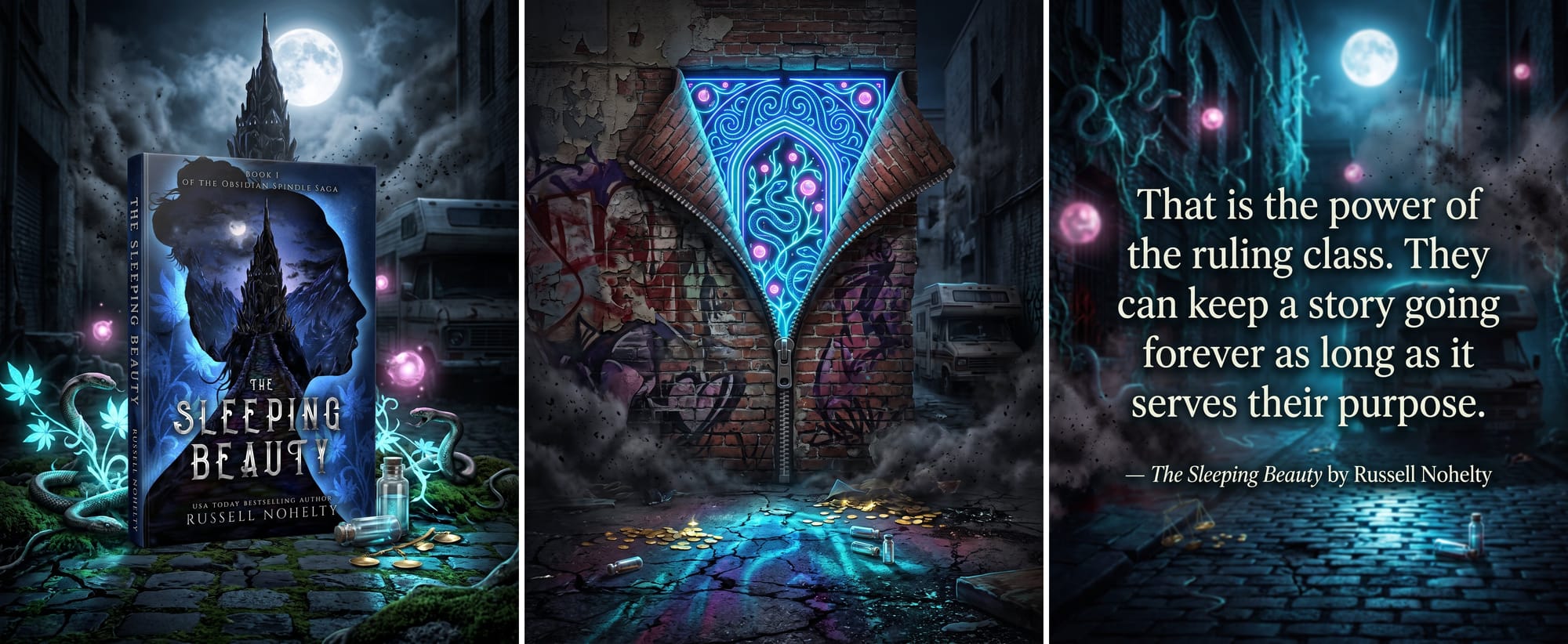
If that layer is overwhelming for one of the most productive bestsellers alive, it isn't a you problem — it's the work, and it's the work the data says moves the money. (Your manuscript is never used to train any model and is deleted within 30 days — the same consent line 96% of authors say they want.)
If you want to look at the full output of ManuscriptReport, I added links to two of the most popular report below. Know that our service handles non-fiction as well as fiction.
- Book Marketing Report - The Sleeping Beauty - Russell Nohelty
- Social Media Kit - The Sleeping Beauty - Russell Nohelty
But the tool is a footnote.
The argument is the thing, so take it even if you take nothing else: stop treating the finished manuscript as the finish line. In this market, with this much supply, the book is the starting line. The race is everything you do after — and the data is unusually clear that almost nobody is running it.