


I was at a conference once when a multi-millionaire speaker took the stage. He was the kind of guy who has already won, multiple times over, by any measure you’d care to use, and he started talking about his YouTube problem.
Basically, he couldn’t get any traction. Even though he had tried everything, nothing worked.
So, he built an AI avatar of himself to make the videos instead. Long story short, the avatar went viral and he turned it into a company with the tagline: Never make a YouTube video again.
The crowd went absolutely nuts at the end, and I just sat there. They talked about it in the halls afterward, and I just looked at them confused, a little sad, and honestly kind of angry.
On one hand, I understood it. What everyone in that room heard was “I found a way to stop doing the thing I hate,” and they recognized themselves in it immediately.
They probably hated making YouTube videos, too, but felt obligated to make them, and here was a guy with a real, clever solution.
He was giving them permission to feel like that obligation was finally lifted…
...except it wasn’t.
He didn’t escape YouTube. He hired a robot to do it for him and built a whole business on top of the premise that you can’t escape it, either.
If anything, he's now more locked into YouTube because he's had "success" there.
Nobody in that room stopped to ask why this multi-millionaire felt the need to dance for an algorithm so much that he couldn't step away. Why did this person feel the need to make YouTube videos at all?
Never make a YouTube video again is the right thesis, but the rest of it is wildly missing the point.
Yes, you could hire a robot to make your videos, but why do you need those videos? You obviously aren’t getting traction on YouTube. It’s clearly something you don't enjoy, so isn’t there some better way to spend your time than thinking about YouTube?
Yes, you might see the first level of your problem, maybe even the second, but every problem in your business exists on three levels.
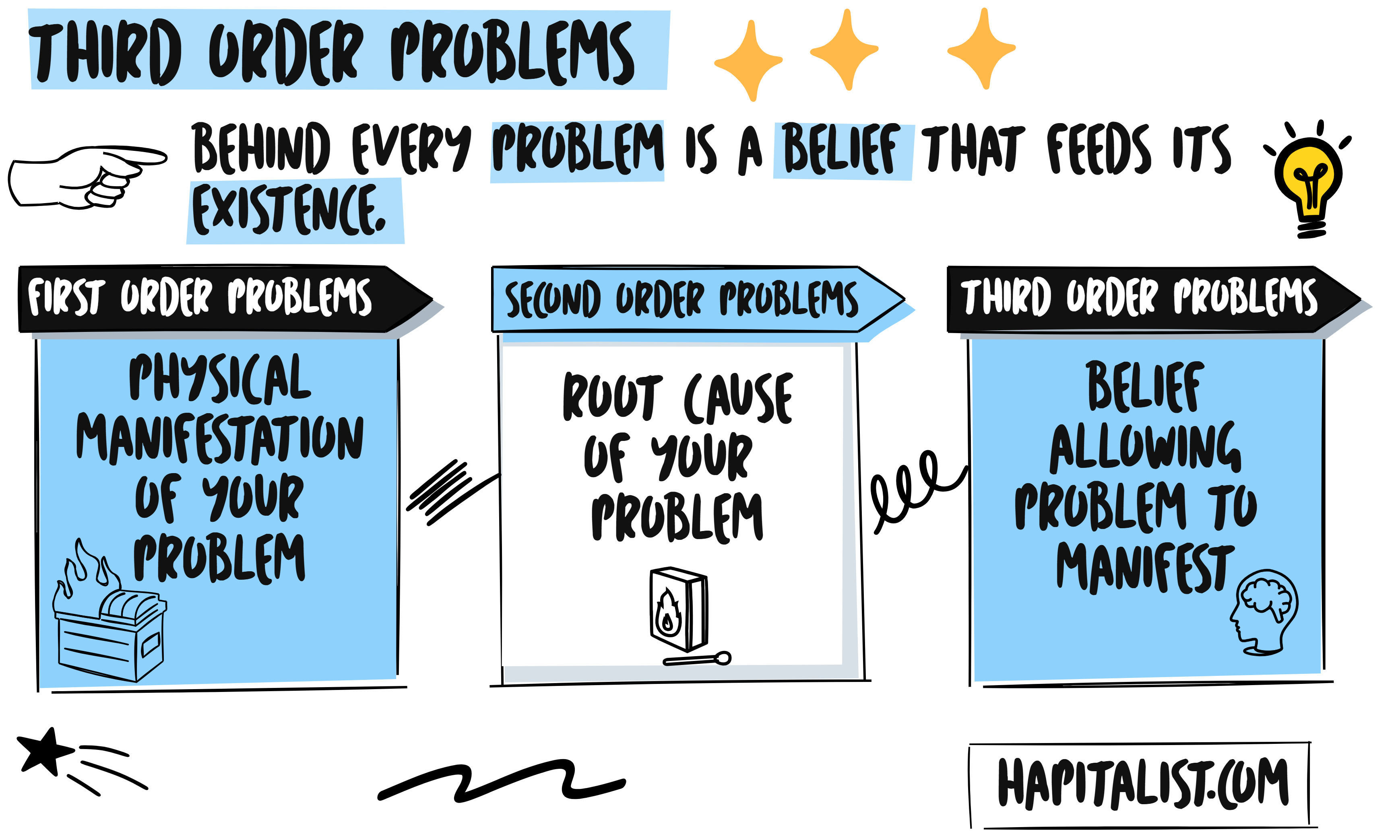
The first level is what’s on fire today. It might be that your YouTube channel isn’t growing, your email list is flat, or your ads aren’t converting. These are first-order problems, and they are loud and urgent and miserable to live with for even a second.
Some might call them pain points.
These problems have entire industries built around them, including software, agencies, consultants, courses, and AI avatars, among many others. They all promise to put the fire out, which feels like an urgent need right now.
So, you buy the tool, hire the person, build the clone, and for a minute it feels like progress…
…until the fire starts again…
…because first-order problems aren’t the real problem. They are the immediate manifestation of your real problems. They are the fire you put out without realizing there's a gas leak under your house.
Underneath every first-order problem is a second-order problem. These are the direct reasons the fire keeps starting no matter how many times you put it out.
All those industries I told you about? At their best, they solve these problems.
For this speaker, his YouTube channel wasn’t growing because he wasn’t using the right script. Once he started using the “right” words and trained his AI to keep doing it, he kept going viral.
Fixing that second-order problem directly solves the first-order problem. Once you fix the problem, that fire stops flaring up, and so you assume the problem is done.
They’re structural, like the gas leak, and fixing them builds better systems and makes everything look better. Yay, YouTube works…
…but why do you need to be on YouTube in the first place? If you love making YouTube videos, then great, but if you are so ambivalent about it that you create an AI avatar, isn’t the real question why your business needs to be there at all?

Money goes where energy flows, and energy flows where you direct it. The easiest way to direct your energy is to control where you spend it...
...and the easiest way to know where you spend your energy is to write it down. This planner is a small way, every day, to manage that direction.
The most important single action in Hapitalist is the 90-day audit, where we take stock of the last quarter, make goals for the next quarter, and track your progress every day.
This is the playbook for that audit.
Third-order problems are the unexamined assumptions your entire business is sitting on top of, often teetering on the verge of collapse.
The tagline from this millionaire’s company is “Never make a YouTube video again,” and like...
...YES! That is the point, but not in the way you think. You could just stop using YouTube altogether, or keep using it but not care how many people watch. That would also solve your problem and ensure you never have to deal with it again.
Then, you wouldn't have to spend money on an AI avatar at all.
Third-order problems are not urgent and usually don’t show up in your metrics, but they are the reason the second-order problems exist, which is the reason the first-order problems keep coming back, which is the reason you keep buying tools that don’t work and wondering why nothing ever fundamentally changes.
This speaker's third-order problem was right there on the stage with him and nobody saw it.
It's like asking, "Why do we use gas at all? Wouldn't it be more economical to clamp off that gas line and switch to solar?"
This man on stage was a multi-millionaire. He had, by any account, already won, yet he was standing in front of a room full of people talking about his YouTube problem like it was a crisis that needed solving.
- Why does a man with that much money feel like YouTube is mandatory?
- What does he think happens to his business if he just stops?
- Why is his business so precarious that it needs YouTube to grow?
Those are third-order questions, and they’re the ones that, if you actually answer them, make the whole stack above them collapse. Fix the third-order problem and the second-order problem disappears, which means the first-order problem never pops up in the first place.
This guy didn’t need a better YouTube strategy. He didn’t need an AI clone. He needed to ask whether YouTube was ever actually the point.
Unfortunately, that question doesn’t get asked at conferences. It doesn’t get turned into a product. It doesn’t make the crowd go nuts.
It’s not sexy, but it sets you free.
So, what’s your metaphorical YouTube?