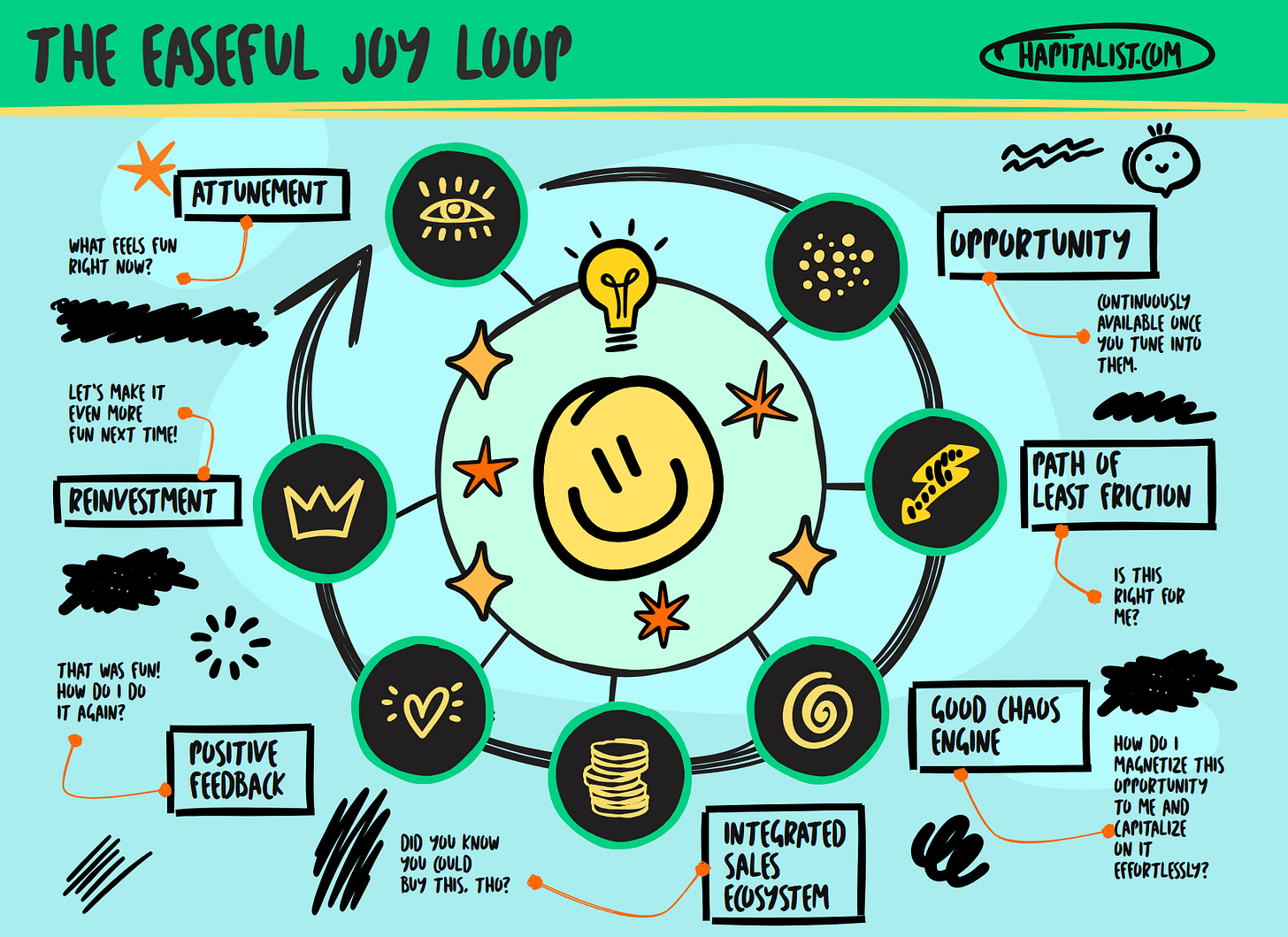
The Easeful Joy Loop
We think that joy follows success, but actually the opposite is true. Success follows joy, and that’s the only way it can ever happen. Even if it could happen the other way, if you succeed without joy you’re stuck in a life you don’t want, or worse, even hate.
Why is this true? When you enjoy something, two things are happening:
- You like the action. That doesn’t mean you’re happy about it, but you at least appreciate it.
- You get a positive feedback loop from it. You put in energy, and more energy than that comes back to you in one form or another.
If, for instance, you go to pet a dog and it bites your leg, you might still love the dog, but I doubt you would enjoy the experience. Similarly, if you’re doing something you hate, I doubt you’d say you enjoy it, even if you’re very good at it.
Both things must be true, and if they are, then you can win. As Emily Sundberg says: “You can’t compete with people having more fun than you.”
Hapitalism is built around the idea that the actions you enjoy are the actions that will also make you the most money.
Not every action you love will work as a business, but there’s at least one little bit inside your heart that does.
In fact, when our business stalls, it’s almost always when we’ve turned away from those actions because we feel guilty things are so easy, and instead do the hard things our Puritan Work Ethic drilled into our head is where real work happens.
The problem is those things that feel like pushing a rock through hummus aren’t working. If they were working, then they would be working. The less something works, the more it feels like work to our messed up brains.
I have coaching calls all the time with stalled creators who don’t know why their business stops working, to which I ask two questions:
- What are the three things you know work in your business? These are almost always things that feel fun to them, and are always inside their zone of genius.
- When was the last time you did any of those? The answer is almost always a long time ago, and usually because they thought it was too easy.
The Hapitalist framework starts with joy as the most important predictor of success. It’s the thing that, when properly channeled, makes the right opportunities find you, the right actions feel natural, and the right results compound over time.
We build your whole business around an Easeful Joy Loop that multiples every time you go through it, producing more and more joy (and money) each time you spin it.
Easeful doesn’t mean effortless. It doesn’t mean you never push through something hard or uncomfortable. It means the overall current of your work is moving with you rather than against you, or even standing still.
When the loop is running correctly, things click, opportunities show up that feel almost too well-timed and he work feels exciting. You finish a project and instead of collapsing, you find yourself thinking: that was fun. How do I do that again?
When it’s not running correctly, you feel that too. The same amount of effort produces less, and opportunities feel like obligations. You’re executing the right moves on paper but something’s off underneath.
The difference in actions that work and ones that don’t is called your Return on Energy Investment (ROE). This more you spend in your highest ROE activities, the more effortless your business feels, and the faster your Easeful Joy Loop spins.
The Three Dimensions of a good life
To understand what the Easeful Joy Loop is optimizing for, you need to understand what “joy” actually means in this framework. In their book Life in Three Dimensions, researcher Shigehiro Oishi identified three distinct dimensions of a good life, and all three matter:
- Happiness is the felt quality of your life. This comes from how good it feels from the inside, moment to moment. It’s warmth, pleasure, ease, delight. It’s the stuff that makes you smile while you’re in it.
- Meaning comes from purpose, coherence, and significance. It’s the sense that what you’re doing matters, that it connects to something larger than the task in front of you, and that your life is building toward something worth building toward.
- Psychological richness is the dimension most people overlook. It’s variety, complexity, and perspective-shifting experience. It comes from a life that is interesting; not merely pleasant, not merely purposeful, but genuinely surprising and alive.
Through this, we’re producing a process to notice, identify, and capitalize on opportunities that fit at least one of those three dimensions without overindexing on any of them.
Happiness without meaning or psychological richness becomes hollow and fragile. It’s pleasant on the surface but ultimately unsatisfying, like a life lived in a comfortable bubble that never really goes anywhere or means anything.
Meaning without happiness or psychological richness becomes martyrdom. It’s a life of relentless purpose that grinds you down, where you’re so committed to the cause that you forget to actually enjoy being alive or let anything surprising in.
Psychological richness without happiness or meaning becomes novelty addiction. You end up chasing the next interesting experience, perspective shift, or rabbit hole, but never feeling good or building toward anything that matters, just a collection of moments that don’t add up to a life.
Too much of even a good thing is not good, so the quest is for balance. From this, we develop our own Easeful Joy Loop.
The stages of your Easeful Joy Loop
Admittedly, this next part is going to have a lot of Hapitalist jargon in it. I’ve tried to link out to the bits that need more explanation. If you get confused, just let it wash over you. This is more vibes than anything, and there’s a cool graphic at the bottom that explains it all.
Stage 1: Attunement
Before you can find the right opportunities, you have to know what “right” feels like for you at this time in your life.
Attunement is the practice of checking in with yourself honestly: What feels fun right now?
This comes from radical acceptance, stopping negative self-talk, acknowledging what you actually want, and what kinds of opportunities will lead you there. Most people have no idea what their body and mind are trying to tell them, which is why this step is necessary.
Even if they correctly attuned themselves once or twice in the past, most creators and entrepreneurs are running on a plan they made six months ago, executing against goals that made sense when they set them, and ignoring the quiet signal that something has shifted. Attunement is how you catch that signal before it becomes a full system breakdown.
Stage 2: Opportunity
Once you’re attuned, opportunities become visible that weren’t before. Actually, they were always there, in infinite supply, but you weren’t attuned to them. We spend so much of our lives talking about what we can’t do, that it’s impossible to see what we can.
This isn’t magic, it’s focused intentional attention. When you know what you’re actually looking for, you start finding opportunities everywhere. The question is whether those opportunities are right for you, which is why you have to know where you’re headed. It’s about holding tightly to the what you want, and loosely to the how you get it.
Stage 3: Path of least friction
Not every opportunity that excites you is the right one. This is where you apply the path of least friction methodology to determine whether an opportunity is a good fit for you at this point in your journey.
Once you detemine your SCALE path, your Ecosystem, your Evolution level, and your major HAPI Compass block, you’ll know, at least in vague terms, what kinds of opportunities are good ones.
The more times you go through a joy loop, the more you’ll be able to hone that instinct inside yourself.
Since you have attuned yourself to where you want to go, you should be able to figure out if it’s a good idea or not to move forward. Side note: This is why you always want to be underleveraged, so you can hop on these experiences when they pop up quickly.
Stage 4: The Good Chaos Engine
Up until this point, you’ve laid the groundwork but you haven’t actually gotten anywhere.
The Good Chaos Engine is how you magnetize an opportunity to you and capitalize on it effortlessly. This is the methodology, branding, and rituals you set up inside your business so that when somebody comes into your ecosystem there’s no doubt whether they belong or not.
It’s about setting up your winning axis and crafting a story where you are the only logical choice for your ideal customer’s transformation.
Stage 5: Your Integrated Sales Ecosystem
Now that you have your engine moving, you need money to keep it running tip-top. This is where your Integrated Sales Ecosystem comes into play.
Using a combination of subscriptions, crowdfunding, catalog, website, and in-person sales, you create a world where you’re bringing somebody into your system once and allowing them to monetize in different ways. Some people will buy through multiple channels, but not everyone.
Having a wide-range of profitable sales channels that amplify each other without taking exponentially of your time gives you the most leveraged use of your time, giving you the space to serve your audience, and yourself, in a multitude of ways.
The goal here is to create a universe where you perform one action and get exponentially more value from it over time. Most entrepreneurs have the opposite problem. They exponentially increase the things they need to do and get incremental (or no) gains from them.
Stage 6: Positive feedback
Once you get a customer through your Good Chaos Engine and Integrated Sales Ecosystem, you should have created a bunch of positive feedback from the experience. If you didn’t, then it’s time to go back and tweak so you can do it better next time.
Remember, this is a loop, so you can cycle through it as many times as you want. With each rotation, you should be making tweaks so that the system becomes more efficient, creates more joy, and amplified you more and more.
Positive feedback isn’t just external like sales, comments, shares, and responses, though those matter. It’s also the internal feeling of finishing something and knowing it was good, the sensation of work that landed, and the moment where you think that was fun.
Stage 7: Reinvestment
Once you’ve gotten your feedback, this is where you’re taking what you learned and making your loop better and more efficient. This might include a reinvestment of money, but I’m mainly talking about a reinvestment of energy in the broadest terms. Money is one kind of energy, but so is time, effort, and attention. Everything is energy, and it’s about giving the loop what it needs to succeed.
Then you attune again. And the whole thing runs forward for another cycle. Usually, you get a lot of things wrong the first time, and that’s okay. You might be wildly wrong in how you attuned yourself, or how you evaluated opportunities. Just be as kind to yourself in failure as you are in success.
Remember, the loop is always running.
The question is whether it’s running properly for you. A hundred creators will set up this loop in completely different ways. What matters is whether it amplifies your joy.
This is supposed to make your business easeful, not easy. We’re looking to avoid any unnecessary friction, but running a business is always going to be hard in a million different ways. Start where you are, do what you can, and make it through one cycle.
Then do it again, a little more effortlessly this time.