

Previous Post
It’s easy to say you don’t care about winning a gold medal after you’ve already won it. But watching how easily and effortlessly Alysa Liu moves through competition, and life, makes me believe she really means it.
When you’re looking for somebody who exemplifies what I call the “Hapitalist” way, look no further than her entire vibe. While Liu claims she doesn’t consciously know the strategies she uses to achieve this kind of outcome independence, if you listen to enough of her interviews, you’ll see a clear pattern emerging—one that entrepreneurs can learn from and apply to their own business careers.
So, what does Alysa Liu do differently?
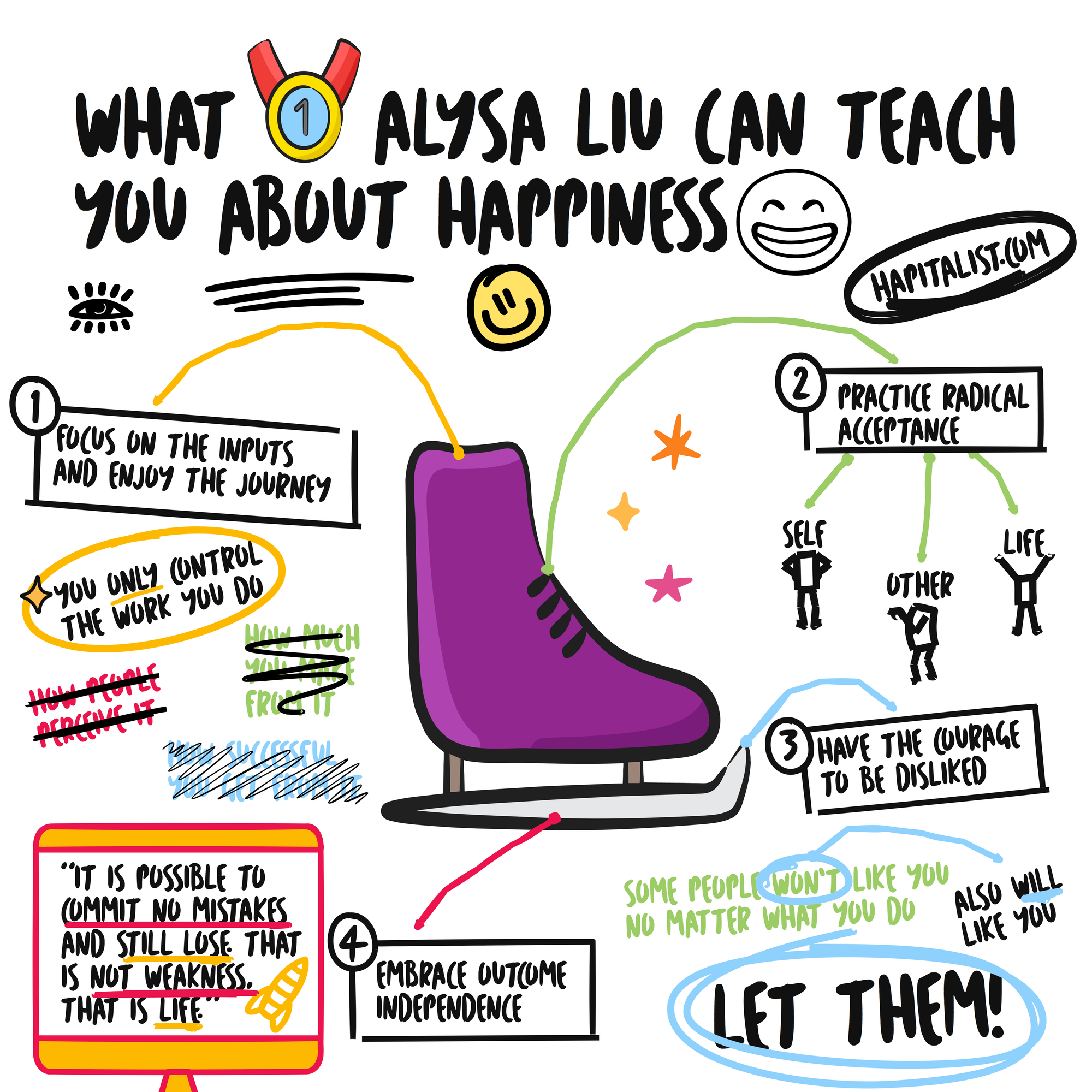
1. She focuses on the inputs and enjoys the journey
I heard her talk about this in an interview after her gold medal win, and it’s so true.
The key to “thinking quantum” as an entrepreneur is letting go of the outcomes. We’ve been taught to think Newtonian for our whole life. Newtonian thinking at its core claims success is linear, predictable, and comforting. That “if I check all the boxes, success should arrive right on schedule.”
Success doesn’t happen like that, though, for almost anyone. The more success you get, the less control you have over the outcome. You can control what you do and put out into the world (to a point), but not how it’s received or whether it will be enough to “win”.
When you’re competing for a gold medal, literally every move you make could send you from the medal stand into the nethers of the rankings. In situations like that, we have two choices; beat ourselves up over every microscopic flaw, or realize that even getting there is a gift and enjoy the journey.
As entrepreneurs, we face this daily. You can control the work you put out into the world and how you move through your creative process, but you cannot control what customers think about it. You cannot control whether your product becomes a bestseller or languishes in obscurity, only how much effort you put out and where. You cannot control whether that investor says yes or that reviewer is kind.
You can only control the work itself, and your relationship to it. You can make it the best you can given the limitations given you, and trust that the right people will resonate with it.
2. She practices radical acceptance
In another interview, I heard her say that the key to her mindset was radical acceptance, which is something I talk about all the time. People get this concept wrong all the time. They say things like, “How can I accept injustice in the world?” or “How can I accept that my product failed?”
That’s totally missing the forest for the trees. The point is not to approve of what’s happening. It’s that you accept the things that are happening are actually happening. You accept reality as it is as you work to change it.
There are three kinds of radical acceptance, and you need a combination of all three to get into Liu’s headspace.
- Self: Accept who you are right now, not who you’ll be in five years, not who you wish you were, but who you actually are today.
- Other: Accepts that judges, competitors, and audiences are going to think what they think, regardless of your intentions or desires.
- Life: Accepts that conditions, the circumstances, the judging panel, and countless other factors beyond your control will impact your score in ways you cannot predict or prevent.
This doesn’t mean Liu becomes passive. It means she stops arguing with reality long enough to work effectively within it.
3. She has the “Courage to Be Disliked”
I’ve heard her in enough interviews blow off people who dislike her with comments like “I can’t stop them from thinking that” or some form to know the courage to be disliked has to be somewhere in that operating system somewhere.
People will think a certain way about Liu whether she wants them to or not. The courage to be disliked is about letting them think what they think.
This concept was famously captured by Cassie Phillips in her 2022 poem “Let Them,” before being popularized by Mel Robbins. My favorite exploration of it, though, comes from The Courage to Be Disliked by Ichiro Kishimi and Fumitake Koga.
For entrepreneurs, this is essential. Someone will hate your product. Someone will leave a one-star review. Someone will say you’re a hack, a fraud, not a “real” entrepreneur. Someone will think your success is undeserved, or that your failure proves you never had what it takes.
Let them. Their thoughts about you are not your concern. Your concern is the work, and your relationship to it.
4. She embodies outcome independence
Captain Jean-Luc Picard famously said, “It is possible to commit no mistakes and still lose. That is not weakness, that is life.”
Even Liu’s best performances are never guaranteed to win. The difficult technical elements she cares most about are sometimes overshadowed by skaters with more theatrical programs that are more palatable to certain judges.
She can skate the most profound, beautiful, technically perfect program of her career and watch someone else win while her routine gets scored lower.
Alysa Liu won gold with 150.2 points. Meanwhile, H.I. Lee scored 140.49 points and placed 8th.
On another day, with different judges, different ice conditions, different atmospheric pressure in the arena, Lee might have won. That is not failure. That is life.
On February 19th, 2026, in this version of reality, 150.2 points won the gold, but the next time will be different as different elements collide to form a new reality.
The same is true in entrepreneurship. Your product launches on a specific day, in a specific market, competing with specific other products, being discovered by a specific subset of customers who are in a specific mood when they encounter it.
Change any of those variables, and you get a different outcome. You can build the same product, do the same marketing, put in the same effort, and get wildly different results based on factors entirely outside your control.
What Liu’s approach actually means in practice
None of this means that we don’t get upset when things go sideways. None of this means we never fall into old patterns of anxiety, control-seeking, or outcome-obsession.
It means that we understand and accept that we don’t have control over most of the things that happen to her, and that’s okay. When we gets into bad patterns, it means we can get ourselves out of them, and fall into them less often over time.
The practice is in getting slightly better at returning to what we can control: the work, and our relationship to it.
The Hapitalist path forward
This mindset and the entire approach that Liu embodies, is the crux of what I teach in the Hapitalist methodology. It’s about optimizing for joy and making money doing it. Not one or the other, but both.
It’s about understanding that you can have a successful entrepreneurial venture without sacrificing your mental health, your relationships, or your basic sense of human dignity.
It’s about learning from athletes like Alysa Liu, who somehow manage to perform at the highest levels while maintaining that ineffable quality of lightness, of not being crushed under the weight of expectations and outcomes.
You can put this into practice in your own entrepreneurial venture. You can cultivate outcome independence while still working toward your goals. You can care deeply about your work without being destroyed when it doesn’t perform as you hoped.
That’s not just possible, but essential because this career is long, and if you can’t find a way to be happy and successful at the same time, you won’t make it to the end with your soul intact.
Let Alysa Liu’s vibe be your reminder: the work is the point. The journey is the point. And everything else? That’s just points on a scoreboard that will be different tomorrow anyway.
What do you think of her vibe? Let us know in the comments.