

Have bots killed emailed, or are they just harming it irreparably?
The enshittification of email is here, and we're so far past the rubicon it has disappeared across the horizon.

Hi,
I did a livestream with Mal Cooper this week, and we got to talking about open rates. I told her how I had been pruning my list and she said “Oh, I never do that.”
Why? To paraphrase:
“Because the people who open your emails probably aren’t getting tracked, and the ones who do are probably bots.”
Did you know:
If you open on Apple? Platforms don’t track that.
If you forward your emails to another address? Platforms don’t track that well.
If you have images turned off? Platforms can’t track who opens.
If you have spyware? Then it usually comes across as opened even if the recipient never sees it.
Back in my Action Fantasy Book Club days, Andy Peloquin and I had a Sendfox account that only let us send to “optimized people” who were engaging.
Sounds great in theory, right?
…except there were people we couldn’t send to who were definitely buyers (and recent) while there were people we could send to who we knew were 100% bots.
Sendfox didn’t care. Think about that for a second. They didn’t care their platform was siphoning off real humans. Do you know how bonkers that is for an email platform?
It’s hard to fathom what kind of platform would make that calculus unless they only cared about vanity metrics.
We eventually ended up moving to a different platform at significantly higher costs.
It was the first time I ran into that specific problem, but it it tracks an experiment I’ve been running for a while now. Over the past year, I’ve identified and culled 21,000+ people from my list who didn’t open.
That’s a lot of people to cull, but I didn’t delete them outright. I’ve been running tests for several months to try and reengage them on different platforms to find out if they actually do exist.
From those tests, I’ve been able to pull several thousand subscribers back onto my main list.
You can see from this graph that the last year has been a rollercoaster. We’ve gone from 55,000 subscribers down to 42,000 up to 46,000 down to 31,000 and then up to 34,000 as I’ve culled, added, culled, added, culled over the last year.
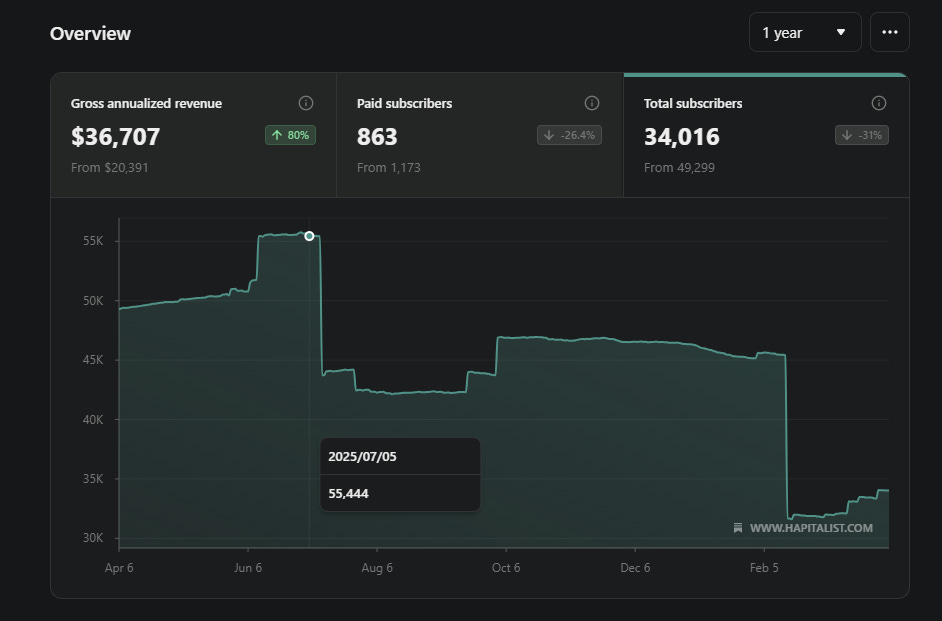
By this point in the story, there are 12,000-ish emails remaining that:
Kit doesn’t show as opening
Multiple Substack accounts don’t show as opening
Mailblast didn’t show as opening
Over the last month, I’ve brought those remaining 12,000 emails onto a “secret” Substack account to see if any of these would show up as opened if I just moved servers on the same platform.
I expected that since multiple Substacks didn’t show any of them as opened, this one would play the same tune. And yet…roughly 5% of people on this list now show up as opening every week.
Just look at this:
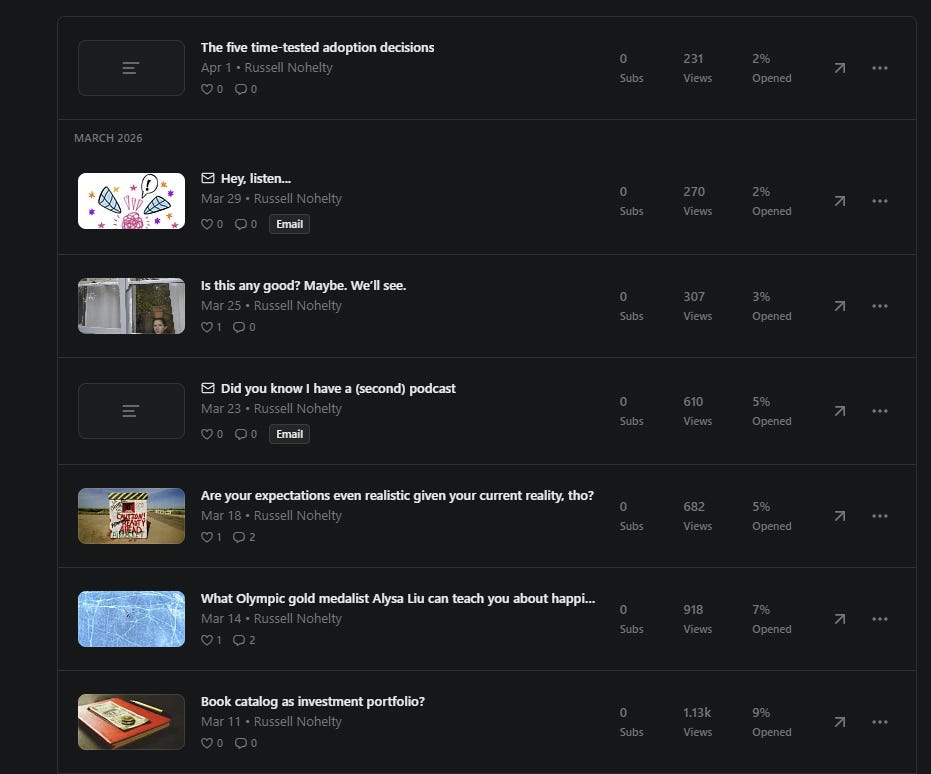
Now, you might say “Obviously, Substack is showing the same 5% as opening…”
…except that after each email I pulled the people who opened back onto my main list and deleted them from this account.
What remained after each email were people Substack showed didn’t open anything from me ever.
No matter how many people I take off this list, 3-5% keep opening every week, which doesn’t make any sense…compels me though.
Over the past month, I’ve added 2,000 people back to my list who showed up as opened in my secret account…and when I do they still don’t show up as opened over on Hapitalist.
Do you know that that means? It means the internal system at Substack isn’t even accurate across publications.
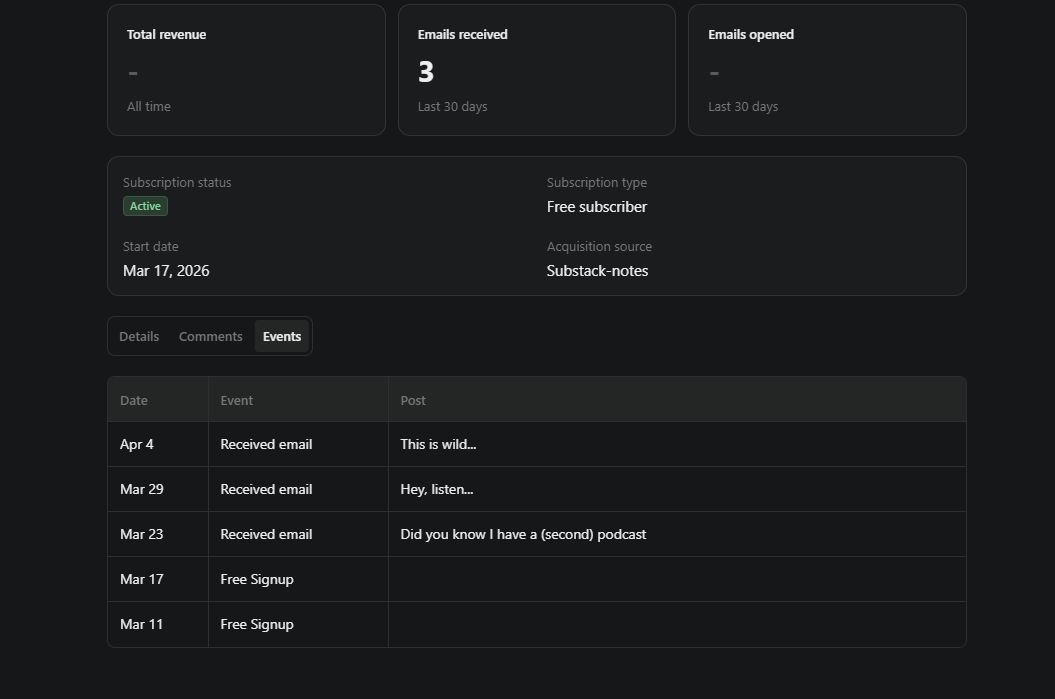
To add to the weirdness, I got two replies to an email I sent yesterday with vastly different metrics. In one, even though the person clearly opened the email because they replied to it, the system showed they didn’t.
The other shows they opened 12 times!
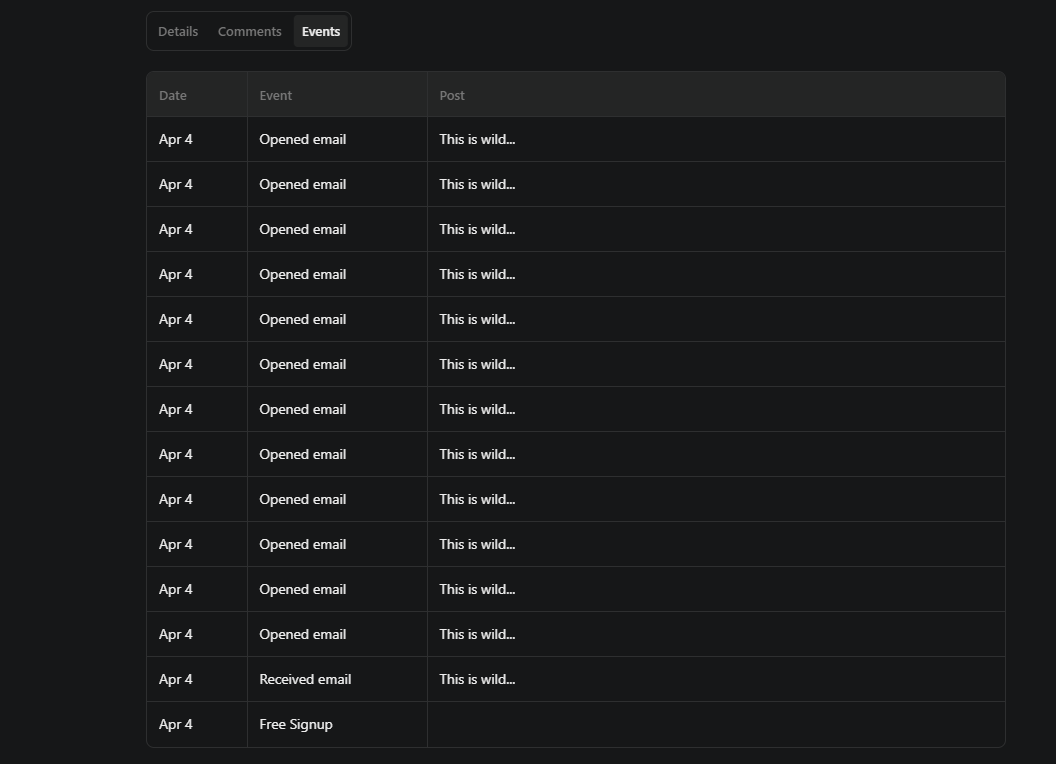
I doubt either of them are true indications of what happened with these subscribers, which vexes me.
I admit that I’ve been doing this so long that I’m stuck in the “old way” of thinking about opens from back in 2019 when only 5% of opens were attributed to bots, and the universe made some type of sense.
Now, with the changes to how platforms count emails, and given that something like 50% of opens are now attributed to bots, it’s just a different world than I’m honestly comfortable playing in much of the time.
On one hand, if you don’t cull your list then you’ll be opening yourself to spam traps and deliverability issues. On the other, if you do cull your list, then you’re obviously dropping people who actually open your emails.
Worse, you’re likely dropping real people who open your emails, and keeping bot accounts just because they accurately give off signals to platform bots that indicate opens.
The internet is becoming nothing but bots talking to bots, with humans being cut out of the mix.
I’ve generally been pretty pro-technology in my life, and even hosted two events called The Future of Publishing, but the deeper I fall into this issue, and the more I track things like OpenClaw, the more I believe we are so far past the event horizon where technology does more harm than good that we can’t even see the line anymore.
Yes, agentic AI is cool, but now that both OpenAI and Claude have cut off unlimited access to them, and you have to pay for most usage, will it be cheaper than hiring an assistant? Will it take less time? Will it improve your life?
I vibecoded an app in Claude a couple weeks ago.
I got about 10 hours into the project before I realized:
I had to host it myself.
I had to update it myself.
I had to do customer service.
I realized there was probably a place that could build me an interface, found one, and then realized I had no interest in an interface and neither did anyone in my community.
It was a fine experience for me, and I was impressed at how quickly I could do it, but once I dug into the nitty-gritty of it, I had no interest or need for it.
This summarizes how I feel about most new technology. Cool, but does anyone really need it?
We used to make genuinely useful technology. Now, we often end up breaking useful technology and then creating new technology to fix what we broke (at significantly higher costs to the consumer).
The current creator economy flywheel looks more like a Rube Goldberg machine than a functional mechanism for growth. It used to be you put something in somebody’s hand or sent an offer into their inbox and they bought it or didn’t.
Now, you have to make a Zap with 50 steps in order to even find that person. This complexity is great for Zapier, who gets to charge for every step in that process, but kind of terrible for every other human.
Then, you have to spend a fortune on ads, that go right into the pockets of billionaires, to make sure they don’t forget about you before the next time you launch something.
I see benefits for AI, including generative AI, and know there are accessibility issues that these technology address which are revolutionary to many people, myself included.
It is genuinely cool than my friend’s 10-year-old can vibe code a video game, but does a 10-year-old need to make a video game? Does everything need to be available to every human on this planet every second of the day?
The AI doc makes the point that the good and bad of every technology are intrinsically linked and can’t be separated. We have to take both or neither, and we have always opted to take both, which has made us prosperous in ways previous generations couldn’t even fathom.
It also makes us believe technology is the answer without ever asking the answer to what or who even posed the question. It’s also pulled us further from human-centered design and forced us to do more and more to “compete”.
We spend a lot of time demonizing the Coral Harts of the world without ever asking why a writer feels the need to release dozens of books a year in order to compete.
We are told that we’re competing against everything bombarding people’s brains without stopping to ask why that is happening.
Why is that competition our responsibility? Why is it our bane? Why is it that we have to exponentially increase our output in order to keep up with technology when technology is the thing facillitating that exponential expansion?
I don’t like keeping up with the Joneses. I tend to run in the other direction when they come around.
I’m unconvinced that AI models will become cheap enough to make agentic AI work effectively in the near term future. It only works now because these platforms are massively subsidizing the cost. Ed Zitron wrote an amazing article on this “subprime AI crisis” recently.
Even if it does “work”, I just fundamentally think humans should talk to other humans for most things. I don’t want to send this email to bots, even highly engaged ones.
It is in the brilliant inefficiency of humanity that magic happens you could never predict or expect. If you take that away, we are just robots, which is the exact opposite of magic.
This is especially true when it comes to email. I fundamentally don’t want Gmail summarizing my 10,000+ word email so you can read it in 10 seconds. That’s not how any of this is supposed to work. It literally breaks the experience. If I wanted you to get a summary of the post, I would write a TL;DR at the top of it.
Speaking of the top, let’s come back to the main question I posed. Do we cull or not? It’s 50ph13’s (Sophie’s) choice.
Keeping people who are dead, or have abandoned their email address, can’t possibly be the right answer (and opens you up to spam traps), but there’s literally no way to get those people off your list in any realistic way that doesn’t also boot off people who want to be there.
This is a worse place to be than six years ago. If technology is supposed to progress us, then why are we moving backwards in such a fundamental way?
Email is a stupid simple technology and that’s why it works.
Maybe ESPs don’t care because more subs means more money for their bottom line, even if their customers have a markedly worse experience.
It’s enshittification at its core. There is no value in keeping us happy as the users, so their loyalty is no longer to us. It is to the shareholders, who only care that we keep giving them money…not that we’re actually happy.
Most of us don’t even know this is happening enough to know we’re not happy. We just see open rates dropping and think it’s our fault. We see engagement slowing and think we’re the problem.
But what if we’re not the problem? Recently, I contacted Substack support because in the past two months I’ve gone from 100-200 recommendations a week down to 100 or so a month. I thought that maybe it was because I changed my subdomain.
This is the response I got from them.

I don’t know the reason for the “slowdown” but many have posited that it’s because Substack is prioritizing followers and Notes for growth instead of the recommendations feature, which makes it markedly worse for everyone involved, at least on the publication side.
We’ll never know if that’s true, but the fact it could be true, and that it feels at least somewhat true, supports the idea that these platforms are a black box we don’t understand, and have too much control of our lives.
You might think: “Why are you complaining about this, Russell? I would kill for 100 recommendations a month.”
And yes, that’s the point. Because I used to get a lot more, I had the scale to see the massive slowdown. Most people wouldn’t even notice going from 10 recommentations a month down to 5, but I saw it.
You’ll see this graph is Substack subscriber growth from the organic network and recommendations over the past year.
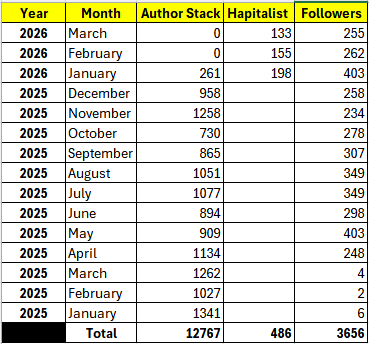
Compared to March last year, I have a 90% drop in subscriber growth. This might be because I changed categories from fiction to business, but I recently changed it back for a week, and saw no change in subscriber growth.
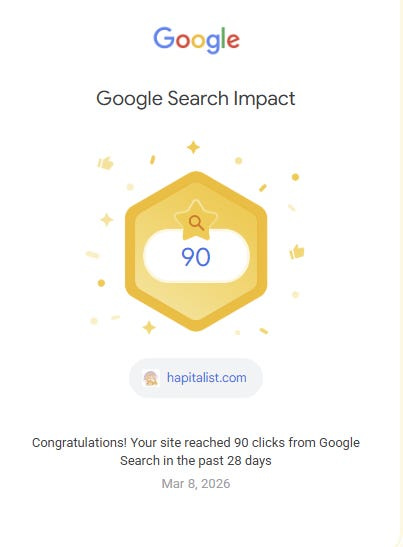
It might be because SEO dropped like a rock. You can see this is March 2026.
This is January 2026.
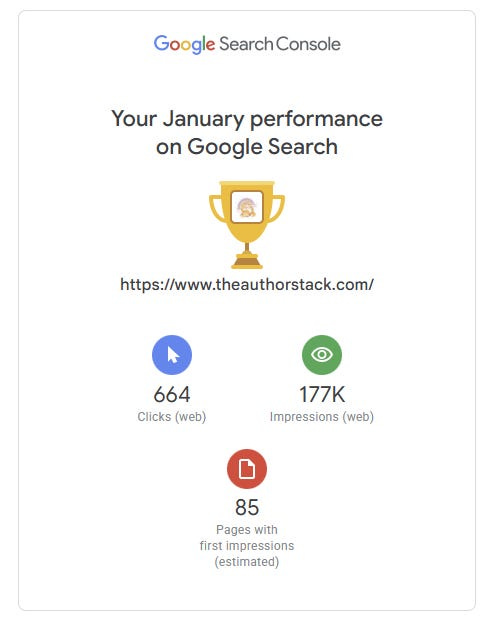
That’s a marked difference, but that’s not enough to really warrant the discrepency. It could cause part of it, but I still have 649 recommendations from other publications.

The only way to really explain it is if the whole of the network slowed down at once, which is something that really only happens systemically.
Are people leaving the network?
Are people just over Substack?
Have they stopped trying?
I don’t know, but it certainly sucks. I pay Substack 10% of my revenue, roughly $3,600/yr, and yet it works worse for me now than it did when I paid them nothing, which is a problem.
All of this is a problem. This whole email situation is a problem. I didn’t expect to pull so many threads into this one post, but as I kept writing more and more of this started to make sense to me.
Really, there is an enshittification of email happening at a systemic level, and I don’t know what to do, except be really pissed about it. There are no good choices, just slightly worse and slightly better ones, with us in the middle, getting screwed.
Thanks, I hate it. So, what do you think? Am I just complaining, or is there a there there? Let us know in the comments.

I think you just described a symptom of late-stage capitalism.
Since switching to Ghost, I saw my open rates go up almost double what they were on Substack, but since I have to pay per subscriber, I do cull my list every quarter. I filter people who haven't opened a single email or clicked, then email them to ask if they still want to be on my list. The first time I did this was eye-opening. Quite a few said they use an email provider that doesn't track opens, like you mentioned. Others said they read via an RSS feed. Many bounced back because the email was inactive or inbox was full.