


Previous Post
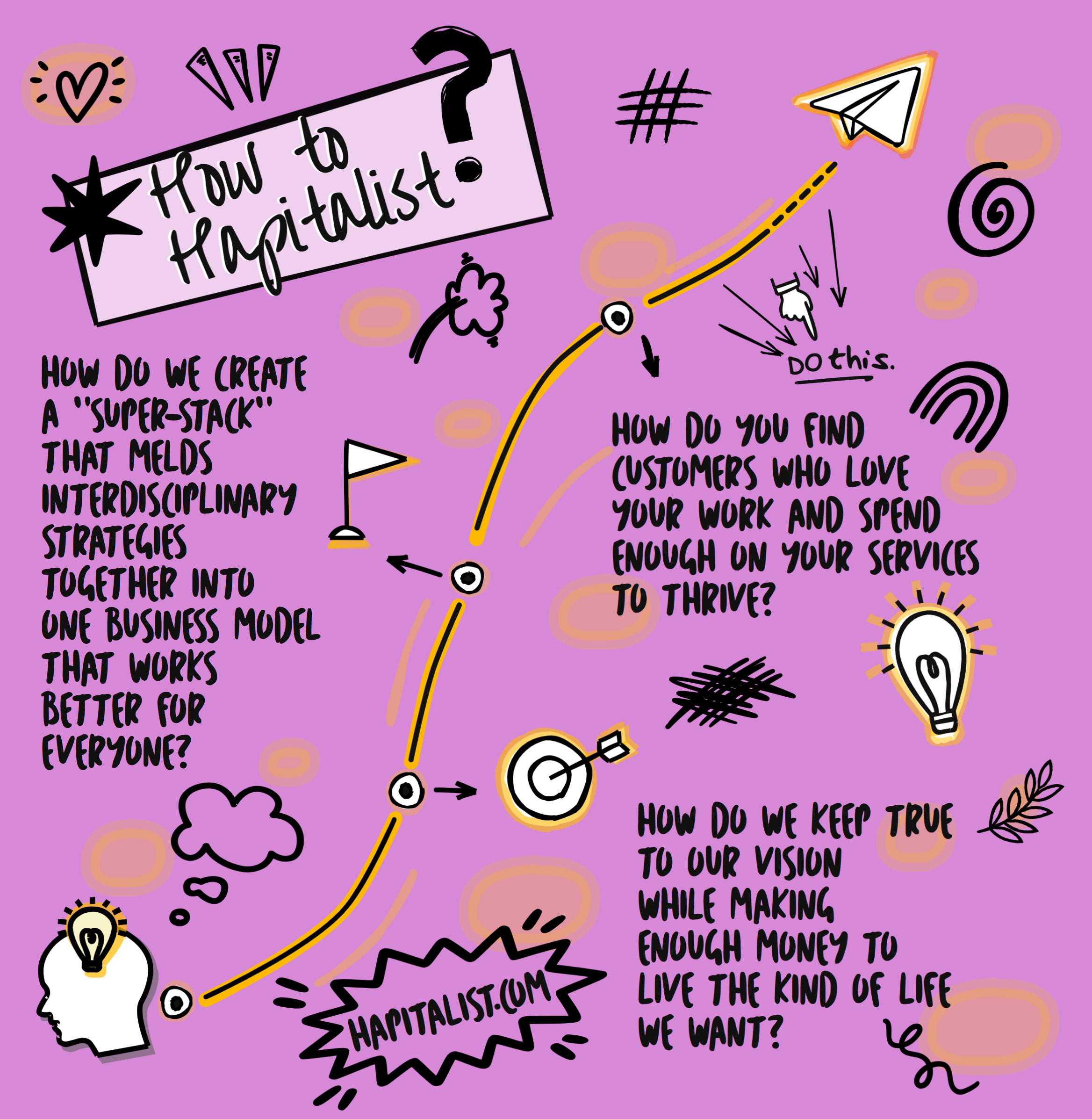
I’ve written a lot about growth in my career. So much that it often paralyzes people from taking action. While we have loads of books and frameworks, I’ve been trying to collect my most powerful concepts together into one place to help you stack processes on top of each other to generate outmoded success.
I believe that most entrepreneurs, at the end of the day, have a sequencing problem. They are trying to do step six before step two and after step twelve. If we could just get entrepreneurs to take these challenges in the right order, than each would build on the last to amplify each other. Instead, what happens is that their process often negates their previous effort, forcing them to start over and they lose all the momentum they built up.
If instead we can sequence our careers correctly, then we would keep gaining momentum over time, and be able to get to success faster.
This article is my best attempt at getting you the correct sequence of events to think about to get you to success faster and to stop spinning your wheels. Much of it is compiled from other articles I’ve put out recently, but there’s a lot of new and bulked out content as well.
If you’re a paid member, you get access to our Hapitalist Quick Start Workbook by scroll to the bottom or clicking here.
1. Sustainable productivity vs. sustainable monetization
If you’ve been in entrepreneurship for any length of time, you’ve probably heard people talk about “sustainability” in order to prevent burnout. The conversation around sustainable productivity and slow growth often emphasizes the personal benefits of aligning work with natural rhythms and patterns, such as reducing burnout, enhancing creativity, and fostering a healthier work-life balance.
Entrepreneurs are encouraged to cut back, focusing on quality over quantity, and to create in ways that are more attuned to their personal energy levels and creative flow. This approach can lead to a more fulfilling and sustainable process, where the pressure to constantly produce is replaced by a more mindful and intentional pace.
However, what often gets overlooked in this discussion is the impact that sustainable productivity can have on income. When you slow down and produce less, especially in industries where output is directly tied to earnings, there can be a significant reduction in revenue.
If you drop your output to something you can sustain, then you have to figure out how to make up that drastic reduction in revenue or you’re just going to replace burnout of one type with burnout of another type.
You can’t sustainably create if you can’t sustainable monetize.
We usually talk about sustainable productivity as a function of our own work, but sustainable monetization requires a broader thought process. It should take all the stakeholders into account, including the ecosystem of other entrepreneurs, and customers, and platform, who collectively work together toward creating an environment that is mutually beneficial for all parties.
Unfortunately, the world is not set up to work that way, and neither is capitalism on a broader scale. It’s set up so that every person is incentivized to maximize their own needs while giving the least to the collective as possible.
This is incredibly short sighted, and why America’s infrastructure is crumbling. Collectively, we can build enough leverage into society to land on the moon. However, if we don’t all contribute a little bit, we don’t have enough to fill the potholes on main street.
In today's society, we celebrate those who amass the most wealth and resources for themselves, viewing it as a mark of success and intelligence. Individuals and businesses are praised for their shrewdness in maximizing profits, cutting costs, and leveraging every possible advantage to come out on top.
This "winner takes all" mentality glorifies self-interest and often incentivizes actions that prioritize personal or corporate gain over the broader societal good. For instance, executives who drive up stock prices by slashing jobs or outsourcing labor to cheaper markets are often rewarded with bonuses and praise, while the broader impacts on employees, communities, and economic stability are overlooked.
On the flip side, those who choose to invest in the collective good, whether through paying fair wages, contributing to social programs, or supporting environmental initiatives, are often criticized for not maximizing their profit potential. Companies that prioritize ethical practices or sustainability over short-term financial gain can be seen as naive or inefficient, and individuals who advocate for higher taxes on the wealthy or more robust social safety nets are sometimes scorned as unrealistic or anti-business.
This scorn stems from a deeply ingrained belief that the primary goal of any financial endeavor should be to extract as much value as possible for oneself, even if it means skirting ethical lines or neglecting the welfare of others.
This dynamic creates a cultural environment where contributing to the collective good is not just undervalued but actively discouraged. Maybe, on a small scale we can build a community that looks out for each other, but once you get beyond 150 or so players, all of that collapses. I am deeply sympathetic to socialism, but I can also admit it doesn’t work on a societal level. Neither does libertarianism, though, which is what’s left when we over-index for the needs of each individual actor.
As an individual actor, being self motivated by making the optimal decision to maximize your own needs is almost always the correct choice, especially in the short term. If you know everyone else will make the selfish choice, then game theory says the only logical move is to also do the same thing.
But to what end?
Each individual actor might not do much damage to the ecosystem by themselves, but collectively they become like a horde economic locusts picking everything clean as they carve a path of destruction through an industry. When you think that way, you create and perpetuate an industry that offers asymmetrical upside for people who act in their own self interest at the expense of anyone else.
You might say “but I’m not talking about systemic issues. I just want to monetize my own work in a sustainable way”, and that’s great, but what happens when a customer leaves your perfectly balanced ecosystem and runs headlong into a creator who’s only interested in making the most money, even at the expense of the customer? Worse, what happens when they run into that person first? Then, they probably won’t even give your work a shot.
This is a rampant problem in the coaching space, where we are constantly trying to find people before they get jaded and indoctrinated by bad actors propper up by endless capital.
You can't build sustainability in an environment where everyone is singularly focused on leveraging their own best interest.
Whether it's overusing resources, cutting corners, or exploiting loopholes, these actions collectively contribute to a system that is fragile and prone to breakdown. When everyone is making decisions toward optimizing their own self-interest, cooperation breaks down, and the collective good suffers. Resources are depleted faster, markets become volatile, and inequality widens, leading to a cycle of instability that harms everyone in the long run.
The longer this goes on, the worse the problem gets, as more and more actors have no choice but to act in their own self interest simply to survive. True sustainability thrives on cooperation, shared responsibility, and a long-term view that balances individual and collective needs. It requires an understanding that personal success is intricately linked to the health and stability of the broader community.
When individuals recognize that their actions impact more than just themselves, they are more likely to engage in practices that support the greater good, such as conserving resources, supporting fair policies, and investing in community well-being.
By shifting the focus from short-term personal gains to sustainable practices that consider the collective impact, we create environments where stability, equity, and resilience can flourish. Without this shift, any efforts toward sustainability are undermined by the constant friction of competing self-interests pulling in different directions.
Unfortunately, thinking beyond the individual to the platform needs, or the niche, or anything is only possible if you expect everyone else to make the same decision and that would be lunacy, right? If you decide to help the group at the expense of yourself and everyone else goes the other way, then you are left holding the bag.
That would be irresponsible to yourself and your loved ones.
When you make the best decision for you to maximize your own needs, then who cares if they are bad, or boring, or turn people off listening to them, because that's somebody else's problem.
That's the next guy's problem.
And that is intrinsically not how a society works. Or how an ecosystem works. Or how sustainability works.
Sustainabilty only truly works when you take the entire supply chain and all the stakeholders into consideration and realizing every part of the process is interconnected.
A company might boast about using eco-friendly packaging, but if the materials are sourced from suppliers who exploit labor or degrade the environment, the overall impact is still harmful. Involving all stakeholders, including suppliers, workers, consumers, and communities, ensures that sustainability efforts are comprehensive and not just surface-level fixes.
So, how do you build sustainable monetization when at least half the industry is working actively to burn it all down at any one time and human nature amplified by capitalism pushes people toward the most selfish and thus least sustainable choice?
I don’t know the answer, but it’s not to keep making the same choices we’ve been making and hoping for different results.
That’s how we got into this stupid mess in the first place.
What I do know is the two things we need to think about first are:
- What does sustainable production look like to me?
- What does sustainable monetization look like to me?
We don’t have to have those answers yet. We’ll get to them, but as you go forward on this article, and your career, it will be helpful to keep that in the back of your mind.
The art of sustainable productivity
Hi, For years, I’ve heard the same advice repeated in the entrepreneurship community: create more, ship more, market more. The modern world seems obsessed with churning out content at an ever-increasing pace. But after spending over two decades in this industry, I’ve come to realize we’ve been thinking about productivity all wrong.
 Russell Nohelty
2. Money as means or money as ends?
Most advice about “growth” comes from people who see money as the ultimate goal. They are usually agnostic about what they sell or how they sell it. To them, the process, whether it is crafting something new, building a platform, or designing a marketing plan, is just a means to an end. Their focus is on the outcome: the accumulation of wealth.
For many entrepreneurs, this mindset grates against their souls. Creatives tend to care deeply about the process and the work itself. It’s not just a job; it is a craft, a calling, and often a form of self-expression. For most heartrepreneurs, money is not the ultimate goal. Instead, it is a tool, a necessary means to create more, connect more, and sustain a career. Once the basics are covered—keeping the lights on, buying time to create—money often fades into the background.
This difference in priorities creates a disconnect. Advice aimed at maximizing revenue can feel out of sync with what creators truly value. When money is the end goal, the strategies you use are very different than when connecting and creating are the end goals. This misalignment leads to creators and growth experts talking past each other, unable to connect because they are speaking entirely different languages.
Money as means
For creative entrepreneurs, money serves as a way to sustain their lives and foster creativity. It enables them to invest in their craft, expand their audience, and build a sustainable career without constant financial stress. Creators who see money as a means prioritize creative integrity and long-term growth over short-term gains.
This approach often involves reinvesting earnings into areas like editing, cover design, marketing, or learning opportunities. For example, an author might use royalties to pay for a professional editor or a marketing campaign that helps their work reach a wider audience.
The goal is not to accumulate wealth for its own sake but to create a virtuous cycle where financial stability supports better work and better work leads to greater impact.
Seeing money as a means allows creators to focus on their craft and their customers. It aligns their financial decisions with their creative values, ensuring that their work remains authentic while still reaching those it is meant to serve. This perspective often leads to careers that are deeply fulfilling, even if they do not yield massive financial rewards.
Most importantly, when money is the means, you aren’t spending a lot of time focusing on how to make more, unless it aligns with the work you are already doing.
- Focus on growth through craft: Creators reinvest earnings to improve their skills, prioritizing quality over quick wins.
- Create stability for creativity: Money is used to remove financial stress, allowing creators to focus on what matters most.
Money as ends
For most entrepreneurs, money is not a tool but the ultimate goal. This mindset shifts the focus from the process of creating something to the financial outcomes it can deliver. Entrepreneurs who take this approach often prioritize market trends, scalability, and profitability over personal or artistic considerations.
This perspective can lead to strategies that emphasize quantity over quality. An author might focus on publishing quickly in high-demand niches, even if the work feels formulaic or disconnected from their true interests. While this approach can result in financial success, it often leaves little room for creative satisfaction or personal fulfillment.
When money is treated as the end goal, decisions are driven by external metrics like sales rankings or revenue targets.
The creative process becomes secondary, valued primarily for its ability to generate income. This can create a disconnect between the creator and their work, as well as between the creator and their audience.
These types of entrepreneurs don’t care about what they are selling (with some exceptions) just that they are making money doing it.
- Prioritize market trends: Decisions are driven by what is profitable rather than what is personally meaningful.
- Measure success by financial metrics: The focus shifts to sales and revenue, often at the expense of creative satisfaction.
The divide between seeing money as a means versus an end reflects deeper differences in priorities and values. Aligning financial strategies with creative goals is essential to sustaining both their brand and their careers.
Growth doesn’t have to mean compromising integrity. It can be a pathway to amplify your voice, build meaningful connections, and create a lasting impact. Whether you lean toward productivity, monetization, or audience engagement, the key is to define what success looks like for you and use actionable KPIs to track progress without losing sight of your values. When approached with clarity and intentionality, growth becomes not just a financial metric but a reflection of the legacy you wish to leave.
3. Money to growth parallel
On top of sustainability, we have to decide whether we’re in a period of growth, monetization, or a balance of both. To help with that, I’d like to introduce you to the growth-to-monetization parallel.
On one end of this parallel, you have growth. In order to grow your audience, you need to invest in marketing to get in front of them and reduce friction to hook them. Basically, you have to give stuff away to lots of people for free by spending lots of money.
At the other end of this spectrum, you are trying to maximize your money in the bank to keep your business running and pay your bills, which means paywalling content, raising prices, and severely increasing friction.
These two actions consume most business actions, and it’s nearly impossible for a small business to do both at the same time.
Each of us lies somewhere on the growth to monetization parallel, but it’s a bit nebulous where for most of us, most of the time.
I’ll bet you have never thought about this spectrum before. Heck, I only just realized it existed and this is as close to a job as I have in my life.
…which isn’t great, since if you don’t know how to judge both your current position and where you’d like to be, you will likely to make decisions against your best interests, and thus get frustrated and stay broke.
Once you understand this parallel and give context to it, though, hopefully you can make better decisions in your business moving forward.
Growth phase
For most entrepreneurs, their initial focus is on building an audience. However, this growth-focused approach comes with financial sacrifices. In fact, you are almost always undercutting your money situation in a growth phase because you’re almost always giving at least some portion of your work for free.
However, this problem exists even with entrepreneurs who build a big, engaged audience. Sometimes, successful people are actually struggling financially even harder than newbies under the weight of all their expenses.
You are almost always undercutting your money situation in a growth phase because you’re almost always giving at least some portion of your work for free.
Many leverage all their time and resources to maintain audience growth, leaving little room for income-generating activities. The illusion of success, driven by high follower counts or large subscriber lists, can mask brutal (and unstable) financial instability.
Bloggers and social media influencers who amass large followings often face this challenge. While they may have millions of subscribers or followers, the income generated from ads, affiliate marketing, or donations may not be enough to sustain them. The pressure to continually produce free content to maintain and grow their audience can lead to burnout, especially when the financial returns are minimal.
Meanwhile, if they stop hustling, so does the growth of their channel, which puts them in a very dangerous doom loop, especially as they try to change their content to appeal to a broader audience.
Monetization phase
After a business owner builds their audience, their focus eventually shifts from growth to monetization—finding ways to generate income from the audience they’ve cultivated. This might involve introducing paid content, offering services like editing or coaching, launching a Patreon, or selling directly to their audience.
Money is great. I especially like the act of exchanging it for things we need and want, but most have trouble simply asking people to financial support their work. Even if an entrepreneur grows comfortable with selling their work, it’s a tricky balance to maintain, especially when many people are only in your audience for the free stuff.
Nothing kills growth like monetization.
Plus, nothing kills growth like monetization. I run a lot of launch events, and I always lose the most subscribers when I’m promoting one, which means I have to make a concerted effort to grow my audience and nurture them once the event is done.
On the other side, if you’re giving away too much for free, you are undercutting your own revenue. So, you end up with a volatile and precarious balancing act that you’re trying to walk at all times, but especially during a monetization event.
The balancing act
Successfully navigating the growth-to-monetization parallel as an entrepreneur involves finding the right balance between expanding your audience and generating revenue. Here are some strategies to consider:
- Time-limited sales: Introduce sales for a limited time to your audience, like through Kickstarter or an event, which allows you to focus on monetization for a little while and then return to your regular content. PBS pledge drives are famous for this strategy. The problem with this is that you will lose a lot of subscribers as people turn away from your work as you try to sell it.
- Market segmentation: Offer different levels of access or content to your audience. For example, you can provide free blog posts while reserving in-depth articles, exclusive stories, or behind-the-scenes content for paying subscribers.
- Maintaining customer trust: It’s essential to ensure that monetization efforts don’t alienate your customers. Be transparent about why you’re introducing paid content and ensure that it complements, rather than replaces, the free content your audience has come to love.
- Set a goal: A lot of creators set a subscriber goal before they monetize, and then make a big event out of it, so it’s part of a celebration. Sales events should be celebrations both of the work and of the audience that helped build it.
- Sustainability and burnout prevention: It’s crucial to strike a balance that allows you to sustain both your audience growth and your income over the long term. Avoid the temptation to continually increase free content production without adequate compensation, as this can lead to burnout.
The growth-to-monetization parallel is not just a one-time challenge but a continuous, fluid process that ebbs and flows throughout your career.
Sustainability is key in this journey. Entrepreneurs need to recognize that growth and monetization are not distinct phases but intertwined elements of their ongoing career. The balance between expanding an audience and monetizing that growth is something that evolves over time, requiring constant adjustment and adaptation.
Without sustainable patterns for both growth and monetization, we are all at risk of burning out all the time.
- Where on this axis am I on now, and what actions can best support my growth toward that end?
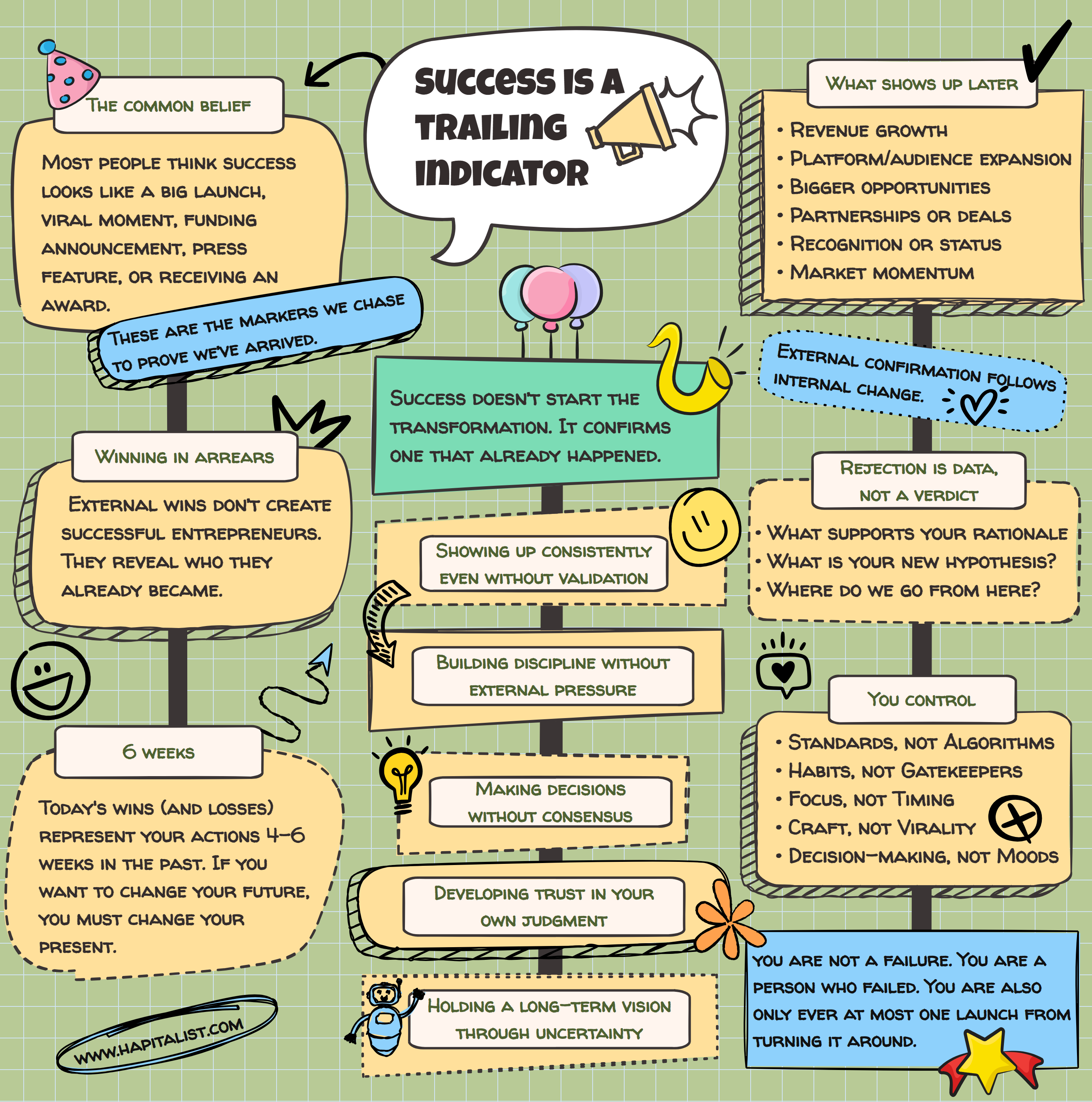
4. How much do you want to make in the next year?
I’m not saying everything comes down to money, but I am saying that it is good to have enough that you can sustainably exchange it for goods and services without struggling. In this section, we are gonna help you find that number for you.
What you measure you manage, so we’re gonna figute out how much money you need and the best way to get it.
This is the first true exercise we’ll run during this framework, and it should take about an hour to get right, as long as you have easy access to financials. If not, it’s going to take as long as it take for you to get comfortable with the whole money situation.
We talked a lot about sustainable monetization in the first section, and this is how we come put a number onto that concept. By the end of this, you should know your sustainable monetization number, or at least what you’re shooting for in the next year.
Step 1: This is the longest and hardest part because it requires you to go back to last year and figure out how much revenue you generated across all projects, including your job (if applicable). This is your baseline.
Step 2: Once you have looked back, it's time to project forward until the end of this year and ask yourself how much money you want to make. Not necessarily how much you think you'll make, but how much you want to make.
Don't worry, we'll bring you back to reality later, but for now, just pick a number and, as they say, dream big, honey.
Step 3: Get out a sheet of paper (but a different sheet of paper you used for the last exercise) and separate it into four columns. Label the columns Q1, Q2, Q3, and Q4.
If you don't do a lot of financial stuff, then those labels mean quarters 1, 2, 3, and 4.
Quarter 1 runs from January 1-March 31st. Quarter 2 runs from April 1-June 30. Quarter 3 runs from July 1-September 30. Quarter 4 runs from October 1-December 31.
Now, under your quarter heading, take the number you want to make this year and divide it by four, then put the final number at the top of each column.
So, if you've made a goal of $100,000 (which is what most people use if you want a guidepost for what number to choose), then you would put $25,000 at the top of each column.
Step 4: Next, take any recurring revenue you make and put it under what you just wrote. This could include your average Amazon revenue, your salary, your membership income, etc.
The thing is, though, you have to add this up by quarter, not by month. So, if you make $3,000 a month, then you're going to put $9,000 down on the sheet.
Why do we do this by quarters? Because things change month to month throughout the year, and it's not a very good predictor of year-over-year growth. Quarters are easier to analyze and better to budget around.
Additionally, often a marketing action starting in January won't pay off until February or even March, so judging a campaign by any one month is folly. Judging it by the complete three-month cycle is more accurate to chart success.
Step 5: Now that you've got your recurring revenue down, write out any planned launches you have for the year, and how much you estimate making on them.
If you've never launched anything before, I'll be frank with you...this is probably not the time to do this exercise. You need baseline data before you can grow.’
However, if you insist, then a single launch on Amazon for a new book will probably make between $250-$500, and a first-time Kickstarter will make about $1000-$2500 if you use our system. If you're trying to launch a membership without a fanbase, I would have a hard time believing you would make more than $25/mo. in the beginning, but your mileage may vary.
It's much better to use baseline metrics and then chart growth from there, but if you really want to do this early in your career, bully on you for getting ahead of the game. There will just be more variance than an established entrepreneur doing this same exercise.
Back to our exercise, if you have three launches in Q1, then you need to add them all up. So, if you plan a launch in January, February, and March, and you estimate to make $1,000 at each launch, then you'll put $3,000 in that column.
Make sense?
If you're wondering how to come up with your estimates, I recommend taking your baseline number and measuring it against your mailing list and social media reach at the time of your launch.
Then, find out how much growth you've had since that launch and use that growth to project your number out.
If you had 300 people on your mailing list and made $1,000 back in March of last year, and you currently have 600 people on your list, your reach doubled, and you can expect to make $2,000 on that same launch this year.
Please note that even the best models are guesses and while you can get very good at guessing, there is variance at even the best estimations.
The biggest culprit of bad estimation is inorganic email list growth strategies.
I have no problem with inorganic email list strategies like viral builders and have run them for years, but entrepreneurs tend to believe that when I ethically deliver a list to them that all their problems are over, which is simply not the case.
If you use a service to help you grow your email list, they might deliver 1,000 or even 5,000 emails to you at the end of a campaign, but that does not mean your potential income grew by that much.
You have to do the painstaking work of whittling those subscribers down to find the people who will love and buy your work. It could take a year or more of nurturing those subscribers before you see any tangible value from them.
I recommend that if you've participated in these high-growth strategies, use your previous baseline number as a predictor until you see how the new subscribers perform.
In general, the best way to estimate well is to be ultra-conservative until events tell you otherwise. I often use my previous baseline when I estimate how something will perform without accounting for any growth.
Step 6: Let's take stock of where you are by subtracting everything you've done so far from your topline number. If you're tracking our example, we put $25,000 as the topline number, and then put $9000 in recurring revenue and $3,000 in launch revenue for Q1.
If we subtract all that out that would leave us with $13,000 remaining in Q1 to "make up" in order to hit our targets.
How do we do that? Let's continue. We're almost done.
Step 7: Here is where we brainstorm what other actions we can take in order to make up that deficit.
- Can you run a Kickstarter for a special edition hardcover? I've seen people make $10,000+ on something like that, though only 25% of campaigns ever pass that threshold.
- Could you put together a direct sales offer? I've made thousands on just one offer and I know people who run 2-3 a month.
- Are you able to do a membership drive to get new subscribers? Maybe you could add $100+ a month using that.
- Could you add more advertising possibilities to help your series make even more money?
- Do you need a new line of business, or to jump to another niche in order to make the kind of money you want?
- Are there conventions you could attend that might put some fast cash in your pocket, or appearances you could set up?
- Could you release a new product line that will up your baseline number with every release so that by the end of the year you're making thousands more a month?
- Is there a new project you can spin up like an anthology that would put additional money into your pocket without adding a backbreaking amount of work?
As you come up with these options, write their potential income on your list with a different color pen. I like to use black for income I'm confident I'll receive and red for income that is theoretical.
This is another reason you should break things up into quarters instead of months. Making up a big deficit in any one month is next to impossible, but making it up in three months is considerably more attainable.
Multiple times in my career, I have, for example, added additional launches and extra conventions into my schedule when I've seen budget shortfalls that accounted for $10,000+ in additional income to my bottom line and literally saved my business.
Being able to make money out of nothing is the kind of magic every successful business knows how to do and is essential for long-term sustainability.
Don't stop adding options until you have either made up that deficit or run out of ideas.
Step 8: Now it's time for an "oops here comes gravity" moment. Is your number achievable this year? Were you able to easily make up that deficit or did it seem impossible?
If it seems impossible this year, that's okay. Now you know the scaffolding you have to build next year in order to make it work. This is why we call it long-term planning.
Or, did you easily make up that deficit? Maybe you undershot and can look at even bigger and better things this year.
Maybe you can't make it up this quarter or even next, but could you start seeing a bigger impact later in the year, or early next year?
The whole point of this exercise is to show you what is possible and how to expand your mind to different ways of making money.
It's all one bucket of money at the end of the day, and there are hundreds of ways to expand it.
The question to ask during this is:
- What is your sustainable monetization number?
- Does your schedule allow you to reach that number without stretching?
5. Prioritizing your business using a modified Eisenhower Matrix
One of the best tools I use is a modification of an Eisenhower Matrix, one of the single best prioritization tools I’ve ever found.
The Eisenhower Matrix is a powerful time management tool that helps you prioritize tasks by dividing them into four distinct quadrants: urgent and important, important but not urgent, urgent but not important, and neither urgent nor important.
Building one for yourself allows you to focus your energy on what truly matters, ensuring that essential tasks are addressed promptly while avoiding the trap of busywork that often feels pressing but yields little value.
My process isn’t exactly an Eisenhower Matrix, but it’s very, very close. If you’ve never done one before, then I highly recommend taking taking some time to audit your business.
Here’s the exercise I do every year.
- Write down all your responsibilities and tasks, no matter how small, either on a notepad, a spreadsheet, or a whiteboard. Really it doesn't matter where you write it down, but try to make it comprehensive.
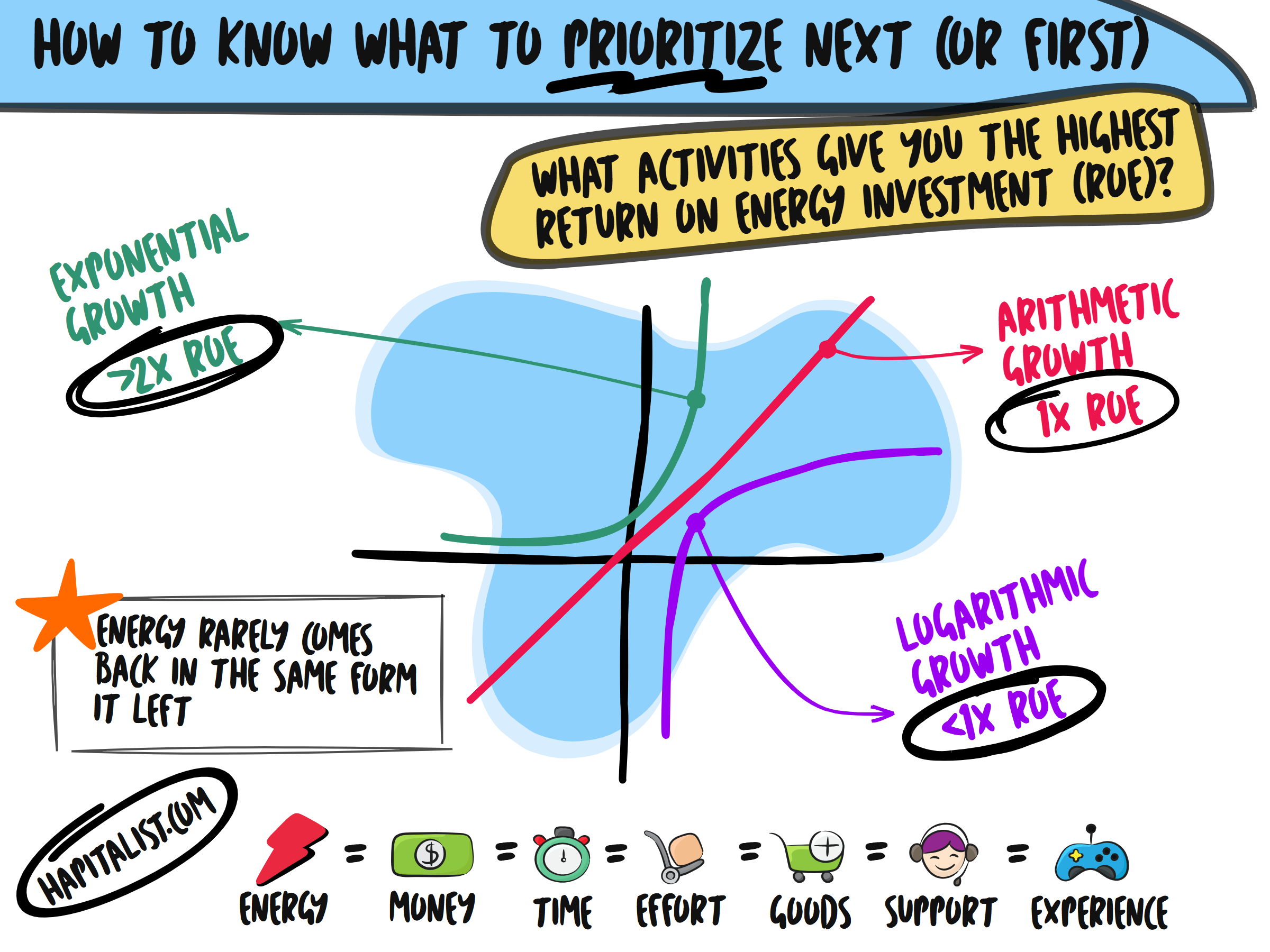
- Create two new columns with headers NECESSITY and ENJOYMENT. The necessity column deals with how important a task is to the day-to-day functionality of your business. The enjoyment column deals with how much you like doing that task.
- Now, rank each of your tasks on a scale from 1-10. Something with high necessity can be monetary or functional, but not always. Some admin tasks are critical for a business, even if they don’t add any revenue to your business. Meanwhile, some monetary tasks might not be very necessary at all. The enjoyment level should be self-explanatory. Here’s the rub. You can’t use the number seven as an answer. Seven is the default when you don’t want to make a hard choice, so you can’t use it here. You must choose either a six or an eight, for reasons that will be clear very soon.
- Once you have your list, it’s time to make a hard break between 1-6 and 8-10. This is why you can’t use seven. Everything on the 1-6 side falls on the DON’T LOVE/DON’T NEED side of the barrier. Everything 8-10 falls on the LOVE/NEED side of the barrier depending on the column.
- Draw a grid with four quadrants. Mark the X-AXIS as ENJOYMENT and the Y-AXIS as NECESSITY. Everything you LOVE and NEED should end up on the TOP RIGHT QUADRANT. Everything you NEED but don’t LOVE should end up in the TOP LEFT QUADRANT. Everything you DON’T NEED and DON’T LOVE should be in the BOTTOM LEFT. Everything you LOVE but DON’T NEED should end up in the BOTTOM RIGHT. It should end up looking something like this when you are done.
- Now, you assess. What is in the top right quadrant? Those should be your core products and offerings. You might even find some new services you could offer that more align with your passions. What is in the bottom right quadrant? How can you make those more important to your business? What is in the top left quadrant? How can you outsource those, or change them so you love them? What ended up in the bottom left quadrant? Cut those things ASAP.
The more time you can spend doing those, the more your company will grow.
What you should find are the things in your business that bring the highest return and provide a high level of satisfaction. You should immediately find ways to double down on those parts of your business.
The question to ask during this is:
- What are you keeping to have your best quarter ever?
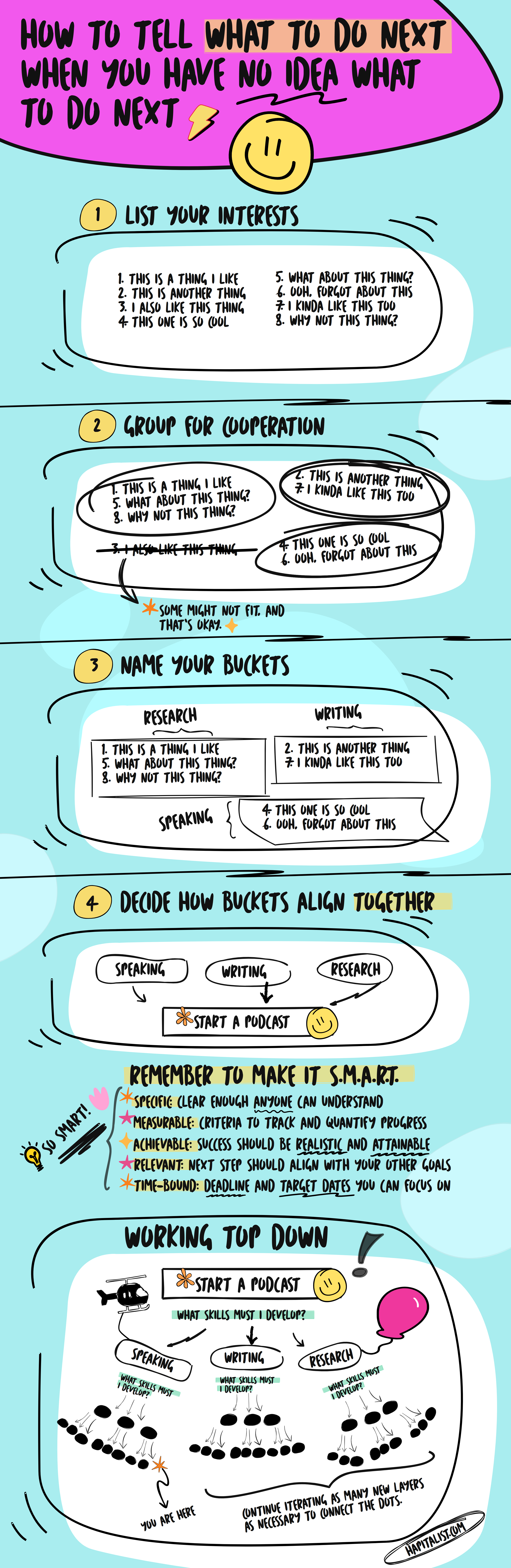
How to tell what to do next when you have no idea what to do next
Hi, Completing an Eisenhower Matrix helps you understand what you’re already doing and where your effort is producing results.
Russell Nohelty
The 4 P's of prioritization
Hi, If you have not yet, I highly recommend doing an Eisenhower Matrix to learn what’s in your zone of genius and completing our Big Domino exercise to learn what you should focus on next before reading this article.
Russell Nohelty
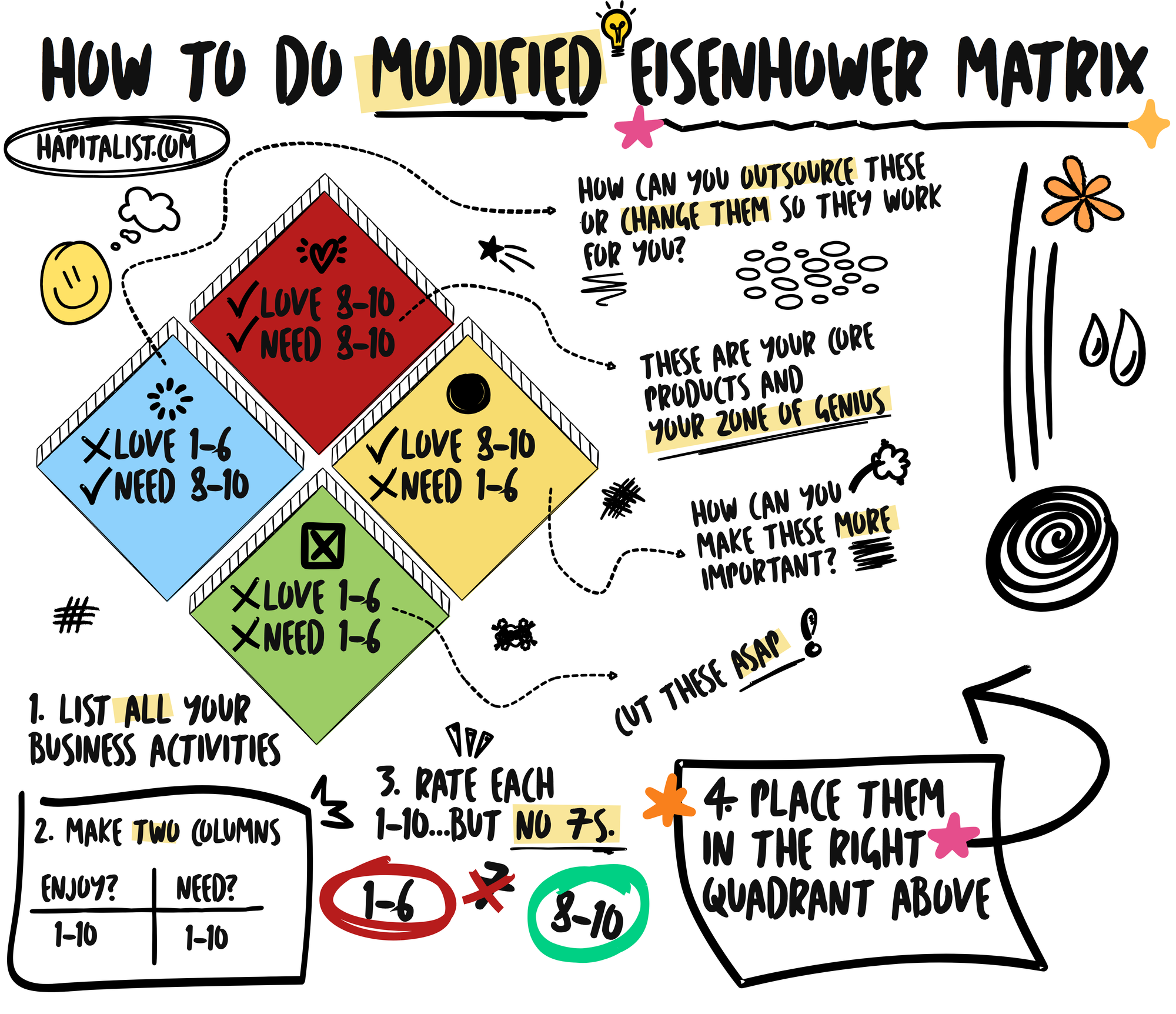
6. Transition points: Why customers buy during life changes
Understanding the psychological and emotional triggers that drive people to buy is crucial. People are most likely to make purchases when they are in flux; times of transition when their lives are changing, and they're seeking clarity, support, or an escape.
By recognizing these pivotal moments, you can craft offers that resonate deeply with customers who are in search of solutions, inspiration, or stories that reflect their inner world.
Customers in transition are often dealing with uncertainty, and as they navigate major life changes, they look for things to bring them clarity, comfort, or perspective.
During these times, people seek things that either provide practical guidance (in the case of non-fiction) or offer emotional resonance and escapism (in the case of fiction). Understanding this need gives entrepreneurs an opportunity to position their work as timely and relevant, creating an emotional connection with potential customers when they are most vulnerable and receptive.
Pain points & transitions
Customers who are in a state of flux often want answers, strategies, and a roadmap to help them navigate their new circumstances. Whether it’s a guide on starting a new job, a course on personal growth, or a memoir about becoming a parent, non-fiction provides customers with the information and insights they need to make sense of their evolving lives.
For example:
- Graduating from school or college: Career planning, financial literacy, and life skills become essential as young adults step into an unfamiliar world, looking for practical advice.
- Starting a new job or career: Customers in this phase want reassurance or tips to succeed, and content on career advancement or leadership fill that gap.
- Becoming a parent: Parenting guides or content about the challenges of family life provide new parents with valuable advice and comfort during an overwhelming transition.
The more your products aligns with these transition points, the easier it will be to reach customers who are actively searching for content that speaks to their current situation.
Offering emotional resonance and escape
When I talk to creators about this, they usually say “Well, that’s great for non-fiction, but that doesn’t apply to me”, and yes it does, absolutely apply to fiction. Fiction is just a different way to incept knowledge into people by letting them empathize and learn from a parable instead of a real event.
These same transition points offer rich opportunities to connect with customers on a deeper, emotional level. Fiction allows customers to see themselves in characters facing similar challenges or provides an escape from the stress and uncertainty of their real lives. Here’s how fiction can play a vital role during transitions:
- Starting a new job or career: Novels about characters striving for success, navigating office politics, or starting over in a new field provide relatable stories that resonate with customers in similar circumstances.
- Moving to a new place: Movies that explores themes of belonging, identity, and the search for home can offer solace to customers uprooting their lives.
- Getting married or entering a long-term relationship: Series exploring the complexities of relationships, resonate deeply with customers experiencing love and commitment, offering both an escape and a mirror to their own lives.
- Divorce or breakup: Fiction about heartbreak, rediscovery, and the strength to move on provides emotional catharsis for those recovering from a breakup. Customers in this phase often seek out stories that help them feel understood or inspired by characters who overcome similar challenges.
- Loss of a loved one: Novels dealing with grief and loss can serve as a source of comfort for those navigating the emotional turmoil of losing someone close to them.
- Health changes: Stories about resilience, healing, or characters overcoming physical challenges can offer hope and emotional support to customers facing their own health battles.
Escapism also plays a key role here. For customers overwhelmed by transitions, fiction provides an escape into another world; a necessary break from the stress of real life. Whether it’s diving into a fantasy realm, a thriller, or a romance, customers in flux often use fiction to recharge emotionally, and creators who provide that escape will find a loyal audience.
Why targeting transitions works
Customers buy during life transitions because these are moments of vulnerability, uncertainty, and emotional intensity. For non-fiction, this means offering content that directly addresses customers’ immediate needs, whether it’s how-to guides, memoirs that inspire, or advice that offers clarity.
For fiction, targeting these transition points means crafting stories that emotionally resonate with customers who are grappling with similar themes in their own lives. Whether they’re seeking escape or reflection, customers in flux are looking for work that provide an emotional anchor.
By tailoring your marketing and messaging to customers going through these transitional moments, you can position your products as essential resources for people seeking connection, understanding, or a break from their current reality.
Whether through practical advice or an immersive story, your brand becomes part of their journey through change.
No matter what niche you’re in, understanding the psychology of transitions allows you to connect with customers when they are most likely to seek out content. By addressing their emotional needs, offering clarity, or providing an escape, your brand can become a pivotal part of their process of navigating life’s many transitions.
The question to ask during this section is:
- What is your transition point where your customers are most likely to buy?
- Are you focused on it, or scattered around working with less effective transitions?
Creating lifelong customers by embedding psychological buying triggers deep into your brand
Hi, At their heart, successful brands create deep connections through layers of meaning and emotional resonance. Just as a garden grows through careful cultivation rather than mechanical planting, brands flourish when each element is thoughtfully developed to engage customers on multiple levels.
Russell Nohelty
7. Platform, audience, and assets
Building a sustainable career requires aligning three things in a strategic way; Platform, Audience, and Assets. If you can make these three things work for you, then you’ll be on your way to reach your priorities.
- Platform refers to the online or offline space where you promote, sell, and engage with your work. It's the foundation for how you share your work with the world and includes the tools, websites, or systems that allow you to connect with customers and manage your business.
- Audience consists of the people who consume your content, whether that’s watching your stuff, following your blog, engaging with your social media, or subscribing to your newsletter. Understanding your audience is essential because their needs, preferences, and engagement directly impact your success.
- Assets are the tools, resources, and intellectual property you already have that can help you grow your career. These include everything from your backlist of content, your email list, your social media following, and your unique skills or experiences.
Each of these elements plays a distinct role in how you grow, engage, and monetize your work. When aligned, they create a cohesive system that supports both your creative output and business goals.
Platform: Meeting the demands of the market
Your platform, whether it's Amazon, Patreon, your website, or social media, has its own unique demands and dynamics. Each one requires a tailored approach to content, engagement, and sales. The key to success is understanding what the platform prioritizes and how you can meet those demands while staying true to your voice and goals.
The main thing I want to get through here is that if a platform isn’t helping you grow, then there’s no reason to give them your money, time, or attention. So many people are on every platform, even when their incentives are not aligned with, or even in direct opposition with, their goals.
You should only be working on platforms that actively help you grow.
Types of platforms:
- Online platforms: Amazon, Patreon, Substack, your own website, social media (e.g., Instagram, Twitter, TikTok).
- Offline platforms: Live events, speaking engagements, conferences, and speaking engagements.
What makes a platform important?
- Visibility: Platforms like Amazon or social media provide access to a wide audience, allowing your work or content to be discovered.
- Sales channels: Platforms such as your website or stores like Amazon are where can buy your work.
- Audience engagement: Platforms like Patreon or a newsletter are where you can build direct, ongoing relationships with your audience, nurturing superfans who support your work long-term.
Examples:
- Amazon: A powerful platform for discoverability, leveraging its algorithm for ranking products and reaching a large, diverse audience.
- Patreon: Focuses on community building and deeper, more personal engagement with fans through memberships and exclusive content.
What does the platform want?
Platforms like Amazon are driven by algorithms that favor popular categories, frequent releases, and reader engagement. To thrive here, you need to release to a hot market and optimize your work for hot keywords that are currently trending. In contrast, platforms like Patreon may prioritize deeper connections with your audience and regular, smaller updates that foster a sense of community. On social media, platforms reward engagement and shareable content, like creating bite-sized insights or visuals can help your work go viral.
- What kind of content does well on the platform: On Amazon, consistent, niche-specific products help you show up in search results and recommendation algorithms. For Patreon, exclusive behind-the-scenes content, serialized fiction, or fan engagement polls often work best. On social media platforms like Instagram or Twitter, eye-catching visuals or quick, meaningful interactions are vital for expanding your reach.
- How to align with platform expectations: To give the platform what it wants, optimize your content. On Amazon, use targeted keywords, imagery that match the expectations of your niche, and release schedules that keep your name in front of customers. On Patreon, offer tiered rewards that reflect your process, giving fans a reason to engage at different levels of commitment. On social media, post regularly, engage with your audience, and create content that encourages shares and comments, driving the platform to boost your visibility.
Differentiating between platforms
Each platform has different requirements for success. For example:
- Amazon requires a focus on keywords, hitting niche expectations, and release frequency.
- Patreon is about nurturing community with regular, exclusive content.
- Social media is driven by engagement metrics, frequent posts, interactive content, and shareability.
Tailoring your approach to fit the specific platform you're using can maximize your success. Entrepreneurs often make the mistake of trying to apply the same strategy across platforms, but recognizing and adapting to each platform's demands can dramatically improve your results. I recommend 1-3 platforms, expanding beyond that only when you are estabished on your previous platforms.
Audience: Aligning your content with reader needs
Types of audience:
- Super fans: These are the types of people who will fly to meet you or spend $100 on a high-end prroduct.
- Core audience: Your most loyal customers or superfans who engage with your content regularly, buy your new releases, and advocate for your work.
- Casual fans: Customers who may have bought from you 1-2 times, but aren’t deeply invested in everything you release.
- Potential customers: People who fall within your target demographic but haven’t yet discovered your work. These are customers you aim to convert into fans.
Why Understanding Your Audience Matters:
- Targeted content: Knowing what your audience loves allows you to tailor your work to meet their preferences, increasing the likelihood that they will buy and recommend your work.
- Engagement: A clear understanding of your audience helps you build strong relationships through direct engagement, offering them content they’re eager to support.
- Marketing efficiency: When you know your audience, your marketing becomes more focused and effective. Instead of casting a wide net, you can reach people who are most likely to become loyal customers.
Examples:
- Romance readers: If your audience is primarily romance fans, they may expect certain tropes like happily-ever-afters, and knowing this helps you create and market accordingly.
- Newsletter subscribers: These are people who have given you their contact information and have expressed a deeper interest in your work, making them a valuable group to nurture for long-term success.
Your audience has specific needs, preferences, and pain points. As an entrepreneur, your success hinges on how well you can align your content with those desires while considering the platform’s demands.
Understanding the customer journey
It's very easy to focus yourself on one piece of the puzzle, instead of seeing the whole picture.
Russell Nohelty
What does my audience want?
Your audience could want different things depending on where they engage with you. For instance, customers on Amazon are often looking for the next quick fix, consistent quality, or products that fit needs. On social media, your audience may be looking for updates on your process, personal engagement, or sneak peeks of upcoming projects.
- How does this align with the platform’s needs? Your challenge is to align what your audience wants with the platform’s mechanisms. If your customers want updates on your journey, Patreon is a great platform to offer behind-the-scenes content. If your customers are looking for consistent new releases, Amazon’s algorithm will reward you for frequent releases. On social media, timely posts and interactions keep your customers engaged and can help build buzz for new releases.
- Creating a feedback loop: Consistently engaging your audience allows you to understand their changing needs. Use surveys, beta testers, or email list engagement techniques to see what they want and how it aligns with your platform. For instance, if you notice that customers are highly engaged with certain types of updates, you can double down on those types of content to enhance both audience satisfaction and platform performance.
- Tailoring for different audience stages: Newer entrepreneurs may focus more on building their audience by offering free content or engaging on platforms like Wattpad or social media, where discovery is easier. Established entrepreneurs, on the other hand, might focus on monetization by launching higher-priced products, exclusive content, or more personalized interactions.
Assets: leveraging your unique strengths
You have assets beyond just the products you ship. These include your mailing list, social media following, your back catalog of goods and servies, or even your personal story. Your assets are the tools that help spur your success and grow your reach beyond your core audience.
What assets do I have?
Your assets could include:
- A robust email list: A direct line to your customers that you own, which allows you to promote new releases, offers, or collaborations without relying on platforms.
- A backlist of peoducts: Multiple titles that allow you to leverage different parts of your catalog, bundling, running sales, or promoting lesser-known works.
- A strong social media presence: This is where you can engage fans, run promotions, and drive traffic back to your website or Amazon page.
- Personal experience or expertise: If you have unique insights or a niche area of expertise, this can be a powerful asset, especially when building a thought leadership platform or writing non-fiction.
Why Assets are crucial
- Monetization: Assets like your backlist or email list can be leveraged to generate income, whether through sales, memberships, or exclusive content.
- Growth: By leveraging your assets strategically, you can expand your reach and increase your visibility across platforms.
- Audience engagement: Assets like exclusive content, bundles, or direct access through email make customers feel more connected to you, which encourages loyalty and repeat purchases.
How can I leverage these assets to reach beyond my core audience?
To grow beyond your current audience, consider how you can leverage what you already have:
- Collaborations and partnerships: Use your network to team up with other brands or influencers in your niche. This can introduce you to new customers while also enhancing your credibility.
- Cross-promotion: Utilize your backlist by cross-promoting new releases with older works. For instance, you can offer discounts on previous products when promoting a new release or offer exclusive bundles to your email list.
- Scaling your brand: If you have a strong email list or a loyal social media following, consider launching exclusive products, like limited edition signed books, merchandise, or even offering workshops or coaching.
Growing your assets over time
Continue nurturing your assets by:
- Building your email list: Use lead magnets like free content or exclusive releases.
- Strengthening your social media: Be consistent and interactive, offering unique insights that make people want to follow you.
- Refreshing your backlist: Update old products, run promotions, or reformat for new platforms to keep older works generating revenue.
Common pitfalls to avoid
Entrepreneurs often make a few key mistakes when aligning platform, audience, and assets. These include:
- Neglecting platform demands: Not optimizing your work for the specific platform, such as failing to use relevant keywords on Amazon or not engaging regularly on social media.
- Ignoring audience needs: Focusing too much on what the platform wants without keeping an eye on what your customers are asking for.
- Underusing assets: Failing to leverage existing assets like your backlist, email list, or social proof (e.g., reviews and testimonials) to grow your reach.
Measurable action steps
To align these three elements, here are some concrete steps you can take:
- Platform optimization: Choose two key platforms and optimize your content (e.g., update keywords on Amazon, increase social media engagement). Track your progress monthly.
- Audience feedback loop: Send out a survey to your email list or social media followers and adjust your content strategy based on the feedback.
- Asset leveraging: Run a promotion using your backlist or cross-promote your new release with older works to boost sales across your catalog.
- Growth goals: Set specific growth targets for each asset, such as increasing your email list by 20% over the next six months or doubling social media engagement through regular posts.
To thrive as an entrepreneur, you need to think of your platform, audience, and assets as interconnected parts of your overall strategy. Understanding the demands of the platform helps you tailor your content to what will succeed, while knowing your audience ensures that you meet their needs in a way that aligns with the platform’s strengths. By leveraging your assets strategically, you can amplify your reach beyond your core audience and build a sustainable career.
When you align these elements, you create a system where each part supports the others, allowing for growth, engagement, and monetization to happen in a balanced, sustainable way.
The secret to beating overwhelm
Hi What you can do as a single human to overcome what seems like overwhelming odds stacked against them when building a business? It really comes down to three words.
Russell Nohelty
There a lot of questions for this part, but they boil down to:
- What platforms do I want to focus on?
- How can I gather my audience?
- What assets do I need to make best use of my platform and audience?

8. SCALE paths
Every business scales differently, but most business advice doesn’t account for any of that. It assumes everyone’s building the same way, at the same pace, with the same goals.
That’s why you keep breaking yourself trying to follow tactics that weren’t built for how you actually grow.
There are five core growth paths that founders, creatives, and entrepreneurial builders follow. Each one based on how you operate, how you show up, and how you scale momentum.
- (S)potlighters go deep, compound slowly, and build legacy work.
- (C)ollaborators grow by building aligned ventures with equally powerful brands.
- (A)rbiters are fast, tactical, and ruthless with execution.
- (L)aunchers thrive on sprints, public stakes, and launch-based calendars.
- (E)vangelists lead with resonance, story, and community trust.
These paths are based on how you move, how you actually get things done. How you gain traction, and how you build a business that doesn’t burn you out.
Pick the one that fits. Build from there. Now, let’s explore each one in more detail.
The (S)potlighter path
Slow. Strategic. Built to Last.
Spotlighters don’t look flashy at first glance. And yet, when you look a little closer you’ll find that some of the most stable, sustainable, and quietly profitable businesses out there are built by Spotlighters.
These entrepreneurs aren’t trying to win the short game. They’re planting roots.
Spotlighters are thinkers, planners, builders. They don’t just ship a product; they build a body of work. They release strategically, often obsessively, around one central idea, topic, theme, or worldview. Their power comes from depth, consistency, and a clear sense of their lane.
If Arbiters win by shipping fast, Spotlighters win by becoming undeniable over time. They’re the ones who create definitive guides, cornerstone series, and content ecosystems that compound year after year.
A healthy Spotlighter can spend ten years talking about the same topic from a thousand different angles and still feel energized by it. Their joy isn’t in the pivot; it’s in the iteration.
Traits of a Spotlighter
- Evergreen-minded: Spotlighters love content that holds value over time. They’re in it for the long haul.
- Focused on mastery: Rather than hopping between niches, they go deep into one niche until they become a known expert or voice.
- Consistency-driven: They prefer sustainable habits to sprints. Give them a solid routine, and they’ll thrive.
- Big-picture thinkers: Spotlighters often have a larger mission, brand, or thesis behind their work.
- Reluctant to launch: They sometimes struggle with perfectionism and “not ready yet” syndrome.
Spotlighters often overlap with nonfiction authors, long-form content creators, and serial educators. If you’ve ever said, “I just want to help people understand this one thing,” you might be a Spotlighter.
What success looks like
Success for a Spotlighter begins quietly. A podcast appearance here, a guest article there, a deep-dive interview tucked into a niche newsletter.
None of it seems explosive in the moment, but each appearance plants another breadcrumb trail back to their hub. A curious listener becomes a subscriber. A subscriber becomes a steady consumer. A steady consumer becomes a client, student, backer, or fan.
Over time, these links and placements start stacking on top of each other. Their work begins arriving in front of new audiences without them forcing anything. They don’t need the adrenaline of big launches or the stress of constant visibility because their ecosystem is visible on its own. Discoverability is the natural consequence of the depth they’ve built.
And as their visibility expands outward, Spotlighters get asked onto bigger platforms, and when they host their own summits, roundtables, or collaborative series, the best people in the space agree to show up.
Their hub becomes a gathering point, a reference library, and a kind of authority center for the entire niche.
They don’t become famous overnight, but over time they become the place people go when they need answers.
Where Spotlighters struggle
Spotlighter struggles creep in slowly, accumulating quietly until something stops working and they can’t quite pinpoint why.
A Spotlighter sits down to write a blog post or outline a new guide, and instead of finishing it in a sitting, they begin researching “just a little more.”
Spotlighters don’t procrastinate because they’re lazy. They procrastinate because they’re building for the future, and the future feels like it deserves perfection. And with each delay, the ecosystem they’ve built starts to lose momentum.
Another struggle lives in the tension between depth and visibility. Spotlighters are brilliant at creating frameworks, archives, and libraries, but that doesn’t mean they enjoy being seen. They prefer the comfort of structured work to the vulnerability of stepping onto a stage. So while they excel at being the expert, they hesitate to declare
And then there’s burnout that comes from carrying too many unfinished ideas at once. Spotlighters rarely have one project; they have fifteen. Half-built funnels, partially drafted series, archived interview notes, unused collaborations… all of it sitting in a mental holding pattern, quietly demanding attention.
At their lowest, Spotlighters feel invisible, as if no matter how much they’ve built, none of it matters. They start wondering whether they’ve wasted years building systems nobody will ever fully experience.
But nothing is wrong with them. Nothing is wasted. The work they’ve created is sound. The depth is real. The only thing missing is momentum, and momentum is the easiest thing in the world for a Spotlighter to rebuild once they see where the system broke.
Best platforms + strategies
Spotlighters thrive in systems that reward depth, reliability, and cumulative value. That means:
- Substack and email newsletters: Perfect for slowly building trust and showcasing expertise.
- SEO blogging: Spotlighters can dominate long-tail keyword traffic.
- Podcasting & YouTube: When planned strategically, these channels become legacy content.
Spotlighters grow the fastest when they combine their depth with the reach of other people’s platforms. Guest lectures, podcast interviews, collaborative essays, anthology participation, virtual summits, and the like become powerful distribution engines. Every time they show up in someone else’s audience, they leave behind a breadcrumb trail that leads directly into their ecosystem.
Spotlighters build quietly and in layers, but once their ecosystem is in place? It’s incredibly hard to uproot.
Sound like you? Take the quiz and find out.
The (C)ollaborator path
Co-Creation. Co-Ownership. Shared Momentum.
Collaborators don’t just sell products. They build partnerships and work together with others to build ventures together that grow through mutual trust, shared execution, and brand-aligned launches.
They think in terms of relationships, opportunity stacking, and win-win business models. Collaborators don’t need to be the star of the show, but they do need to bring something of their own to the stage.
When you build like a Collaborator, you don’t just expand your reach.
You expand your influence, your audience, your IP, and your impact — by building with other real builders.
Traits of a Collaborator
- Co-equal builders: They partner with others who already have traction — not followers looking for handouts.
- Strategic operators: They don’t “jump into collabs.” They design shared value.
- Brand-forward thinkers: Their own brand is active, healthy, and evolving — they bring it to the table.
- Execution-minded: They build real things. Launches, offers, products, movements.
- Mutualist by nature: A good Collaborator wants both sides to win, and they make sure it happens.
- Community-aligned: They seek partners whose values and audiences resonate with their own.
If you’ve ever said, “We could build something incredible together,” or “I’m not looking for clients, I’m looking for co-creators,” you might be a Collaborator.
What success looks like
When they’re in sync, Collaborators are powerhouses of momentum.
They don’t grow by accident. They grow by launching real things with real people they trust. Not endless ideas. Actual offers, ventures, and experiences that scale faster and further than any solo effort could.
They do well with:
- Co-created product lines or experiences
- Cross-branded launches (email swaps, bundles, events, anthologies)
- Shared subscription or membership programs
- Strategic crossover projects (e.g., one universe, two creators, three entry points)
- Joint crowdfunding or co-owned product lines
- Dual-platform campaigns that allow both audiences to co-invest
When Collaborators hit their stride, they’re not just running launches — they’re building shared IP, shared equity, and shared worlds.
They’re not asking, “How do I get more eyes on this?”
They’re asking, “Who can we build this with so we can grow together?”
Where Collaborators struggle
The danger of being a Collaborator? Unequal energy.
If one side isn’t showing up — with time, brand power, or execution — everything starts to wobble.
Common traps:
- Unbalanced ownership: One person drives. The other coasts.
- Undefined expectations: Nobody’s sure who’s responsible for what.
- Lack of brand momentum: A partner with no platform can’t carry their weight.
- Unspoken misalignment: One partner wants quick cash. The other wants long-term equity.
- Overcollaborating: Saying yes to every offer without assessing fit or ROI.
- Resentment cycles: Doing the work for two, then pulling back too late.
A failed collaboration hurts the project, your relationships, and sometimes your audience’s trust, too.
That’s why strong Collaborators only build with other strong brands.
Best platforms + strategies
Collaborators thrive on platforms where relationships and shared value can be made visible. Top tools for launch and growth:
- Kickstarter & crowdfunding: Excellent for co-branded launches with tiered rewards, lets both audiences “buy in” together, and works well for joint editions, bundled offers, or crossover events
- Email + newsletter collabs”: The core of every collaboration. Use shared onboarding sequences, co-authored newsletters, or swap campaigns. They are especially powerful when each party has a healthy list
- Substack or Patreon (dual ownership models): Run serialized stories, shared posts, or co-managed content, share revenue. or direct people to dual funnels and invite both communities into the collaboration in real time
- Direct sales stores (Shopify, Payhip, etc.): Allow each party to cross-promote and bundle products. Perfect for collaborative product lines or launch-specific storefronts
- Cross-platform projects: Anthologies, podcasts, digital magazines, collaborative world-building. Each creator takes one channel — podcast, YouTube, print, event — and brings it all into one central offering
The Collaborator path isn’t about being the loudest or the biggest. It’s about being the most aligned.
You don’t need to create everything alone, but make sure to choose partners who can carry the weight with you — not on your behalf, not behind the scenes, but right beside you.
You’re here to connect and make new things real.
Sound like you? Take the quiz and find out.
The (A)rbiter path
Fast. Focused. Ruthlessly Efficient.
Arbiters are survivors. Tactical, lean, highly adaptable. They thrive in resource-scarce environments by doing more with less. Their superpower is efficiency. Arbiters look at an opportunity and ask, “How can I win today?” They don’t need it to be sexy. They just need it to work.
And it can work. Some of the most profitable businesses of all time are Arbiters. They’ve built systems, dialed in their customer, and scaled their catalogs into revenue machines.
But not everyone is built to be an Arbiter. If you’re not an Arbiter and you try to force yourself into that model? You’re going to break.
This path isn’t about depth or slow-burn community-building. It’s about execution and velocity. It’s about being faster, leaner, and more data-driven than the competition.
Arbiters aren’t here to feel all the feelings. They’re here to deliver product. Full stop.
Traits of an Arbiter
- Speed-focused: Arbiters move fast. They don’t need a perfect product. They need something that ships.
- Trend-aware: They spot market gaps, hit rising niches, and drop content when the timing is right.
- Tactically driven: Everything is part of a system including building, launching, advertising, and scaling. It’s all part of the engine.
- Minimalist marketers: Arbiters don’t spend months building community. They build a funnel, test the ads, and optimize for ROI.
- Emotionally detached: They don’t romanticize the work. They produce. If the market doesn’t respond, they move on.
What success looks like
A healthy Arbiter has systems for everything. They know their niche, their customers, and their competitors. Their work is dialed in to hit expectations on purpose. They track data, tweak quickly, and test ruthlessly.
Their marketing is lean. Think low-cost lead magnets, Facebook ads, newsletter swaps, and backlist optimization.
When everything is working, Arbiters generate steady cash flow. They may not have a huge audience, but the audience they do have is highly targeted. They’re not building community, they’re building income.
Where Arbiters struggle
Burnout is the big one. Arbiters can run hot, especially when chasing trends or trying to match the pace of others in their niche. Because they’re constantly producing and rarely pausing to refill the well, they risk hitting a wall and wondering, “Why do I even like this anymore?”
There’s also the risk of commodification. When you’re producing fast and marketing to data, it’s easy to lose touch with why you started in the first place. That’s when stagnation sets in—and suddenly the money machine starts sputtering.
Plus, not every Arbiter is ready to scale. A lot of new entrepreneurs try to become Arbiters without the infrastructure. They don’t have processes, data, ad budgets, or audience insight and crash hard trying to keep up.
Best platforms + strategies
Arbiters thrive on systems where speed and scale are rewarded. That includes:
- Amazon: Short-term sales windows, rapid release, and voracious buyers? Check.
- Amazon Ads and Facebook Ads: Great for pushing products to hungry markets.
- Social media: Anywhere they can find virality and arbitrage, they can game the system.
The Arbiter model isn’t bad. It’s just not for everyone.
If you’re an Arbiter, lean into it. Build the machine, find your rhythm and automate everything you can, but remember: it’s okay to slow down once in a while.
If you’re not an Arbiter, stop trying to be one. There are other ways to win. You don’t have to outpace everyone. You just have to build a system that works for you.
Sound like you? Take the quiz and find out.
The (L)auncher path
Explosive. Cyclical. Launch-Oriented.
Launchers aren’t here to build forever. They’re here to build for something. They don’t just create, they build toward. If there’s no deadline, no audience waiting, no ticking clock pushing them forward, they often freeze up, but give them a big launch, a hard date, and a shot to make noise? They light up like fireworks.
Launchers are the sprinters of the business world.
They don’t do well with never-ending content calendars or slow-drip marketing. They need a build-up. A release. A moment to explode. Their energy is cyclical, vacillating between intense and all-consuming during the push, followed by a necessary period of rest and recovery.
If you’ve ever crushed a Kickstarter then ghosted your audience for three months? You might be a Launcher. If your productivity spikes the moment you set a public launch date, and completely dies when you’re “just working on the next thing”? Welcome to the ice fields.
Launchers don’t create for the sake of it. They create for impact.
Traits of a Launcher
- Launch-driven: Deadlines, campaigns, and events are what get them moving.
- Hype-loving: They enjoy the energy of anticipation—teasing a new project, revealing covers, running countdowns.
- Focused creators: When they’re in a production sprint, they can be unstoppable.
- Recovery-based: After a big push, they have to rest. Otherwise, they burn out (and so does your audience)
- Emotionally invested: Their launches feel personal. Wins are euphoric. Losses can knock them out.
Launchers have never met a project they didn’t want to launch, and generally they can do so very well. They’re not usually the ones emailing every Tuesday. But when they hit your inbox? It’s with a mission.
What success looks like
A healthy Launcher is a launch machine.
They plan their calendar around campaign cycles. They stack content and production schedules to align with big releases. They know how to build buzz, how to galvanize a list, and how to create momentum. Launchers excel in event-based marketing: Kickstarter, convention signings, limited-edition drops, box sets, timed bonuses.
They don’t need a massive audience, just a motivated one. Their strength isn’t in being everywhere, it’s in showing up exactly when it counts, with energy that’s contagious and stakes that feel real.
And when the launch is over? They disappear to the mountains (figuratively…usually) to recharge and gear up for the next one.
Launchers don’t win by being always-on. They win by knowing when to turn it on and when to turn it off.
Where Launchers struggle
Launchers are masters of momentum… but can be total messes without it.
They often struggle with consistency. If there’s no urgency, no countdown, no audience to perform for, they drift. They’ll second-guess their work, overthink every decision, or jump to a new project just to get that dopamine hit of “starting fresh.”
Burnout is real, and it’s brutal. Their cycles are intense, so Launchers are prone to flaming out, especially if they try to go back-to-back-to-back without building in recovery time.
Another trap? The Launch Spiral.
This happens when a Launcher finishes a project and immediately feels the need to start hyping something else even if the last launch nearly killed them. They don’t know how to rest without guilt, so they overcommit and self-sabotage.
Unhealthy Launchers also risk tying their self-worth to launch outcomes. If a campaign flops or underperforms, it doesn’t just feel like a business failure, it feels personal, and that can cause deep creative paralysis.
Best platforms + strategies
Launchers thrive where visibility spikes, deadlines matter, and launches have built-in urgency. Their best playgrounds include:
- Kickstarter & crowdfunding: The ultimate Launcher environment, fixed deadlines, public stakes, and community buzz.
- Convention sales: High-energy, face-to-face selling with built-in adrenaline.
- Pre-order windows: Give them something to build hype around.
Launchers can also do well with seasonal schedules with 3–4 big pushes per year, spaced out with strategic downtime. They don’t need to be everywhere. They need to be where it matters, when it matters most.
Launchers are volcanic. Cold most of the time, until they erupt with creative fire.
If that’s you, embrace it. Don’t beat yourself up for not being consistent. Be cyclical on purpose. Plan your year around your bursts. Build rest into your schedule like it’s sacred.
You’re not lazy. You’re just hibernating until it’s launch season.
Don’t try to be “on” all the time. You’re not built for it. You’re not supposed to be. And when you try to be like a Arbiter or a Spotlighter, you’re only accelerating your burnout.
Launch hard. Recover harder. That’s the Launcher way.
Sound like you? Take the quiz and find out.
The (E)vangelist path
Resonant. Referable. Community-Driven Growth.
Evangelists don’t grow by shouting louder, spending more, or optimizing funnels to death. They grow because other people spread the word for them like a social contagion.
This path is built on advocacy that compounds.
Evangelists create products, experiences, and stories that people can’t help but talk about because it speaks to the core of their identity.
When those customers share your work, through testimonials, referrals, recommendations, and community hype, that’s where the exponential curve comes and shoots you to the moon.
You’re not just trying to “get attention.” You’re building a world customers want to invite other people into and live inside.
Evangelists thrive because they:
- Create highly shareable customer experiences
- Generate stories customers want to repeat
- Build identity-driven brands that people self-identify with
- Make customers feel seen, included, and valued
- Empower fans to become advocates, testers, and ambassadors
The business grows because people talk, and keep talking, and keep talking. Evangelists don’t need a big audience, but they do need an activated one.
Traits of an Evangelist
- Brand-first thinkers: Evangelists are often their brand. Their voice, aesthetic, and story all reflect who they are.
- Sensitive to rejection: Evangelists take feedback (especially silence) personally, sometimes painfully so.
- Belief-based brands: Your values, voice, and ethos are easy to understand and even easier to share.
- Emotion → Advocacy: Evangelists connect deeply, which triggers organic word-of-mouth.
- Community trust: They naturally build circles of belonging that customers want to bring friends into.
- Testimonial rich: Customers describe your work better than you can.
If you’ve ever said, “I want to build things that matter to people,” or “I want to create something that makes customers feel seen,” you’re probably a Evangelist (or at least embracing your inner Evangelist).
What success looks like
When an Evangelist succeeds, it never looks like a spike or a sprint. It looks like compounding advocacy, the slow and steady stacking of people who genuinely love what you do and can’t help talking about it.
Their customers become their amplification system. Every launch creates a ripple of excitement, and every ripple pulls new people into the orbit.
An Evangelist doesn’t need a giant audience; they need the right fifty people saying the right things to the right friends. Their growth comes from a rising chorus of screenshots shared in stories, long heartfelt emails, unexpected tags on social media, and glowing reviews that explain the product better than any marketing copy ever could.
Those stories spread through group chats, Discord servers, comment sections, and private DMs. It’s subtle at first, but then one day the Evangelist realizes that most customers didn’t find them through ads or search, they found them because someone else vouched for them.
When Evangelists thrive, their community feels alive. Not the “I post and hope someone comments” kind of alive, but a real sense of belonging. Customers form friendships inside the ecosystem.
They start using the Evangelist’s language to describe their own goals and process. They recommend the brand without being asked. They show up for launches not just to buy but to participate, to spread the word, to help.
That’s the moment when the business stops feeling like an exhausting solo push and starts feeling like a shared movement. Success, for an Evangelist, is when the community takes the torch and begins to carry it forward on its own.
Where Evangelists struggle
The shadow side of the Evangelist path is that everything is personal. When the business is built on connection, silence can feel like abandonment.
A slow launch doesn’t just sting financially. It feels like a reflection of your worth. A quiet inbox can spiral into self-doubt. Evangelists are wired for emotional resonance, which means they absorb emotional noise in both directions. The praise lifts them higher than it should, and the absence of praise hits harder than it needs to.
Evangelists also struggle with the structural side of growth. They often assume that if people love the work, they’ll naturally talk about it. But love alone doesn’t create referrals. People need prompts, systems, and invitations to share.
When an Evangelist doesn’t build those pathways intentionally, they end up doing all the work themselves, waiting for organic word-of-mouth that never fully materializes. They pour more energy into nurturing everyone individually because that’s what feels natural, but without boundaries, they end up depleted, resentful, or creatively shut down.
There’s also a unique form of guilt that comes with being an Evangelist. Charging money feels fraught. Asking for testimonials feels like fishing for compliments. Running a referral program feels like asking too much.
They want to help, to hold space, to connect, but this instinct can become a trap. They say yes too often, overshare, overgive, and overstretch. And when the community becomes too heavy to carry, they retreat, not because they don’t care, but because they cared too hard for too long without a system to support them.
Evangelists don’t fail because their community doesn’t love them. They fail because they try to grow on heart alone without the containers, boundaries, and structures that turn love into advocacy.
Best platforms + strategies
Evangelists do best where authenticity, story, and relationship-building are rewarded. Their entire growth model depends on creating moments, stories, and experiences that customers feel compelled to pass along.
For an Evangelist, marketing is never a one-way broadcast. It’s a chain reaction. Every sale has the potential to become two more, every customer can become a storyteller, and every story can become a spark that pulls someone new into the ecosystem.
- Referral and ambassador programs Create simple, frictionless referral pathways. Design insider roles for your most passionate supporters. Give them early access, exclusive perks, and a sense of identity. Ambassadors become the engine of hype, testing products, creating buzz, and rallying the community during launches.
- Influencer partnerships and user-generated content campaigns: Evangelist brands thrive with creators whose audiences trust them deeply. Encourage customers to show your product in action. UGC and Influencer content spreads faster than brand content and activates the referral engine effortlessly.
- Community spaces (Discord, FB Groups, Patreon): Evangelists need a place where their people can see each other. Communities amplify your language, share experiences, and create the emotional glue that makes referrals explode.
- Story-forward social channels: Platforms like Instagram Stories, TikTok, and YouTube Vlogs help Evangelists build trust at scale. Customers share these videos with friends, which creates organic, high-quality discovery loops.
The key for Evangelists is building a business with structure behind the connection. Not just hoping people will talk, but making it easy, fun, and rewarding for them to do so.
You don’t grow by shouting louder. You grow by giving your community the tools, the prompts, and the experiences that make sharing feel like a joy rather than a chore.
You’re not here to chase virality or fame. You’re here to build something people care about so deeply that they want others to care too. That’s the heart of the Evangelist path.
And when you lean into building with your community instead of for them, growth stops being something you fight for and starts becoming something that flows through your people.
Sound like you? Take the quiz and find out.
Embrace your path
There is no one right way to build, Only the right way for you.
Maybe you’re a Spotlighter, quietly building something deep and unshakable. You’re here to master something, refine it, and share it with the people who care. You make work that lasts.
Or maybe, you’re a Collaborator, a builder who doesn’t want to do it all alone. You grow through co-creation. You expand through aligned partnerships. You’re here to create something new with people who are already building something real of their own.
Maybe you’re an Arbiter, wired for speed, efficiency, and repeatable wins. You don’t need everything to be beautiful, just effective. You build engines, print money, and keep it moving.
You might be a Launcher, living in bursts, driven by the moment, the stage, the crowd, and the countdown. You build for the build-up. You create for the launch. And when it’s over, you vanish to recharge.
Or maybe you’re an Evangelist, built on resonance, story, and connection. You make people feel seen. You create belonging. Your brand isn’t a product line. It’s a heartbeat. And people follow you because they feel it.
None of these are better or worse. They’re just different ecosystems. Different engines. Different ways of growing.
So, stop forcing yourself to fit someone else’s path. Stop acting like you’re broken just because you’re not fast, loud, optimized, or always-on, and stop chasing advice from people who are playing a completely different game.
You don’t need to be more consistent or more confident. You just need to be more you, on purpose, and with a strategy that actually fits.
Know your path. Build from it. And if you ever feel lost?
Find your way back to the path.
There is a whole section on SCALE paths.
SCALE paths: Return on Energy Investment (ROE)
Hi, I see too many talented entrepreneurs drowning in overwhelm, and it’s not usually because they don’t have enough time.
Russell Nohelty
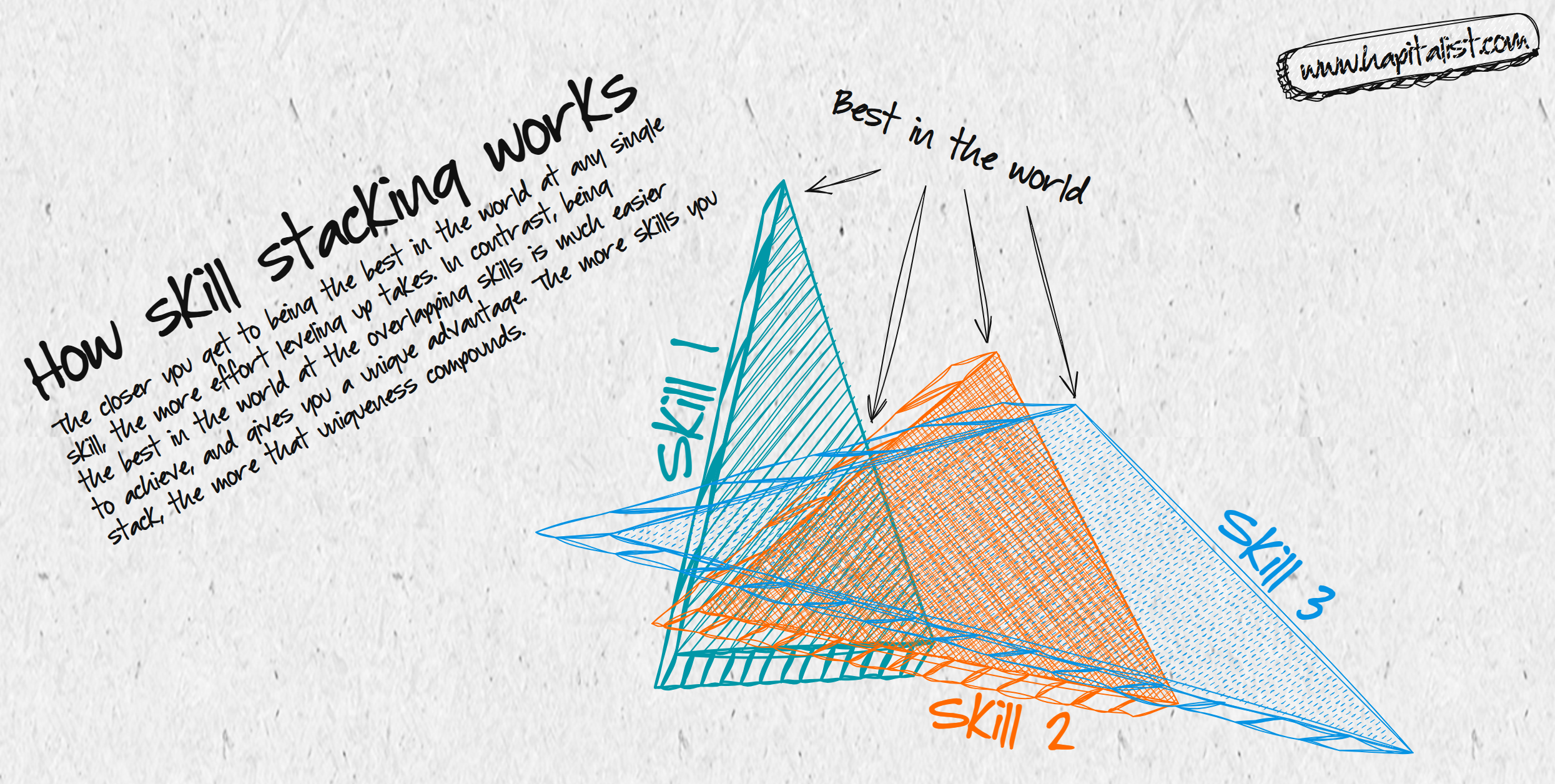
9. Evolution tracks
Knowing your SCALE path is great, but it’s only half the equation. The other half is knowing your evolution track.
We found there are five evolution levels in a business. Knowing both your SCALE path and your evolution level allows you to triangulate the advice you take and the advice you give to others.
Here are the five levels we found through our research. If you are not even ready to think about that kind of thing, then you would be a Level 0.
- Level 1 - Founders at this level don’t even know how to start doing things because it’s so overwhelming. They are pulled in every direction and feel like they are drowning in information from every direction. In order to get out of this level, you need to start doing something and it doesn’t matter much what you do.
- Level 2 - Entrepreneurs at this level have started doing things, which is great, but nothing is working. They are following all the best practices as best they can, but they are failing at everything they try. If you want to get to the next level, you have to find something that works and latch onto it.
- Level 3 - Brands at this level have found something that works, but they are also doing all sorts of other things that aren’t working. To get out of this level, you need to shed everything that’s not working and double down on things that are working for your SCALE path.
- Level 4 - Entrepreneurs at this level have fully embraced their path and are making money, but they are capped out at what they can earn without evolving beyond what they’ve been doing. In order to exit this level, you need to integrate other start building a team and/or bringing new paths into your business.
- Level 5 - At this top level, entrepreneurs have built out a team and have all the paths working for them, and need to keep building out.
- If you know you are a level 3 Arbiter (we call that a A3), then so much suddenly becomes clear to you. For instance, you know that the thing you should be focused on right now is optimizations to get from level 3 to level 4. You also know you should be focusing on finding the next hottest trend before the arbitrage goes away.
You also know that you should be focused on learning from other Arbiters who can help you embrace the qualities that will help you thrive. Conversely, if you’re a level 4 Arbiter (A4), then you know that you should be focused on learning from other paths to help you expand.
One of the biggest things that hampers founders is that they try to expand too quickly into other SCALE paths. While you should be testing things to find what works at level 2, once you have found those things that work you should be shedding everything else in level 3 to double down on what’s working to push through into success. Once you have had success, then and only then should you start adding other paths back into your business.
Each stage has its own growth metrics.
- Are you at level 1? Then you need to settle and start somewhere, anywhere.
- Are you a level 2? Keep testing and experimenting with different paths to find something that works for you.
- Are you in level 3? It’s time to double down on what’s working and cut things that aren’t so you can focus your attention and find success.
- Are you evolving into level 4? Now it’s time to start integrating new things into your business to allow you to build.
- Are you at level 5? Awesome. Keep going and adding team members as necessary.
One thing to remember about these levels is that you can ascend or descend them. Founders often think that once they are a level 3, they can never descend back to level 2, but more often than not this descent is a major cause of burnout.
Strategies that have worked for years can suddenly start failing, which causes an entrepreneur to double down and double down again, losing ground with each iteration until they collapse in a heap from exhaustion.
This is why it’s so important to double down quickly once you find something that works, so you can create a stable income and then start incorporating other SCALE paths into your business before those strategies lose efficacy.
Most founders become stuck in level 3, getting distracted by shiny objects while their business stagnates and they fall back into level 2, only to continue that cycle again and again until they burn out. If instead we can double down on what’s working quickly without getting distracted, then we can push through level 3 and start building out systems in level 4 to make our businesses more resilient.
The vast majority of businesses we talk to are stuck between level 2 and level 3. They are either floundering to find something that works or using all their energy on actions that don’t work instead of focusing on those things that do.
Most founders will never get out of level 3 because they are bogged down with actions that have marginal efficacy to them. Instead, they are in a continuous cycle between level 2 and level 3. They are so tired that they can’t get enough momentum to achieve escape velocity into level 4.
Build the way you’re built
Hi, The internet is overflowing with marketing tactics, funnels, hacks, frameworks, and “proven systems.” If information alone created growth, you’d be drowning in customers by now.
Russell Nohelty
10. Ecosystems
If you really want to grow and embrace your SCALE path, it helps to understand your natural tendencies on a deep, personal, visceral level.
That’s where the Ecosystems can benefit you. They’re the operating system for your entrepreneurial journey. The SCALE paths help you grow, but the Ecosystems are how you’re wired.
Think of Ecosystems like the operating system of your computer. You might use Windows, Mac, Linux, Ubuntu, etc. Whichever you choose goes far to determine how you interface with your computer, including what programs you can run, and how they run.
It doesn’t really influence what you create, though, how you share it, or who you meet through it. That’s where SCALE paths come into the picture.
SCALE paths have a lot of overlap with Ecosystems, and lots of people confuse the two. However, they actually serve two very different functions.
- SCALE paths are how you grow.
- Ecosystems are how you operate.
Ecosystems have nothing to do with growth. They are all about how you build your business on a deep, foundational, and structural level. Your ecosystem isn’t how you want to be. It’s how you actually function.
They show you how to structure your work so it doesn’t drain you. Yes, each Ecosystem is echoed in a SCALE path.
- Spotlighter = Grassland
- Collaborator = Aquatic
- Arbiter = Desert
- Launcher = Tundra
- Evangelist = Forest
And yes, most entrepreneurs will align both tightly together, but that’s not necessarily the case. Each base Ecosystem could work equally effectively with multiple SCALE paths.
Grasslands are steady, strategic and methodical. They grow slow, deep, and sustainably, which aligns well with the Spotlighter path. However, they could also build a legion of ambassadors, like Evangelists, that spread their message all over the internet, or partner with brands on new products like Collaborators.
Aquatic are expansive, layered worldbuilders who create systems that span universes, which pairs well with the Collaborator, as they both rely on outside validation from partners to normalize their work, but an Aquatic could also choose to get out front and center of their brand like a Spotlighter, or build ambassadors like an Evangelist, depending on their path of least friction.
Deserts are fast, tactical, and opportunistic. They move quickly and build lean, which matches well with the Arbiter who is always looking for the next trend to hop on. However, it’s equally possible for them to take advantage of a Launcher path since they can both spin up new projects quickly and almost at will.
Tundras are cyclical, burst-driven, and seasonal sprinters who sprint hard, then recover hard. This is a natural fit for the Launcher path, but since they work fast it’s possible for them to build quickly like an Arbiter, or rely on partnerships to help build during their recovery like a Collaborator.
Forests are relational, connective, and built for emotional resonance, which makes them ideal for the Evangelist SCALE path. However, it’s just as possible for them to broadcast their message like a Spotlighter, or launch their programs repeatedly like a Launcher.
As you can see, there’s a natural fit for most brands to align their SCALE path and Ecosystem together, but it’s possible to have success many different ways. However, we must know both your SCALE path and base Ecosystem if we want you to find success.
Ecosystems describe how you function under load, how you create when the inspiration’s dried up, and how you make business decisions when everything is on fire. They show you how to structure your work so it doesn’t drain you. They help you understand what kind of creative ecosystem keeps you alive, so your business doesn’t just grow, but actually lasts.
There are five ecosystem types:
- Deserts: Fast. Tactical. Ruthlessly efficient.
- Grasslands: Strategic. Sustainable. Built to last.
- Tundras: Launch-driven. Cyclical. Explosive, then dormant.
- Forests: Relational. Emotional. Driven by connection and belonging.
- Aquatics: Expansive. Visionary. Building entire worlds.
Each one reflects a different internal rhythm, emotional cycle, and creative pattern. If you build your business in a way that fights your ecosystem, you’ll lose. You’ll burn out or quit, even if the money’s good, because your body and brain will eventually say no.
Most entrepreneurs chase strategy while ignoring the system that has to run that strategy. Then, they wonder why it never sticks, why they keep burning out, and why it always feels like they’re building someone else’s business.
Let’s find your ecosystem. Then use it to build a business that actually allows you to breathe.
Sound like you? Take the quiz and find out.
The Grassland ecosystem
Slow. Strategic. Built to Last.
Grasslands are thinkers, planners, builders. These entrepreneurs aren’t playing the short game, they’re building a legacy. They develop frameworks, write create content, and craft offers that solve real problems with clarity and depth. Their power comes from consistency, mastery, and a strong point of view.
If Deserts win by being fast and first, Grasslands win by becoming undeniable over time. They’re the ones who create definitive guides, flagship programs, and evergreen content stacks that keep delivering year after year.
A healthy Grassland can spend a decade circling the same core idea and still have fresh, useful things to say. Their joy isn’t in the pivot — it’s in the refinement.
Traits of a Grassland entrepreneur
- Evergreen-minded: Grasslands create assets that stay relevant for years.
- Focused on mastery: They don’t jump from one trend to the next — they go deep and stay in their lane.
- Consistency-driven: They build systems, habits, and infrastructure they can sustain.
- Big-picture thinkers: There’s usually a larger mission or worldview driving the work.
- Launch-resistant: They struggle with “good enough” and often delay shipping until everything is perfect.
You’ll find a lot of Grasslands in consulting, education, personal development, long-form writing, evergreen info products, and business architecture. If you’ve ever said, “I just want to teach this thing really well,” you might be a Grassland.
What success looks like
At their best, Grasslands are slow-burning powerhouses. They stack wins, create high-value IP, build trust over time, and operate on systems that keep compounding.
Their launches aren’t dramatic and their wins don’t come with fireworks, but they’re reliable, profitable, and repeatable.
Grasslands build libraries of content. They repurpose intelligently. They lean into SEO, podcasts, long-tail YouTube, and newsletters that people actually read.
Best platforms + strategies
Grasslands thrive in environments that reward depth, consistency, and cumulative value:
- Substack + email newsletters: Long-form essays, serialized insights, big-picture thinking.
- Evergreen courses: Modular, well-structured, sold on automation.
- SEO blogging: Grasslands dominate when given time to rank and build a library.
- Podcasting / YouTube: When they own a lane, they stay top-of-mind for years.
- Strategic partnerships: Especially with Launchers or Tundras who can create hype while the Grassland builds the offer.
Grasslands usually don’t thrive in high-speed launch cycles (Kickstarter, challenge-based promos, etc.) — unless they partner with someone who can run point on the urgency side.
Where Grasslands struggle
- Over-preparing: Grasslands have high standards. That’s the upside. The downside? They often delay launching because something “isn’t ready yet.” They’ll rewrite the same course five times. They’ll create three new content maps instead of publishing the first one.
- Visibility: Most Grasslands are builders, not performers. They don’t want to dance on Reels or shout into the algorithm. Which means that unless they build smart SEO pipelines or partner with high-visibility ecosystems, their work can go unnoticed — even when it’s excellent.
- Trying to sprint: Grasslands crash when forced into speed. If they try to run like Deserts by constantly launching, rapidly iterating, building fast, they hit burnout. Hard. They need room to build slow and deep. Without it, the whole system starts to crack.
Grasslands build quietly. They don’t shout. They don’t sprint. But when the system is in place? They’re near impossible to dislodge.
We see a lot of Grassland entrepreneurs who think they’re broken because they’re not hitting seven-figure launches, building emotional cult brands, or growing their TikTok by dancing in carousels.
You’re not broken. You’re a builder. A teacher. A systems thinker. You don’t need to explode. You just need to compound.
Sound like you? Take the quiz and find out.
The Aquatic ecosystem
Expansive. Immersive. System Thinkers.
Aquatics are not content creators as much as visionary system architects. They pull threads that nobody else would and weave them together into something new, showing you a whole new way to look at a world, a niche, a trend, or even your own life.
They build worlds that spans formats, channels, mediums, and vibes. Products become platforms. Brands become stories. Offers become living ecosystems. And their audience? It’s not just “customers.” It’s a fandom.
Aquatics are natural brand-builders. They think in systems, media, IP, and long-term resonance. If they had unlimited budget, you’d get a Netflix docuseries, a merch drop, a storytelling podcast, a community game, five spin-off products, and an annual summit, all orbiting the same universe.
This is what makes them great collaborators, but vision comes with a price. Aquatics can see everything, and sometimes, that’s the problem. Their creativity is sprawling. Their ideas breed ideas. Their mind is wide, deep, and full of movement, but without structure, they drown in it.
Still, when they get it right? Aquatics don’t just grow businesses. They create universes.
Traits of an Aquatic entrepreneur
- Brand-centric: Aquatics don’t run “offers.” They build universes. Everything connects.
- Pulling threads: The defining characteristic of an Aquatic is their ability to pull threads from different modalities, trends, niches, and paradigms into something wholly original.
- Systemic planners: They live for frameworks, maps, lore, timelines, interconnected experiences.
- Collaboration-driven: They seek other creators, brands, and platforms to grow with.
- Overwhelmed easily: Vision overload leads to execution bottlenecks.
If you’ve ever said, “This isn’t just a business — it’s a world people can live in,”
or, “I have ten projects and can’t pick which one to finish,” you’re probably an Aquatic.
What success looks like
Aquatics win by building immersive systems that can’t be ignored. It’s hard to describe the things that Aquatics make because they pull so many threads together. They look like things you might recognize, but don’t function in any way you’ve seen before.
That’s why so many Aquatic superfans stay around forever. They’re hard to find, but there’s literally nowhere else on Earth to get something similar, so they are incredibly brand loyal.
When they’re aligned, Aquatics are unstoppable. They build rich, immersive brands that pull people toward them. Their community buys in, not just because of what they sell, but because of the world they’ve created around it.
They’re the ones running serialized launches, storytelling podcasts, merchandise drops, and premium fan clubs, often at the same time. Aquatics turn passive followers into active fans as they delight people with every release.
Best platforms + strategies
- Kickstarter / crowdfunding: Ideal for big, bold launches with layers, tiers, stretch goals, and experience-driven design.
- Direct sales (Shopify, Payhip, WooCommerce): So they can control the customer journey and bundle like a boss.
- Substack / Patreon: For serialized storytelling, behind-the-scenes content, community engagement, and fan-tier subscriptions.
- Email lists (segmented): Aquatics often have multiple product lines or entry points — segmented automations can meet people where they are.
- World-building websites: Think interactive content hubs, branded lore, customer journeys, timelines, guides, and narrative onboarding.
Where Aquatics struggle
- Overextension: Aquatics chase every shiny idea. Every spark becomes a strategy. They start 15 projects, try 10 platforms, reinvent their funnel mid-launch, and wonder why nothing finishes.
- Clarity: It’s really hard to describe what an Aquatic does, and nobody struggles with that more than the Aquatic themselves, which is why they need so many collaborators and partners to validate them in the market.
- Perfectionism: Because their vision is so big and they care about every detail so much, they feel like nothing is ever “ready.” So they delay. Revise. Abandon. Relaunch. Spin. Drift.
The key for Aquatics is sequencing. You can do everything, but not all at once. Vision is your gift, but it’s also your kryptonite. If you don’t prioritize and ship, you’ll stall.
So make sure to prioritize one launch at a time and find partners that can help you fulfill your vision. Just make sure to collaborate with people who can execute.
Basically, stop building 20 doorways and finish one front porch.
You’re not too much or too scattered. You’re brilliant and you’ll get there, just not all at once. The world needs what you’re building, but you have to build it one brick at a time.
Sound like you? Take the quiz and find out.
The Desert ecosystem
Fast. Focused. Ruthlessly Efficient.
Deserts are survivors. Tactical, lean, highly adaptable. They thrive in resource-scarce environments by doing more with less. Their superpower is efficiency. Deserts look at a business opportunity and ask, “How can I make this profitable now?” They don’t need it to be sexy. They just need it to work.
In many ways, the Desert archetype became the default for solopreneurs and bootstrappers, especially during the rise of online courses, drop shipping, and low-cost digital offers. The entire creator economy tried to sell you the Desert dream: build a funnel, automate delivery, run ads, scale to six figures.
Some of the most profitable creators and founders we know are Deserts. They’ve got systems, their products are dialed and their backend is a cash machine.
But not everyone’s built to be a Desert. And if you’re not, and you try to force yourself into that model? You’re going to break.
This ecosystem isn’t about soul-driven missions or community building. It’s about execution. About velocity. About being faster, leaner, and more data-driven than the competition.
Deserts aren’t here to feel all the feelings. They’re here to build machines that print money. Full stop.
Traits of a Desert entrepreneur
- Speed-focused: Deserts move fast. They don’t need it perfect. They need it shipped.
- Trend-aware: They spot market gaps, ride trends, and launch when the timing hits.
- Tactically driven: Every piece, the offer, the funnel, the copy, the delivery, is part of a system.
- Minimalist marketers: They don’t build “audiences.” They build acquisition engines.
- Emotionally detached: If it doesn’t convert, they kill it. No drama.
What success looks like
A healthy Desert has systems for everything: idea testing, product building, delivery, email, ads. They know their customer, their niche, their metrics. They track relentlessly and optimize fast.
Their marketing is lean. Think low-cost lead magnets, evergreen funnels, short campaigns, high-leverage touchpoints. They’re not here to build influence — they’re here to build income.
When it’s working, Deserts run efficient businesses with predictable cash flow. They may not have a massive following, but the people in their funnel convert. That’s the metric.
Where Deserts struggle
- Burnout: Deserts run hot. Fast production cycles, constant marketing, low-margin offers — it adds up. When you build everything for speed, you don’t leave room to breathe.
- Commodification: Deserts can lose touch with their “why.” When everything is optimized for ROI, the work can feel hollow. And when the machine starts stalling, they’ve got nothing else to fall back on.
- Lack of infrastructure: Most people fail at the Desert model because they try to scale like a pro without the backend. No processes. No team. No clarity. Just hustle and chaos.
Best platforms + strategies
- Meta/Google ads: Clean, optimized funnels that convert cold traffic.
- ClickFunnels / Kajabi / HighLevel: End-to-end automation with minimal complexity.
- Low-ticket offer stacks: Tripwires, micro-courses, fast upsells.
- Email marketing with clean segmentation: No fluff, just logic.
- Ghostwriting, client services, content creation: Done-for-you revenue.
The Desert model isn’t bad. It’s efficient. But it’s not for everyone. If you’re a Desert, lean into it. Build the machine, run the numbers, and make it sing.
If you’re not, stop pretending this is your path. There are other ecosystems that don’t require you to kill yourself for a 3% conversion rate.
Sound like you? Take the quiz and find out.
The Tundra ecosystem
Explosive. Cyclical. Launch-Oriented.
Tundras are the sprinters of the entrepreneur world. They’re not made for endless content calendars, evergreen funnels, or “show up every day” marketing advice. Their energy is cyclical — full-throttle in the sprint, followed by real, non-negotiable recovery.
If you’ve ever crushed a product launch, made $30K in a week, then ghosted your audience for three months because you had nothing left in the tank? You might be a Tundra.
If you only come alive when there’s pressure, a clock ticking, and something big on the line? Welcome to the permafrost.
Tundras don’t create for the algorithm. They create for impact.
Traits of a Tundra entrepreneur
- Launch-driven: They need fixed dates, real stakes, and an audience to perform for.
- Hype-loving: They thrive on anticipation — teasers, countdowns, trailers, bonuses.
- Focused creators: When they’re in the zone, they’re machines.
- Recovery-based: After a launch, they go offline. Period.
- Emotionally invested: Highs are sky-high. Lows hit deep.
You’ll often see Tundras in crowdfunding, cohort-based courses, live program launches, and high-stakes event-driven sales. They’re not emailing every week. But when they hit your inbox, it matters.
What success looks like
A healthy Tundra is a launch machine.
They structure the year around big pushes. They map content, build funnels, and time their output around those moments. They excel at urgency, scarcity, and real-time momentum. Their audience may not be huge, but they’re engaged AF when it counts.
They don’t need to always be on. They just need to know when to be on. And when the campaign’s over? They go dark. They recharge. And they plan the next explosion.
Best platforms + strategies
Tundras thrive on visibility spikes and clear deadlines. Their ideal ecosystem includes:
- Kickstarter & crowdfunding: Built-in urgency, community energy, and public accountability.
- Time-limited launches: Think Black Friday sales, bundle drops, or pre-order bonuses.
- Live coaching or events: Short-term, high-impact delivery.
- Burst email campaigns: Not drip sequences. High-intensity, high-frequency pushes when it matters.
- Seasonal program calendars: 3–4 major launches per year with downtime baked in.
Tundras don’t need to be “always on”, but they need to be strategic about when to turn it on.
Where Tundras struggle
- Consistency: If there’s no external pressure, Tundras flounder. They lose momentum, overthink, or jump to something shiny just to feel progress again.
- Burnout: Their sprints are intense. If they don’t build in real recovery, the crash is brutal. And if they try to run back-to-back launches like a Desert, they implode.
- The launch spiral: After a big win, they feel obligated to do it again — immediately. Even if they’re wiped. Even if the last one nearly killed them. They start hyping the next thing before they’ve healed from the last one.
- Identity crash: If a launch underperforms, they take it personally. Their worth gets tied to outcomes, and that creates creative paralysis.
Tundras are volcanic. Cold most of the time, then they erupt. If that’s you, own it. Stop forcing consistency. Plan your year around bursts, make the launch season sacred, and protect the rest season like it’s oxygen.
You’re not lazy. You’re just hibernating until it’s time to blow the roof off again. The world doesn’t need you to show up every Tuesday. It needs you to show up when it counts.
Sound like you? Take the quiz and find out.
The Forest ecosystem
Rooted. Resonant. Community-Centered.
Forest entrepreneurs don’t care much about conversions as long as their seen. They want their work to make people feel seen. They want to create something that feels like home to the people who find them.
Forests build businesses on emotional resonance and trust. Their marketing isn’t about hacking attention or optimizing a sales page. It’s about honesty, identity, and vulnerability. When they’re healthy, they build community that endures. One that buys, supports, shares, and sticks around because of how the work feels, not because they got hit with a tripwire funnel.
Forests don’t need a massive audience. They just need the right one.
Traits of a Forest entrepreneur
- Brand-first thinkers: Their identity is the brand. Their voice, story, and aesthetic are all aligned.
- Emotionally tuned in: They sell through meaning. Depth > scale.
- Community-driven: Forests want conversation, not broadcast.
- Shared language creators: They give their people the words to understand themselves.
- Sensitive to silence: Forests take feedback — or the lack of it — personally. And yeah, it stings.
If you’ve ever said, “I just want to help people feel understood,” or “I want to create something that matters,” you’re probably a Forest.
What success looks like
When Forests are thriving, their business feels alive. Their clients don’t just buy, they adore and proselytize the brand. Their emails feel like letters, their content resonates, and their work builds loyalty that lasts.
A Forest might only launch one offer a year. Or two. But they’ll sell out — because their people care about what they’re doing. They’re also more likely than anyone else to get fan DMs, heartfelt testimonials, or random “I found your work and cried” emails from strangers.
Best platforms + strategies
- Patreon or Ream: Recurring support in exchange for behind-the-scenes access, early looks, or bonus content.
- Email newsletters with voice: Not drip campaigns. Actual writing. Actual you.
- Substack: Especially when paired with personal essays, serialized stories, or vulnerable insights.
- Live events & intimate groups: Whether it’s a booth, a Zoom room, or a Slack channel — they thrive in real-time.
- Socials with engagement: Instagram Stories, TikTok behind-the-scenes, YouTube diaries — anything where the audience can connect to the person, not just the product.
Where Forests struggle
- Emotional exhaustion at scale: Forests feel their business. Every win, every silence, every unsubscribe, it’s all personal. When something underperforms, it doesn’t feel like an offer failed. It feels like they failed. They carry everything emotionally. That depth is their superpower, but it’s also what burns them out.
- Boundary collapse: Forests want to help everyone. They hate charging. They say yes too much. They don’t want to offend or disappoint anyone, so they over-give, under-price, and avoid conflict. Or worse, they force the conversation and feel fake doing it. If they don’t learn to protect their energy and filter feedback with intention, they eventually go numb. They shut down. The light dims.
- Visibility avoidance: Because their business feels so personal, Forests are hyper-sensitive to being ignored or misunderstood. So they procrastinate. They tell themselves they’re “not ready” when really they’re just afraid of being hurt. And that’s how their best work never gets seen.
Forests don’t need to go viral but they do need to be consistent. Show up, be real, and let the right people in.
You don’t need to shout or convince, and you don’t need to run 37 scarcity-based timers. You need to connect, and protect your peace while doing it. Set boundaries, say no, charge what it’s worth, and step back when you need space.
Silence doesn’t mean rejection. It’s just the internet being the internet. Lean into that.
Sound like you? Take the quiz and find out.
So what do you do with all this?
The Ecosystems are your operating system. They are about how you work, how you create, how you move., and how you create a healthy environment for your business. They’re about how you show up internally.
The SCALE paths are your growth strategy. They help you scale, earn, and expand. They’re how you build traction externally.
You need both, and they will probably mirror each other. If you’re a Desert, you’ll probably resonate with the Arbiter path because your natural tendencies graviate toward it, but you could use a different SCALE path if you see value there, even if it’s for a season.
If you lined them up, then:
- Grassland=Spotlighter
- Aquatic= Collaborator.
- Desert=Arbiter
- Tundra=Launcher
- Forest=Evangelist
That said your ecosystem ≠ your path.
- You can be a Forest Ecosystem and use an Arbiter SCALE path.
- You can be a Desert and scale as a Collaborator.
- You can be a Tundra and thrive as a Spotlighter.
You probably should align them, but they are not the same. Your ecosystem is how you’re wired and your path is how you win. Trying to force yourself into the wrong growth path just because it “matches” your ecosystem will break you just as fast as trying to work against your natural rhythm.
So instead, match your ecosystem to how you create, how you show up, and how you refill your tank. Then, choose a path that aligns with your goals, strengths, audience, and timing.
- Want to build slowly and deeply? That’s a Spotlighter move.
- Want to dominate through recurring campaigns? Launcher.
- Want to lead a movement? Evangelist.
- Want to own the arbitrage? Embrace the Arbiter.
- Want to scale through partnership and reach? Collaborator.
Stop trying to bolt someone else’s system onto your business. Build one that’s rooted in who you actually are and where you actually want to go.
Then go there…deliberately, sustainably, and successfully.
We have a whole section on Ecosystems
Blended Ecosystems
Hi, Before you read this, it’s would be very helpful to learn about your SCALE path and your base Ecosystem.
Russell Nohelty
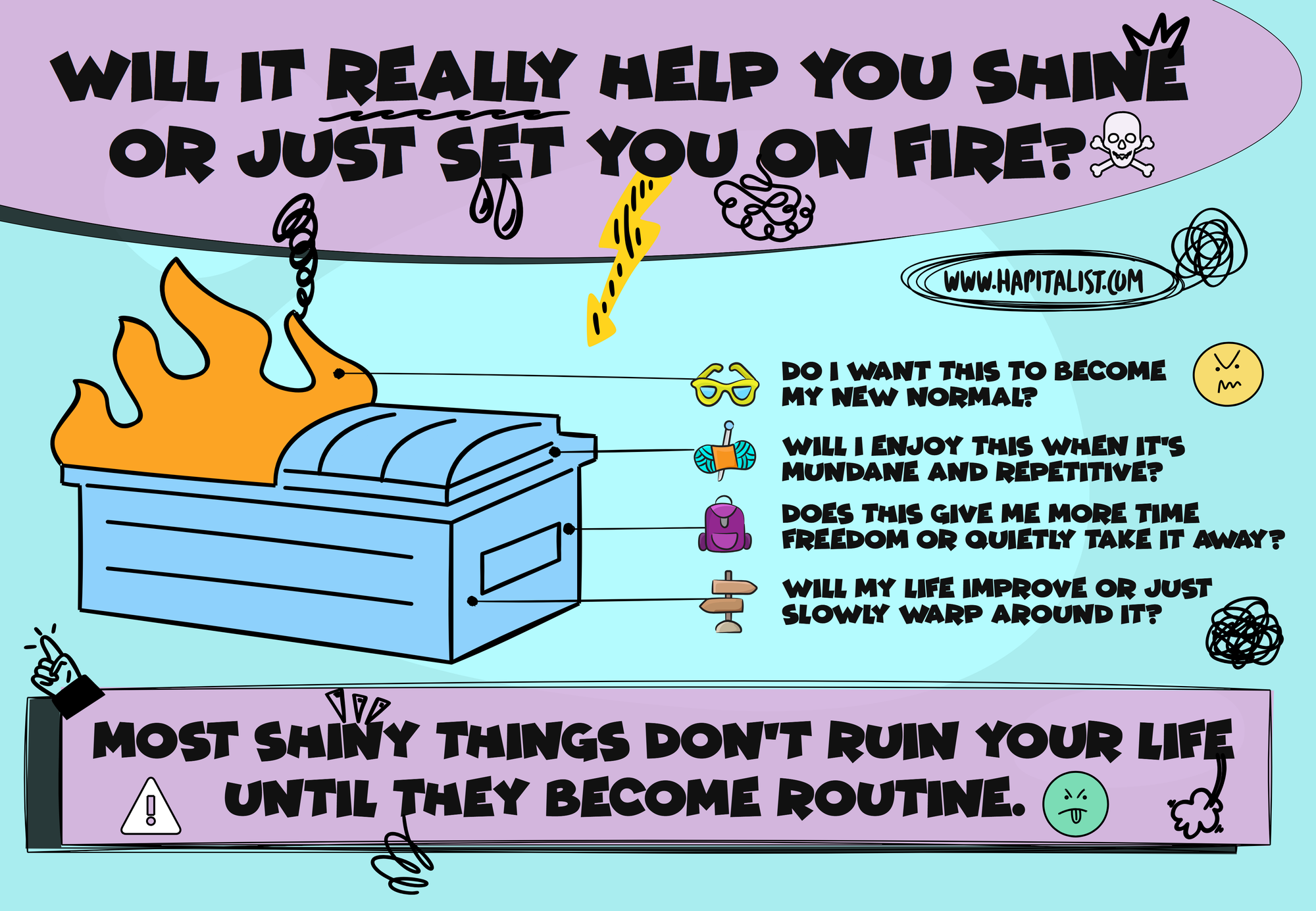
11. Media channels
Amplification is the process of magnifying your message and reach to build and sustain audience engagement. It involves understanding when and how to communicate to ensure your voice resonates with the right people at the right time.
There are four major marketing channels you can use to stabilize your revenue. You should work toward being excellent at a minimum of one if you want to build a successful business. It doesn’t matter which one, but it is much better to be a master at one than pretty good at all four.
- Owned media channels: Owned media refers to the platforms and content that you have complete control over. These are the channels that you directly manage and where you can consistently communicate your message without relying on external parties. Owned media is essential for establishing your brand, building a loyal audience, and creating a hub where people can regularly engage with your work.
- Paid media channels: Paid media involves any form of advertising or promotional content that you pay for to reach a broader audience. This includes ads on social media, search engines, display ads, paid influencers, sponsored posts, and more. Paid media is an effective way to quickly increase visibility, drive traffic, and boost engagement, especially when you’re looking to reach specific demographics or expand beyond your existing audience.
- Earned media channels: Earned media refers to the exposure you gain through organic, unpaid methods—essentially, it’s the recognition you “earn” rather than pay for. This includes any media coverage, word-of-mouth, social media mentions, shares, reviews, and any other form of promotion that comes from outside your direct control. It’s often seen as one of the most credible forms of media because it’s driven by others talking about your work rather than by your own marketing efforts.
- Borrowed media channels: Borrowed media, sometimes referred to as “shared media,” involves leveraging someone else’s platform to reach their audience. This type of media includes guest appearances, collaborations, or content that is published on platforms or channels not owned by you but where you have permission to share your message. The key here is that you’re using someone else’s established audience to amplify your voice, often through partnerships or mutual agreements.
Amplification strategies evolve as your career progresses. as you grow your owned, earned, paid, and borrowed media channels.
Paid media channels
Paid media refers to any channel where you invest money to reach new audiences, amplify your message, or accelerate growth. These placements allow you to get in front of people who might never discover you organically, giving you leverage, speed, and scalability. Paid media isn’t about “buying attention”—it’s about strategically placing your work where the right people are already paying attention.
Used well, paid media can jump-start momentum, validate ideas quickly, and turn proven messages into predictable results. It’s especially useful when you’re ready to scale, test new offers, or break out of the limitations of algorithm-controlled organic reach.
Examples of paid media channels
- Digital ads (Facebook, Instagram, TikTok, Google): Running targeted ads helps you reach specific audiences based on interests, behaviors, and demographics. Whether you’re promoting a product, a newsletter, or a new campaign, ads give you the ability to test messaging, gather data fast, and scale what’s working.
- Sponsored posts and influencer partnerships: Paying creators or influencers to promote your work expands your reach to communities you don’t yet have access to. The key isn’t size—it’s alignment. A well-matched micro-influencer can drive more meaningful engagement than a broad, unfocused audience.
- Podcast or newsletter sponsorships: Buying ad spots inside aligned newsletters or podcasts allows you to tap into built-in trust. These channels already have an audience that shows up consistently—your message piggybacks on that attention and credibility.
- Search engine marketing (SEM): Buying placement in search results helps you capture intent-based traffic. Instead of interrupting someone’s scroll, you meet them at the exact moment they’re looking for what you offer.
- Digital event or webinar promotions: Paid placements for virtual summits, masterclasses, or workshops help you attract a larger audience rapidly, especially when you’re testing demand for a new idea or launching something with urgency.
- Marketplace and platform promotions: Some platforms allow paid boosts—like Amazon ads, BookBub PPC, Etsy promoted listings, or Kickstarter Spotlight. These put your product in front of high-intent shoppers who are already browsing similar offerings.
Owned media channels
Owned media refers to the platforms and content that you have complete control over. These are the channels that you directly manage and where you can consistently communicate your message without relying on external parties. Owned media is essential for establishing your brand, building a loyal audience, and creating a hub where people can regularly engage with your work.
Examples of owned media channels
- Website/blog: Your personal website or blog is a central hub for your content, including articles, updates, resources, and other information about your work. It’s a primary space where you control the user experience and the messaging.
- Email newsletter: Newsletters allow you to communicate directly with your audience, providing regular updates, exclusive content, and personal insights. Since you own your email list, it’s a reliable way to reach your audience without depending on external algorithms.
- Social media profiles: While social media platforms themselves are not owned, the profiles and pages you maintain on platforms like Instagram, LinkedIn, and Facebook are spaces where you control the content and how often you post.
- Podcasts and YouTube channels: If you create and manage your own podcast or YouTube channel, these serve as owned media where you have complete control over the topics, format, and audience interaction.
- Books and ebooks: Your published works, whether traditional or self-published, are forms of owned media that reflect your voice, brand, and expertise.
- Online courses or membership sites: Platforms where you host your own content, such as online courses or member communities, provide a controlled environment to deliver value and engage deeply with your audience.
Earned media channels
Earned media refers to the exposure you gain through organic, unpaid methods—essentially, it’s the recognition you “earn” rather than pay for. This includes any media coverage, word-of-mouth, social media mentions, shares, reviews, and any other form of promotion that comes from outside your direct control. It’s often seen as one of the most credible forms of media because it’s driven by others talking about your work rather than by your own marketing efforts.
Examples of earned media channels
- Press coverage: Articles, interviews, or mentions in news outlets, blogs, or industry publications.
- Social media mentions: Shares, likes, comments, or posts by others on platforms like Tiktok, Facebook, LinkedIn, or Instagram.
- Reviews and testimonials: Reviews on platforms, or endorsements from customers and other entrepreneurs.
- Word-of-mouth: Personal recommendations from customers, peers, or influencers.
- User-generated content: Content created by your audience, such as fan art, videos, or blogs related to your work.
Borrowed media channels
Borrowed media, sometimes referred to as “shared media,” involves leveraging someone else’s platform to reach their audience. This type of media includes guest appearances, collaborations, or content that is published on platforms or channels not owned by you but where you have permission to share your message. The key here is that you’re using someone else’s established audience to amplify your voice, often through partnerships or mutual agreements.
Examples of borrowed media channels
- Guest blog posts: Writing for other websites, blogs, or newsletters that have a built-in audience interested in your niche.
- Podcast appearances: Being a guest on podcasts to share your insights, which can reach new fans.
- Social media takeovers: Temporarily taking over someone else’s social media account to interact with their followers.
- Collaborative content: Joint webinars, articles, or videos where you work with other creators to reach both of your audiences.
- Influencer collaborations: Working with influencers who share your content or discuss your work on their platforms.
As you grow your audience, you’ll gain access to more and more powerful media channels as you build the structure of your network.
You could, if you wanted, spend a millions dollars in advertising and overcome a lot of these effects, but otherwise most of your amplification over time will fall over your growth in these three channels.
It’s important to note here that you should focus on one of these, and your success with them will naturally buoy your success with the others. Personally, my business is built upon owned media, with a significant amount of borrowed media, a little earned media, and paid media sprinkled in to keep growth steady.
Because I have a mailing list with over 44,000 people on it (owned), it’s a lot easier to book partnerships (borrowed) and get press coverage (earned). My message naturally gets amplified now in a way it didn’t 10 years ago. So, what does this look like?
The questions to ask here are :
Which media channel feels best for me right now?
Where are you already having growth?
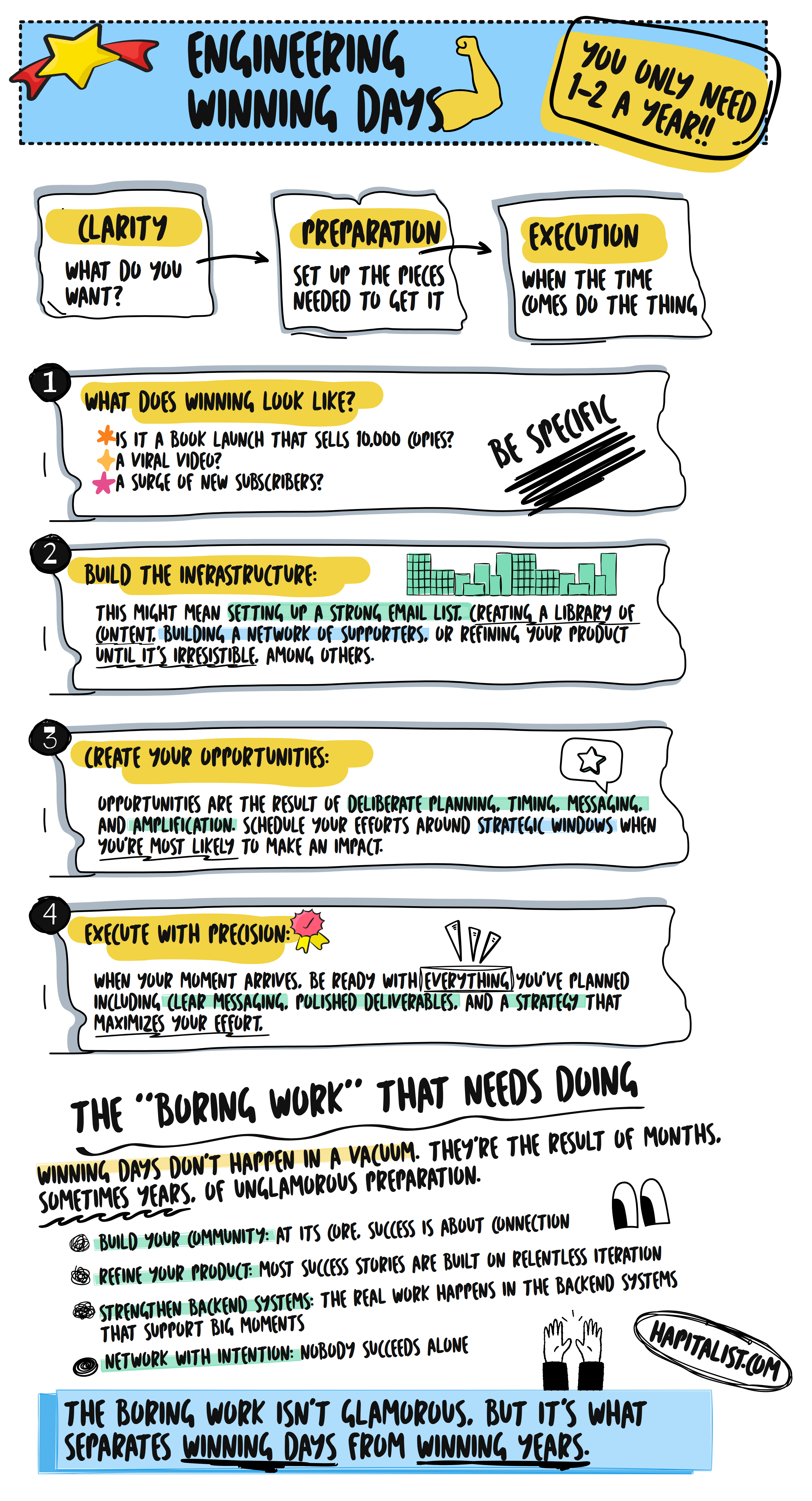
12. Set your win condition
We finished conference season not too long ago, and wow was it sobering to see so many people I love and respect burned out beyond what I thought possible last time I saw them when they were already burned out beyond what I thought possible.
The exhaustion wasn’t just physical; it was emotional. We’re talking about the kind of burnout that comes from chasing a goal you’re not even sure you want anymore. Worse, it comes from never really wanting it in the first place.
Don’t get me wrong, we all wanted to be entrepreneurs, maybe even influencers, but did any of us really want to own a media empire that pulled at our every last nerve every waking hour of the day (and plenty of our sleeping ones, too)?
It feels like we’re cast adrift on an ocean we never signed up to sail and now the only choice is to navigate the choppy waters and find land before we either drown or die of dehydration.
Too many of us are following a plan that doesn’t align with the success we actually crave because we never even knew we had to plan for a thing that hadn’t even been invented yet.
Burnout is almost a given at conferences, but this year there was a deeper issue. I talked to so many people who had been grinding for a long time, expecting that at some point it would get easier, only for the opposite to happen Many of them had a plan, but their win condition was either undefined or at odds with that plan.
I’m definitely not immune from this kind of things. In fact, I feel like I’m acutely aware of noticing this in other people because I’ve been through it multiple times recently.
It wasn’t easy, and it still isn’t. When people asked how we planned to make money, we shrugged. The truth was, we didn’t know. We just hoped it would work out. Looking back, had we been a little more strategic at the beginning and projected forward to our win condition, we might have avoided this whole mess entirely.
What is a win condition?
A win condition is the ultimate goal that makes all your hard work worth it. It’s not necessarily about hitting specific revenue targets or achieving fame.
It’s about what makes you feel fulfilled in your work.
This is such a powerful exercise because it cuts through all the noise and settles on how winning feels to you. It probably has nothing to do with having a million followers, either. It’s probably about having the security to live your best life.
Nobody’s best life is lifestreaming their every thought to their followers, not even the Kardashians. Sometimes, you just wanna have a think and a poo in peace.
One major key to finding happiness in your business is to pick a win condition that’s aligned with what you truly want, not what the industry or society says success should look like. Many people make the mistake of setting a win condition based on external validation, like money or fame, when their real desire might be more personal, like more time with family or space to pursue their creativity.
Once you have your win condition, you can work backwards to the platform, audience, and assets that help you get there. Then, you can work forward to find the actions that can best help you get to your win condition without betraying your values.
If you haven’t ever thought about this before now, trust me you’re not alone. I talk to creators all the time who’ve planned and prioritized their whole adult life who have never set a win condition for their career.
My personal win condition looks a lot like my life now. I want to be able to take any weird idea in my head and find enough people excited to make it happen that it will make me money. I want to do very few things, and have my whole day free to dicker around with people that inspire me, without having to worry about the money piece of it all because there is always more than enough and its growing all the time.
I’ve slowly been able to expand doing that kind of thing from a mere 10% of the time a decade ago to 60% of the time these days, but it wouldn’t have been possible if I couldn’t visualize my win condition.
When your win condition doesn’t match your actions, you’re setting yourself up for burnout and frustration. You might feel like you’re constantly hustling but never getting closer to what you really want. Worse, if you don’t know your win condition, you could create a plan at odds with what you really want out of life, which is my nightmare situation.
After talking with thousands of creatives in my career, I think that they mainly have a KPI misalignment issue. There are hundreds, maybe thousands of different data points that we can track in our business at any time. Tracking any one of them closely will send us tumbling off in a different direction. While these raw data points track various aspects of our business (like website visits, email opens, or social media followers), KPIs are carefully chosen to align directly with what matters most to success.
KPIs are specifically chosen to highlight performance in areas that most critically impact success, ensuring clarity and alignment across the team. Tracking too many metrics can lead to information overload, but carefully selecting a few KPIs allows organizations to focus on what matters, make actionable decisions, and efficiently monitor progress without being distracted by less relevant data.
Most business track no more than 3-5 KPIs at any one time, and reevaluate every quarter.
Creators often struggle with defining the right KPIs because we’re not just businesses; we’re people, too. People often have different needs and desires than businesses, so it’s hard to parse which ones really align with our wants and needs.
This leads to creators either tracking the wrong things because somebody told them what was important to them and it sounded nice, or getting overwhelmed and tracking nothing then wondering why they aren’t getting anywhere.
If that sounds like your life, then you’re not alone. Many creators track the wrong KPIs, focusing on metrics that don’t align with their win condition. It’s not that they aren’t productive. They’re measuring the wrong things.
The key to sustainable success is aligning your KPIs with your win condition. For me, I’ve had three KPIs that worked for years:
- Quality conversations had in a week: I aimed for 10 meaningful interactions where something valuable was exchanged.
- People added to my mailing list every month: Since I launched a lot, I needed to constantly refresh my prospects so I could keep growing.
- Projects finished in a year: As long as I was completing projects, I wasn’t too concerned about income goals, but if I finished something, I knew it would be okay.
These KPIs worked because they aligned with what I actually wanted to achieve. I knew that if I had good conversations and kept finishing projects, the money would follow.
Defining your win condition
Realigning your actions with your win condition isn’t easy by any stretch. You may find that old habits die hard or that you’re tempted to revert back to traditional measures of success. The key is to stay focused on your true goal. Don’t be discouraged if it doesn’t happen overnight.
Winning is kind of like meditation. We all know that it’s impossible to clear your mind for long, but the process is the point. It’s okay to take small steps toward realignment, and it’s normal for the process to take time.
Some may fear that shifting their KPIs could hurt their business in the short term. For example, if you stop obsessing over sales and start focusing on conversations with customers, you may initially see a dip in revenue. But over time, this realignment can create a more sustainable business model that’s rooted in the things you actually care about.
If you’re feeling burnt out or like your work isn’t moving you toward success, it’s time to reflect on your win condition. Here are some steps to help realign your actions with your true goals:
- Reflect on your most rewarding experiences: Think back to moments in your life where you felt a deep sense of accomplishment or fulfillment. What were you doing? Why did it matter to you? These moments often reveal your real win condition. For example, if you felt most alive while traveling or mentoring others, your win condition might be more about freedom or impact than financial success.
- List what you truly enjoy doing: Write down the activities that bring you joy, even during challenging times. These are the things that energize you, rather than drain you. If you consistently find joy in brainstorming with others, or spending time outdoors, those activities are likely more aligned with your win condition than, say, endless hours of marketing.
- Set KPIs that align with your win condition: Once you know what’s most important to you, set 3-5 KPIs that reflect that. If family time is your win condition, track hours spent with loved ones, not just projects completed. If creating a community is your goal, measure quality conversations instead of just sales. Aligning your metrics with your values helps reduce the cognitive dissonance that leads to burnout.
It’s easy to get caught up in what the industry says your KPIs should be, whether that’s sales, social media followers, or revenue. ON top of that, it’s very easy for external pressure to push you further away from your win condition, especially if you don’t have one. The challenge is to resist these external markers of success and focus on the internal metrics that matter most to you. Your journey may not look like anyone else’s, and that’s okay. In fact, it should be different.
Picking your hard
It’s also important to recognize that sometimes your short-term actions might not fully align with your win condition, especially if you have immediate financial or professional obligations. As I said above, I only get it right about 60% of the time and I’ve been deep in it for a long time.
I’ve done lots of things that didn’t align with my win condition for years in an effort to get where I could move toward my win condition with better alignment. The goal is to ensure that the majority of your efforts align with your long-term vision as often as possible.
For example, you may take on projects that pay the bills even if they don’t perfectly align with your win condition. That’s okay, as long as those projects don’t steer you too far away from what you ultimately want for too long. Just make sure you’re always moving toward your win condition, even if it’s in small, incremental steps.
Every path is hard. The universe is full of hard choices, and it’s up to you to pick the ones that align with what you truly want. For Monica and me, that meant choosing the hard work of building a community and shipping. We could have chosen the hard of running a coaching business, but it wasn’t the hard we wanted.
If you pick a hard that aligns with your win condition, the challenges will still be tough, but they’ll be worth it. When the hard you pick leads you toward something meaningful, it makes the struggle more bearable.
If you’re feeling burnt out or unproductive, I suggest rethinking what productivity means to you. Blow up everything you think about success and productivity, and focus on the 3-5 things that you actually:
- Like doing: Think about what activities bring you joy. This is about finding the work that excites you, even when it’s hard. What do you enjoy enough to keep going when things get tough?
- Do consistently: The key to success is consistency, but not in the way you might think. It’s not about forcing yourself to grind every day; it’s about finding the things you naturally do consistently. These are often the activities that don’t feel like work because they align with who you are. If you’re always finding time to garden, walk, or brainstorm with a friend, those might be the things that drive your success more than any productivity hack.
- Really make you feel successful: Success is personal. It’s not just about hitting big milestones or revenue goals. Instead, focus on what makes you feel accomplished on a daily or weekly basis. The key is to find the metrics that make you feel like you’re winning, even if they don’t match up with traditional notions of success.
It could be “birds watched in a day” or “hours strolled through town” or literally anything. That is not a success issue. It’s a KPI misalignment issue, and it’s driving us all crazy right now.
We spend so much time “prioritizing” and “setting intentions”, but have you ever sat down and thought about your win condition? What is this all for? Is it for freedom? For prestige? For money?
What does it even look like when you wake up after getting “everything you always wanted”? The reason people are almost unanimously disappointed when they “win” is because they realize their intention was misaligned with their reality.
Take a second to think about what “winning” feels like and how you move through the world once you get everything you want. Then, really look at your priorities and ask “Are these things really going to get me to that win condition?”
Either way you will suffer for what you love. Life is little more than choosing your hard, but often it’s possible to pull forward bits of our win condition over time.
I’ve been semi-retired for years because I realized my win condition was about freedom, and the ability to explore whatever I wanted whenever I wanted, and largely, I already had that.
I don’t want to retire. I want to (mostly) do whatever I want whenever I want to do it. Ten years ago that kind of thing only happened on weekend, and then when I started my business for years it only happened never. Instead of doing what I wanted, I was stuck going to shows every weekend, and then hammering out projects during the week.
By the time the pandemic came, I was pretty good about doing whatever I wanted for half the week, but the other half would be filled with shows.
After the pandemic, when shows stopped being important to my business, I had developed the structures so I had could do mostly what I wanted,
Since I enjoyed the work, it wasn’t much of a struggle for me to do it, but that still wasn’t much freedom. I still had to write, and then launch/pack books.
After getting saddled with long COVID, I’ve not been able to do that much, so now I have fulfillment houses that mainly pack my books, and I do very, very light launches mostly contained to my email list.
I have a lot of financial obligations that I’m on the hook for, but by and large I nailed it.I don’t have many meetings during the week, unless it’s with somebody I want to talk to, and there’s only about 5-10 hours of work a week I’m forced to do.
Some of that is because I physically can’t do shows anymore and doing more than 1-2 hours of work is exhausting. Much of it is because I like to be able to go see a movie and disassociate for long periods of time. I read a book or two every day, and many interesting articles, which is a neat way to spend my time.
Most days, the biggest hinderance to me doing what I want is taking a shower.
This is my win condition. I have some money in the bank to help with any emergencies, am working on projects I love with people I love, and I have few obligations weighing me down.
I was sold a bill of goods about being an entrepreneur, and I feel like I finally made good on it. I can still only do it 60%-80% of the time or so (thus the semi) part, and I can’t just stop right now, but my retirement will look mostly like what I do now. So, I’ve already won.
Aligning your actions with your win condition is the key to avoiding burnout and finding long-term creative fulfillment. It’s not just about the hustle. It’s about identifying the goals that truly matter to you and measuring success on your terms. Pick the right hard, track what truly matters, and create a life where your daily efforts move you closer to the success you truly want.
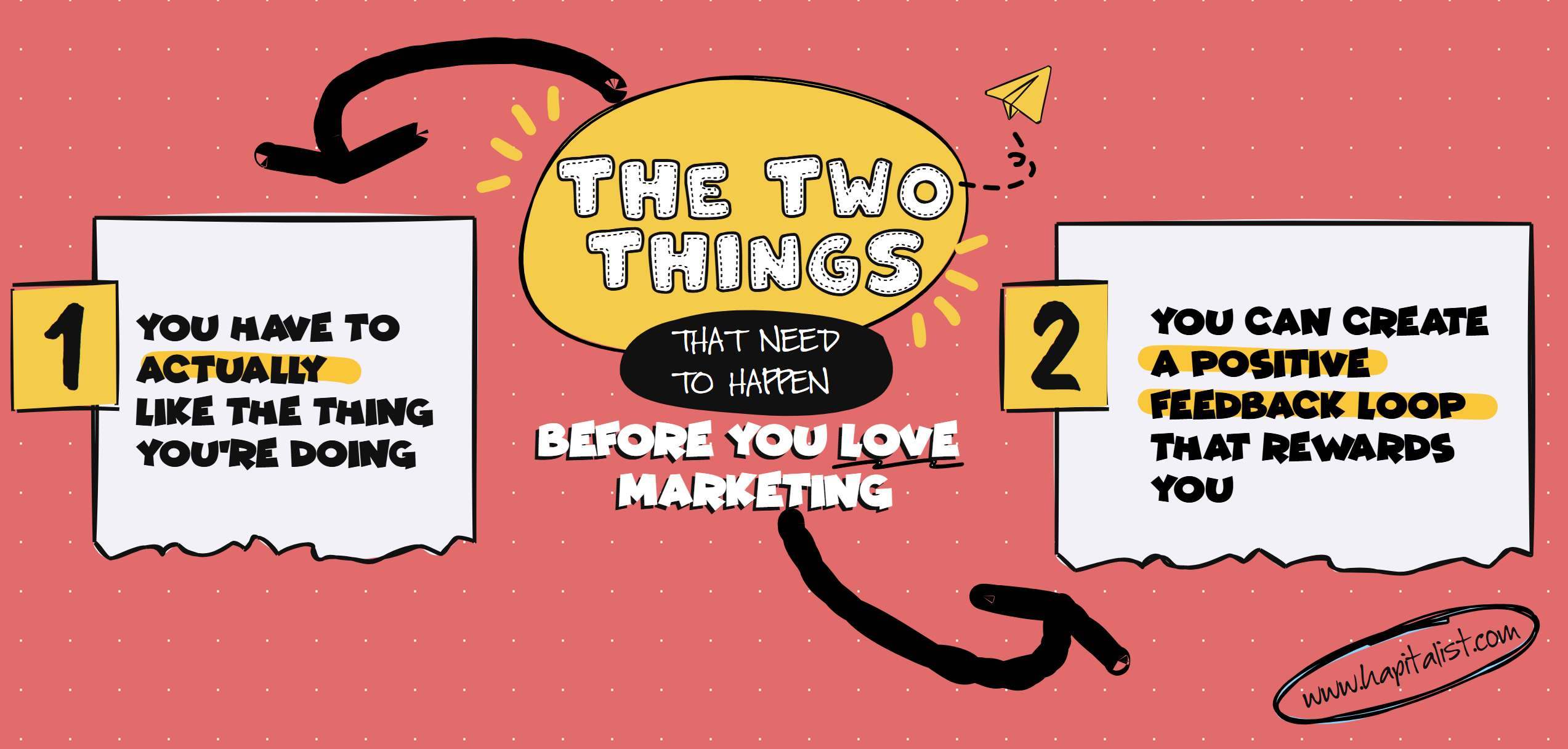
13. The HAPI Compass framework
Hi,
It took me years of tinkering, hundreds of tiny adjustments, countless failed experiments, and more than a few existential crises, to develop a framework that actually works for most entrepreneurs trying to build sustainable careers.
But I finally got there.
I call it the HAPI Compass, and it’s become the foundation of everything I teach about building a business that doesn’t just make money, but actually nourishes you.
At its core, the HAPI Compass is a four-point system designed to help you find alignment and direction in your career. It’s about learning how to triangulate yourself and solve the right problem with the right solution.
(H)eart
Heart isn’t only about inspiration. It’s about whether a project is worth doing—not in theory, but in reality. It asks: Is this thing sound, clear, and aligned? Or is it broken, bloated, and soul-sucking?
This is where so many entrepreneurs suffer; not because their ideas are bad, but because they’re trying to execute projects that are fundamentally misaligned with reality, market feedback, or their actual desires.
Heart is where you interrogate a project before you give it your time, energy, and resources. You ask:
- Does this project make sense?
- Is it built on a shaky premise?
- Are the goals clear, the effort worth it, the outcome desirable?
A Heart-aligned project isn’t necessarily fun. Sometimes it’s hard, but hard is worth it. What you’re looking for is worthwhile.
And when it’s not worthwhile? That’s a Heart misalignment. The question isn’t “Will following my Heart make me money?” The question is “Can I build a sustainable career without it?” And the answer, for most business owners, is no.
Common Heart challenges
- You’re halfway into a project and realize you hate every minute of it
- The work feels brittle, slow, or bureaucratic because of poor structure
- You’ve launched something that flopped, and now you’re stuck supporting it
- Customers hate it, reviews are bad, and fixing it would cost more than it’s worth
- The scope is vague, the payoff unclear, and you’re bleeding energy
Heart solutions
- Project scoping: Before you start, define exactly what success looks like, how you’ll get there, and where the risks are.
- Brutal audit: Review every active project. Do I enjoy this? Is it performing? Would I choose this again today? If not, cut, pause, or sell it.
- Shut it down: Every project should come with a “pull the plug” clause. When does it become a sunk cost?
- Build with feedback: Don’t make big bets in isolation. Get proof-of-concept from real users before you scale.
- Permission to quit: If it sucks, you hate it, and it’s not working, you’re allowed to walk away. Quitting isn’t failure. It’s alignment.
Why Heart is unique: Heart is about project fitness. Not just do you love the idea, but is it solid, buildable, and actually delivering? A Heart-aligned business doesn’t mean every project is fun. It means the hard stuff is worth doing.
(A)udience
Your Audience are the people orbiting your ideas, ready to champion them, amplify your reach, and fall deeply in love with what you create.
Finding your Audience means understanding who actually needs the stories you’re telling. It’s about building genuine connections with customers who will become superfans, not just extracting value from random strangers on the internet.
When your Heart aligns with your Audience, magic happens. You’re not trying to convince people to care about your work. You’re finding the people who are already predisposed to love it.
If Heart is about the project, Audience is about the market.
Your Audience point on the compass helps you identify the specific humans who are already looking for what you’re creating. They’re out there right now, searching for products like yours, frustrated that they can’t find enough of what they want.
Your job isn’t to persuade everyone to read your work. Your job is to make yourself findable to the people who are already seeking what you offer.
This shift from convincing to connecting changes everything about how you approach marketing. Instead of feeling slimy and sales-y, you’re simply saying “Hey, if you’ve been looking for what I got, then I have that thing.”
Audience isn’t just a demographic profile or a segment in your CRM. It’s the real humans who resonate with your approach, need what you offer, and are actively looking for solutions you’re uniquely qualified to provide.
Common audience challenges
- You’re talking to people who don’t value what you do
- Your messaging attracts followers but not buyers
- Your clients consistently ask for things you don’t want to deliver
- You’re building offers based on guesses instead of real feedback
- You’ve outgrown your audience, but haven’t shifted your positioning
Audience solutions
- Define your Bullseye Buyer: Who are your top 10 favorite past clients or customers? What do they have in common?
- Reverse engineer offers: Build based on real requests, not hunches
- Run messaging experiments: Test different angles to see what resonates with the right people
- Segment strategically: If you’re speaking to multiple types of people, separate your comms so they’re each heard clearly
- Retire misaligned channels: If your audience hangs out on LinkedIn and you’re killing yourself on TikTok, cut it
Why Audience is unique: Audience is your calibration to reality. It forces you to get honest about who’s actually responding, what they need, and how you can best reach and serve them. It ensures your message lands in the right inbox, and that your business isn’t built on wishful thinking.
(P)rioritization
Prioritization is about deep focus on one high-leverage move at a time. You let it pay off, then reinvest the space and cash it creates to widen your runway and buy yourself time for what actually matters.
This is the hardest point for most entrepreneurs because we’re wired to chase shiny objects, but Prioritization is what separates founders who build sustainable careers from those who burn out after two years of frantic activity that leads nowhere.
Every week, you’re bombarded with new opportunities, strategies, and platforms. TikTok is hot. Substack is essential. You need a podcast. You should be doing Kickstarters. Direct sales. Speaking gigs. Patreon. Courses.
All of these can work. None of them work if you’re trying to do them simultaneously while also, you know, building a company.
Prioritization asks you to get ruthlessly honest about what actually moves the needle for your specific situation right now. Not what worked for that person you follow on Twitter or what the guru promised in their course. What will create meaningful progress toward your goals given your current resources, constraints, and season of life.
This means saying no to good opportunities so you can say yes to great ones. It means finishing what you start before jumping to the next thing. It means being willing to look like you’re moving slower than everyone else while actually building something that lasts.
The Prioritization point on your compass helps you ask: “Of all the things I could do, what’s the one thing that, if I did it well, would make everything else easier or unnecessary?”
Then you do that thing. And only that thing. Until it pays off.
Common Prioritization challenges
- You’re stacking too many major initiatives at once and nothing is moving
- You’re doing low-impact work because it feels urgent
- You’re reacting to noise instead of driving a plan
- You keep abandoning half-built assets for new shiny ones
- You’re saying yes to opportunities without weighing the cost of focus
Prioritization solutions
- The One-Thing method: Choose one thing that, if finished, would unlock growth, space, or clarity for everything else
- Win condition mapping: Define what “done” means for every initiative. No more open loops.
- Stacking limits: One major project per 90 days. That’s it.
- Work backward from constraints: What can you actually finish, given your energy, resources, and bandwidth?
- Kill list reviews: Every month, ask: what am I carrying that no longer serves me?
Why Prioritization is unique: Prioritization is about strategic momentum. It’s not enough to be busy. You need to be building in the right direction. This compass point ensures you’re not scattering your effort across things that don’t compound.
(I)ncome
Income isn’t just about revenue. It’s about sustainability. You’re not just trying to make money, you’re trying to make money in a way that works long term. Income is what sustains your ideal life while fueling the creative work that lights you up.
The Income point of your compass helps you figure out what “enough” means for you, then build systems to generate it in ways that align with your Heart, serve your Audience, and fit within your Prioritization strategy.
Once you know your numbers, you can design income streams that align with the other three points on your compass. There’s no single right answer. There’s only what works for you, in your life, with your goals and constraints.
Common Income challenges
- Inconsistent cashflow that causes feast-or-famine panic
- Revenue streams that rely on burnout-level effort
- Offers that sell but suck your soul
- Revenue looks good, but profit margins are terrible
- You’re not charging enough to make your model work
Income Solutions
- Cashflow mapping: Know when and how money hits. Predictability is power.
- Effort-to-earnings ratio: Audit your income streams: which ones require the most effort per dollar?
- Revenue model alignment: Are you trying to run a high-volume model with low visibility or team size? That won’t work.
- Pricing checkpoint: Are you charging for the full value and impact of what you deliver?
- Bridge offers: Short-term services that provide immediate cash while you build long-term assets
Why Income is unique: Income is your stabilizer. It makes every other compass point possible. You can’t prioritize well if your cashflow is in crisis. You can’t quit a bad project if you’re financially strapped. You can’t speak clearly to your audience if you’re in survival mode. Income gives you choices, and choice is the foundation of strategic clarity.
(B)elief and (E)mbodiment
Before we end, we need to talk about two foundational elements that aren’t technically part of the HAPI Compass but are absolutely essential to making it work. We don’t add them to any one category because they are fundamental to every category.
(B)elief is your mindset. It’s the stories you tell yourself about what’s possible, what you deserve, and what success means. If your beliefs are working against you, no framework in the world will help.
I’ve worked with incredibly talented people who sabotage themselves at every turn because they don’t actually believe they can succeed. They believe they’re not good enough, that they missed their window, that they don’t have what it takes, that their niche is too saturated, that customers won’t want their work.
These beliefs become self-fulfilling prophecies. If you believe you’ll fail, you’ll unconsciously make choices that lead to failure. You’ll give up too soon, avoid necessary risks, or never truly commit to your goals.
The HAPI Compass can show you the way, but you have to believe the destination is reachable. You have to believe you’re capable of getting there. You have to believe your work has value and your goals are legitimate.
This doesn’t mean toxic positivity or pretending obstacles don’t exist. It means doing the internal work to identify and dismantle the belief systems that keep you stuck.
(E)mbodiment is about the physical experience of being a human. How you care for your body, manage your energy, and create sustainable work practices. You can’t build a thriving career if you’re burning yourself out or ignoring your physical needs.
Embodiment means recognizing that you’re not just a brain producing words. You’re a whole human being who needs rest, movement, nourishment, and care. Your physical state directly impacts your creative output, your decision-making, and your ability to sustain a long-term career.
This isn’t indulgent. It’s practical. An entrepreneur who sleeps well, moves regularly, and manages their energy sustainably will outperform and outlast the one who treats their body like an inconvenient vessel for their brain.
The HAPI Compass shows you where to go. Belief gives you the confidence to take the journey. Embodiment ensures you have the energy and health to actually get there.
Seek and you will find
The HAPI Compass is now yours to use. I’ve given you the framework, the concepts, and the questions to ask. But the specific application? That’s entirely personal.
There’s no single path to a sustainable career. There are thousands of paths, and you get to choose yours.
The compass just helps you stay oriented while you walk it.
Start by identifying where you currently are on each point. Be ruthlessly honest. You can’t navigate from where you wish you were. You have to start from where you actually are.
Then choose one point that needs the most attention right now. Not all four. One.
Maybe you’ve been doing work that doesn’t align with your Heart, and you need to reconnect with what you actually want to create. Maybe you’ve been building an Audience of the wrong people and need to shift your focus. Maybe your Prioritization is scattered and you need to narrow your focus. Maybe your Income strategy isn’t working and needs revision.
Pick one. Work on that. Use the resources available for that point to help you make progress. Then, when you’ve made meaningful movement on that point, check your compass again. See where you need to adjust next.
This is how you build a career: one intentional choice at a time, always checking your compass to make sure you’re still heading in the right direction.
You will drift. You will get lost. You will make wrong turns and waste time on dead ends, but if you keep your compass handy and check it regularly, you’ll always be able to find your way back.
That’s the promise of the HAPI Compass. Not that you’ll never get lost, but that you’ll always be able to orient yourself and keep moving toward the career you’re trying to build.
So grab your compass. Check your position. Choose your next direction.
And start moving.
We have an entire book about calibrating your HAPI Compass.
Introduction
Russell Nohelty
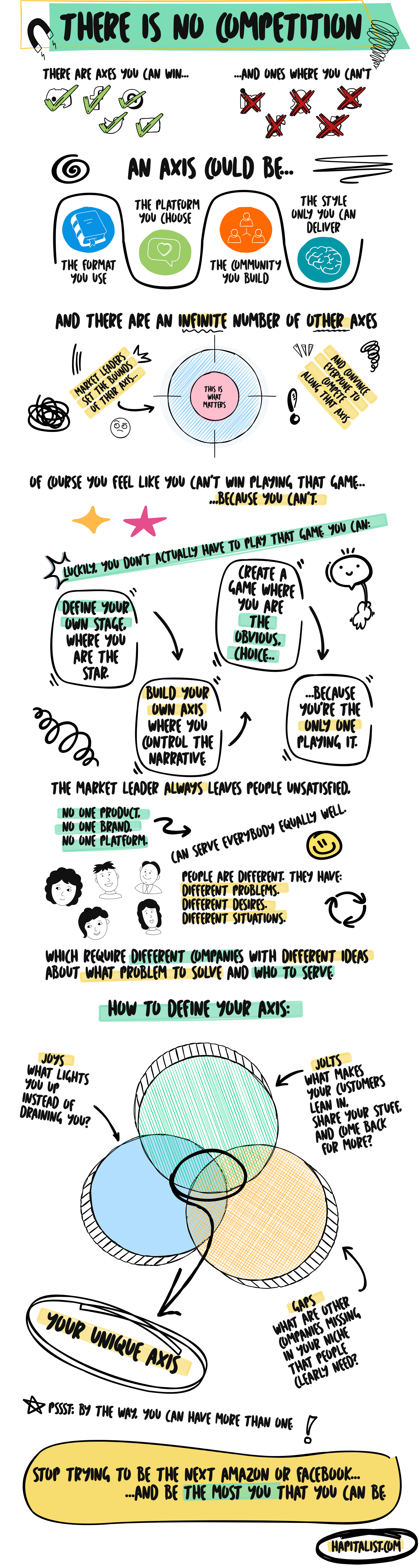
14. Bringing it all together with KPIs
Now that you’ve done all of this stuff, we can tie it all up by focusing on your most important metrics, or KPIs. Most people aren’t stagnating. They are just focusing on the wrong metrics. I talked to somebody recently who didn’t release much in the past year…but they got triplet off to college.
That’s an epic year, but their KPIs are misaligned.
KPIs, or Key Performance Indicators, are measurable values that help entrepreneurs assess the success of their activities in relation to specific goals, such as productivity, audience growth, and monetization.
While there are hundreds of performance indictator metrics, your KPIs are the 3-5 that you’re looking to improve at any one time, which should be reanalyzed every quarter.
By regularly monitoring these indicators, entrepreneurs can make data-driven decisions to ensure consistent growth, adapt to changing market trends, and create a sustainable, thriving career.
To align your KPIs (Key Performance Indicators) with the article's framework on business growth, productivity, monetization, and sustainable practices, follow these steps. The KPIs will be tied to the key themes discussed in each section of the article to help you measure progress in both creative and business aspects of your career.
Building an integrated sales ecosystem
Hi, The business landscape gets noisier by the minute. Founders are constantly bombarded with “next big thing” tactics, miracle funnels, and gurus promising a shortcut to scale. It’s exhausting trying to keep up with every new platform, software tool, and marketing fad that pops up in your feed.
Russell Nohelty
1. Sustainable productivity vs sustainable monetization KPI
KPI focus: Determine whether your level of output and your revenue model can coexist without creating burnout or instability.
KPIs to track and what they mean:
- Revenue per unit of effort: Measures how much income is generated relative to the time or energy invested. This helps identify whether increased effort is actually producing proportional financial returns.
- Products or initiatives shipped vs revenue generated: Compares the volume of work completed to the income it produces, revealing whether fewer, higher-quality initiatives outperform frequent low-impact output.
- Energy sustainability score: A self-assessed metric tracking physical, emotional, or cognitive energy over time. This indicates whether your current pace is maintainable.
- Burnout indicators: Tracks warning signs such as missed deadlines, skipped recovery, or disengagement. This KPI helps identify when productivity gains are being achieved at an unsustainable cost.
2. Money as means vs money as ends KPI
KPI focus: Evaluate whether money is functioning as a tool to support the business and life you want, rather than becoming the primary objective.
KPIs to track and what they mean:
- Revenue reinvestment percentage: Measures how much income is reinvested into the business (tools, education, delegation, systems), indicating whether earnings are supporting long-term growth.
- Revenue-to-impact ratio: Assesses how effectively money translates into meaningful outcomes such as improved products, increased capacity, or reduced stress.
- Creative or strategic output vs financial input: Compares completed projects or initiatives to the money spent supporting them, helping ensure financial investments align with actual execution.
- Income stability score: Tracks predictability of income over time, highlighting whether financial stress comes from low earnings or volatility.
3. Growth-to-monetization parallel KPI
KPI focus: Clarify whether your business is currently optimized for audience growth or revenue generation, and manage expectations accordingly.
KPIs to track and what they mean:
- Audience growth rate: Measures expansion of reach through subscribers, followers, or users, indicating momentum during growth-focused phases.
- Revenue growth rate: Tracks increases in income over time, showing whether monetization efforts are scaling.
- Free-to-paid conversion rate: Measures how effectively free value converts into paid offerings, indicating readiness for monetization.
- Churn during monetization efforts: Tracks audience or customer loss when monetization is introduced, helping assess timing and execution quality.
4. Monetary goals KPI
KPI focus: Translate financial goals into measurable, time-bound targets that support planning and decision-making.
KPIs to track and what they mean:
- Annual revenue target: Defines the total income required to support the business and personal obligations over a year.
- Quarterly revenue targets: Breaks annual goals into actionable checkpoints, making progress measurable and course correction possible.
- Recurring revenue baseline: Tracks predictable income sources, indicating financial stability independent of launches or campaigns.
- Launch or initiative revenue: Measures income generated from specific campaigns or projects, helping evaluate effectiveness.
- Revenue shortfall or surplus: Identifies gaps between targets and actual income, informing adjustments to strategy or scope.
5. Prioritization KPI (modified Eisenhower Matrix)
KPI focus: Ensure time and energy are concentrated on high-impact, sustainable work while minimizing low-value activity.
KPIs to track and what they mean:
- Time spent in NEED + LOVE quadrant: Measures how much time is allocated to work that is both necessary and energizing, which tends to compound over time.
- Tasks eliminated per quarter: Tracks reduction of low-impact or unnecessary work, improving focus and efficiency.
- Tasks outsourced or delegated: Measures how effectively non-core work is removed from your workload, freeing capacity for higher-leverage activities.
- Time spent on core business activities: Tracks focus on actions most directly tied to growth, stability, or differentiation.
6. Transition points KPI
KPI focus: Identify when customers are most likely to engage or buy based on life or business transitions.
KPIs to track and what they mean:
- Purchase timing correlation: Measures when purchases occur relative to known transition periods (career changes, life milestones, seasonal shifts), helping identify high-intent moments.
- Engagement during transition periods: Tracks email opens, clicks, replies, or social engagement during key transition windows to assess relevance.
- Content resonance by transition: Measures which content performs best for audiences experiencing specific changes, indicating message–moment alignment.
- Inbound signals tied to transitions: Tracks direct messages, replies, or inquiries referencing change or uncertainty, signaling readiness to buy or engage.
7. Platform, audience, and assets KPI
KPI focus: Assess whether platforms, audiences, and existing assets are aligned and reinforcing one another.
KPIs to track and what they mean:
- Platform performance metrics: Measures effectiveness of each platform (traffic, engagement, conversion) to determine where effort produces results.
- Audience growth and engagement rate: Tracks list growth, open rates, click-throughs, or participation to assess audience health.
- Asset utilization rate: Measures how often existing assets (products, content, backlist, systems) are reused or monetized instead of creating new ones.
- Revenue from existing assets: Tracks income generated without creating something new, indicating leverage and compounding value.
8. Success path alignment KPI
KPI focus: Determine whether your current growth strategy aligns with how you naturally scale and execute.
KPIs to track and what they mean:
- Primary growth-channel effectiveness: Measures performance of the dominant growth mechanism you rely on (launches, collaborations, content, referrals).
- Return on primary growth effort: Tracks results generated per growth cycle, indicating whether effort aligns with strengths.
- Consistency across growth cycles: Measures repeatability of results, revealing whether success is systemic or accidental.
- Friction indicators: Tracks resistance signals such as avoidance, prolonged setup, or dropped initiatives that suggest misalignment.
9. Media channel KPI
KPI focus: Evaluate how effectively different media channels amplify reach and results.
KPIs to track and what they mean:
- Owned media growth: Measures expansion of assets you control directly, such as email lists, websites, or communities.
- Earned media mentions: Tracks organic exposure through shares, referrals, interviews, or press, indicating resonance.
- Paid media ROI: Measures revenue or growth generated per dollar spent on advertising or sponsorships.
- Channel concentration ratio: Tracks dependence on a single channel versus diversification, identifying risk exposure.
10. Evolution stage KPI
KPI focus: Ensure KPIs match the complexity and maturity of your business.
KPIs to track and what they mean:
- Primary constraint identified: Measures whether the current bottleneck (time, skill, capital, attention) is clearly defined.
- Problem-type alignment: Tracks whether you are solving problems appropriate to your current stage rather than future or past ones.
- Systemization progress: Measures repeatability of outcomes through processes, documentation, or delegation.
- Decision leverage ratio: Tracks how often decisions create compounding effects rather than one-off gains.
11. Win condition KPI
KPI focus: Measure whether business outcomes align with your personal definition of success, not just external benchmarks.
KPIs to track and what they mean:
- Personal fulfillment alignment score: Measures how closely current work aligns with stated values such as autonomy, flexibility, impact, or creative satisfaction.
- Time allocation vs stated priorities: Compares how time is actually spent against what you’ve identified as important, revealing misalignment between intent and behavior.
- Tradeoff acceptance rate: Tracks how often you consciously accept or reject opportunities based on your win condition, indicating clarity and discipline.
- Regret signals: Monitors recurring frustration, resentment, or disappointment tied to business decisions, signaling drift from your win condition.
12. Sustainability and recovery KPI
KPI focus: Ensure the business can continue operating without requiring continual crisis response or personal depletion.
KPIs to track and what they mean:
- Recovery time built into cycles: Measures whether rest, downtime, or reduced output periods are intentionally scheduled and honored.
- Crisis frequency: Tracks how often urgent, reactive situations arise, indicating structural fragility.
- Workload volatility: Measures swings in workload intensity, highlighting whether systems are smoothing effort or amplifying stress.
- Dependency risk score: Tracks reliance on single clients, platforms, or revenue sources, identifying points of failure.
How to determine your KPIs using this framework
- Step 1: Identify your current position within each section (productivity vs. monetization, platform optimization, etc.).
- Step 2: Set clear, measurable goals for each section, making sure they are aligned with your long-term vision.
- Step 3: Break down your yearly financial and creative goals into quarterly or monthly KPIs.
- Step 4: Regularly track your progress through simple, actionable KPIs.
- Step 5: Adjust your strategies based on performance, ensuring that you maintain balance across all areas of your business.
This approach ensures that you’re not only building toward short-term financial success but also establishing long-term creative and business sustainability.
Building a sustainable business is a complex process that requires thoughtful sequencing, balancing productivity with monetization, and aligning your platform, audience, and assets.
As entrepreneurs, we often get caught up in doing too much at once, losing momentum by skipping steps or focusing on the wrong areas. By following a clear, structured approach, whether that’s prioritizing growth over monetization, tapping into life transitions to drive sales, or leveraging owned and borrowed media channels, you can create a career path that amplifies itself over time.
Success isn’t achieved overnight, but through consistent effort, strategic decisions, and adaptability, you can position yourself for long-term growth. Remember, the key is to understand where you are, what your audience wants, and how to best utilize your assets to build a sustainable, thriving business.
So, what do you think?
- What’s your biggest challenge in balancing growth and monetization?
- How do you prioritize tasks to grow your business?
- What strategies have helped you align platform, audience, and assets?
Let us know in the comments.